
You are currently browsing the tag archive for the ‘jewish’ tag.
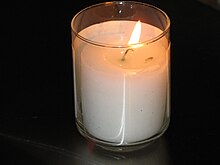
Occasionally, it’s crossed my mind to wonder whether my parents would want me to say Kaddish for them after they died. I don’t think I could promise getting to a morning minyan every day for the full 11 months, but if it were important to them, I’d make it a regular practice. I know that for my own sake, I will light yahrzeit candles every year. Seeing one on the kitchen counter now and then kept the rhythm of the year, reminding me that my mother had her own heart-calendar. (I remembered exactly which dates of the secular calendar my aunt and grandmother died, but one marks the yahrzeit on the Hebrew calendar, and I didn’t know those dates. But Mom did.) Without ever consciously deciding, I’ve always known that I would have that candle for my family in time, a reminder and beacon for over 24 hours until it was entirely consumed. L’dor va’dor, from generation to generation, is a common phrase in Judaism, and lighting a candle continues a ritual that speaks to me and that each generation has observed before me. Kaddish is different, though, at least as it is usually observed: not in the privacy of one’s own home, but communally. It’s one of the prayers that requires a minyan, the quorum of ten adults.
Never having asked him while he was alive, I thought about it after Dad died last month, and was pretty sure that if we had talked about it, he would have made a dismissive gesture and said that he didn’t believe in that stuff anymore. Then he probably would have told a story about helping make up a minyan for the sake of a friend in the synagogue when they were saying Kaddish, or said something else to move the moment on. Or said that if it were meaningful to me, then sure, I should say it. I am still Jewish in some indelible ways, but since the Kaddish is famously focused on praising God (it doesn’t mention death), and since lauding a God I don’t believe in doesn’t bring me comfort, I haven’t said it for my own sake.
Today, though, I went to shul for the first time since my nephew’s Bar Mitzvah, as part of Neighboring Faith Communities, a program I’m co-leading in our congregation. We learn about. I’m teaching the adults and a few lay leaders are teaching a group of middle schoolers, and they make the visits together. I haven’t joined them so far because the visits have all been on Sunday mornings, but as soon as we set the date to visit Congregation Beth Am, on a Saturday morning of course, I put it on my calendar. I had never been, and it was enjoyable.
What I didn’t consider until a few minutes into the service, though, was that there would be a Mourner’s Kaddish at the end of the service and that I was a mourner. I quickly looked over the prayer to make sure I could still say it, as I know my Hebrew reading is a little rusty; the Reform prayer book has transliterations of everything, but I find them harder to read than the Hebrew script. (To be precise, the Mourner’s Kaddish is in Aramaic, but the script and pronunciation of the two languages are the same.) And I felt a strange frisson, to enter the world of Jewish mourners, visibly and audibly, and with members of my congregation around me to boot. When we got to that point in the service and it turned out that Beth Am’s practice is for everyone to say it together, the frisson was replaced by an equally unexpected letdown. But the rabbi asked us to call out the names of anyone we were remembering, I said “David Zucker,” as others spoke the names beloved to them, and then, as we began the prayer, I was back on the long, upholstered pews of Temple Beth Sholom, my father rising next to me to say Kaddish for his father. L’dor va’dor, no question. The tears rose, my voice dried up, and I had to whisper the beginning of the second paragraph: “Yitbarach v’yishtabach, v’yitpa’ar v’yitromam v’yitnaseh” . . . I managed to get my voice back by “b’rich hu,” but I was wrung out.
We’ll say the Kaddish as part of Dad’s memorial service in April. It’s an important part of my sister’s practice, and it seemed right to suggest it when she and I met with the (Unitarian Universalist) officiant, but I wasn’t thinking about what it would mean for me personally. Now I am.

 Sermons in Stones
Recent comments