Earlier today, Egyptians marched from Tahrir Square to the US Embassy in solidarity with Occupy Oakland. The circuit is complete and the power is ON!

If you’re a little closer than Egypt, say, in the Bay Area, please read this:

1. There will be a tent called the “Sacred Space Tent” that will be the clearinghouse and meeting place for clergy related info and events. The tent will be interfaith and non-faith welcoming. It will have a very high flag or other identifying markings. It will be staffed from 8 AM – 10 PM by a clergy person of some faith tradition. If you are interested in helping staff this group show up early to sign up for a time slot.

2. All Clergy should gather at the Sacred Space Tent a half hour before the three march times (9 AM, 12 PM and 5 PM) so that we can all march together and multiply the effect of our presence. Those meet-up times at the tent are:
-8:30 AM
-11:30 AM
-4:30 PM
These are very important meet-up times and should be spread as widely as possible through all of your networks.

2.5
Another opportunity for people of faith at the General Strike (held in the Interfaith Tent):
Wed. 11/2 – 1:30 – 3:30 pm: What is Wise Response? A conversation about ongoing faith-based responses within Occupy Oakland.
The General Strike on November 2nd is only the beginning. How can faith-based people participate in this ongoing movement of resistance? Join Spring Washam with East Bay Meditation Center, Dawn Haney with Buddhist Peace Fellowship, and others to have a conversation about how our practices and teachings can strengthen Occupy Oakland.

3. There will be trainings going on all day Tuesday, Nov 1 for anyone (clergy, lay, etc) who wishes to learn more about non-violence and how to embody the principles of Gandhi and King in the actions that we will be participating in on Wednesday.

Finally, we ask that you not only come on Wednesday, but that you bring as many people with you as you can, spread this information through all your networks and contacts!

My inner organizer is not thrilled with the “General Strike” part of the event. I appreciate the sense of history that made Occupy Oakland call for a General Strike today, but I suspect that the last General Strike in the US–in Oakland, in 1946–had some more organization behind it. People do not just walk off the job in massive numbers because a small group suggests it the week before, even when they sympathize with the cause. It takes a lot of planning and consultation: for example, with labor unions. So I doubt the strike will be widespread, though I’d love to be surprised.

In any case, my concern is not that a strike is a bad idea but that the Oakland protesters and the wider 99% movement will feel deflated if there is little response to the call for a strike, even if by every other measure things go well. But I don’t think they should. I will consider the day a success if a couple of thousand people show up and we get good press.

I was strongly tempted to be there, but I have prior obligations at home and decided instead to devote a chunk of today to supporting the movement in a couple other ways. One, the Palo Alto Police Department was involved in the October 25 clash between police and protesters, and tear-gassed the crowd. As a Palo Alto clergyperson I want to speak up about this, so I’m writing something to send to the paper. Two, I’m eager to take the movement to other places besides the streets. After all, people can’t live on the street forever–many of us, fortunate enough to be employed–can’t protest in that way for more than a few hours here and there–and the point of the movement is not to camp out but to press for needed changes in every way we can. I’m going to call together some of the folks in my congregation and the community to suggest some other actions.

And I’m so thankful to everyone who went to Oakland today, with particular gratitude for colleagues (hello, Jeremy Nickel, author of the above call to clergy) who are organizing and staffing the interfaith clergy presence there.

Here’s Alan Grayson with an excellent articulation of the issues.

ETA: Today I’m also going to take the necessary steps to move all my money to the credit union I joined several months ago. I’ve kept my old checking account for complex and boring reasons, but it’s time to move. It will feel good to be investing in my neighbors and businesses in the Mission, via an organization whose purpose is to help its customers, not put money in the pockets of faraway speculators. For a long time I figured there were no credit unions I was eligible for, but it turned out that I could join this one simply by virtue of my address. Here’s how to find a credit union you’re eligible for.

I haven’t posted any drawings in ages. It’s too much trouble to scan them, and they mostly don’t fit on the scanner, but today I got smart and photographed them instead.

They all have their strengths and weaknesses–for example, the second one is entirely unclear on the whole left half, but I like the elbow–but I’m particularly happy with the last two. What seized my attention in both poses was the light on his hand, and I caught it here to my more-or-less satisfaction.

The munchkin and I traveled to Washington, D.C., for four days this week, to visit a sick friend in Baltimore. We stayed with other friends in Washington. I was hoping for a day wandering on the Mall, but we had only one afternoon for it due to rain. As it turned out, that was nothing. We got out of the region with 48 hours to spare before yesterday’s big storm hit.

So, Wednesday we went on the carousel, popped into the natural history museum for the living butterfly exhibit and a look at a lot of skeletons, and “climbed on things.” The Mall is full of low walls and fountains that were clearly designed with a four-year-old in mind. As far as Munchkin was concerned, we could have spent all day at the US Navy Memorial fountain on Pennsylvania Avenue. This was our compromise, since I wasn’t about to fly 3,000 miles to go to playgrounds, which probably would have been her first choice.

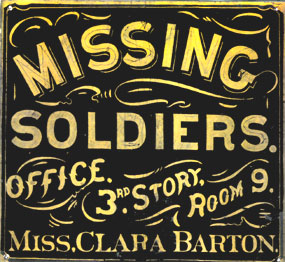
An unexpected, interesting-only-to-Mama treat awaited us on the way back from the Navy Memorial, though. Walking up toward the metro on 7th Street, we passed a sign reading

Unitarian Universalists collect famous Unitarian Universalists, and Clara Barton was a Universalist all her life. I did not know about this chapter in her career, which immediately predated the involvement in the American Red Cross for which she is most famous. Apparently she had done a great deal of work to identify Union soldiers in Andersonville Prison, and as the war ended, President Lincoln asked her to head up a Missing Soldiers Office in Washington. The site, the 9th floor of what is now 437 1/2 7th Street, NW, is held by the federal government as a potential museum.

I let out a little exclamation when I saw the sign, and of course, stopped to read about it, which led to one of those interesting conversations with the munchkin in which I try to explain the unexplainable and unthinkable. The wearing of identification tags wasn’t common practice yet during the Civil War, and tens, maybe hundreds of thousands of dead soldiers were buried, unidentified, on the battlefields where they died. Apparently Barton’s office handled over 63,000 letters in three years. The same source, the General Services Administration website,  says she was able to provide information to the families of 21,000 men. I wonder if it was ever good news.

Poet Everett Hoagland will be speaking in the service tomorrow morning. Usually our two services are the same, but he’s going to share two different poem cycles, one at 9:30 and one at 11. We have great music that fits his themes of the cosmic journey and homecoming, and I get to enjoy the service from the vantage point of Worship Associate. Our Worship Associates give a 3-5 minute reflection.  I was brought up with poetry as one of our family’s religions, with our household gods bearing names like Shakespeare and Frost, and it’s been fun to reflect on how that has affected my religious and ethical life. I’m really looking forward to seeing and hearing this poet in person.

Or want to do something more useful for Spirit Day?  Here are five things you can do to make it better for LGBT teenagers and non-teenagers.

Sign the Defense of All Families pledge.

Write a letter to the editor saying that, although suicides of LGBT teens are not making the headlines right now, you haven’t forgotten that there’s an epidemic of deadly bullying underway, and urging everyone to ask their Congressperson to co-sponsor H.R.975, the Anti-Bullying and Harassment Act of 2011.

Write your Congressperson, yourself. (It’s easy. Put your zip code in here. “E-mail me” or “Contact form” will be on your representative’s webpage.)

Come out as a supporter of LGBT equality. Tell one person who’s never heard it from you before how you feel.

Find an LGBT youth support center or Gay Straight Alliance near you
and send them a check.

A BBC story reports that the US has the worst rate of death from child abuse or neglect of any industrialized nation, with 1,770 kids killed in 2009. (A recent Congressional hearing estimates that the real numbers are even higher.)

So how do these other nations differ from us? By and large, they have lower poverty rates, lower crime and imprisonment rates, universal health care, better family-leave and child-care policies, better pre-school options, and much better networks of help for families with children.

Another thing we learn when we compare ourselves to the countries that are doing much better is that they have markedly lower rates of teen pregnancy. Very young people with unplanned children, unstable relationships, a curtailed education and therefore low earning potential, and lots of contempt from their community* are at an elevated risk of killing their kids. This paper compares measures of US teens’ sexual health (rates of pregnancy, abortion, STDs, HIV) with the teens of Germany, France and the Netherlands–you must click, just to see how much higher our teen pregnancy rate is than these countries’–and concludes that we would do well to adopt their approach of “Rights, Respect, Responsibility” regarding teenage sexuality.

That sounds a lot like the sexuality education program we offer at church, Our Whole Lives. OWL was developed by the Unitarian Universalist Association and the United Church of Christ, but you don’t have to be UU or UCC, or religious in any way, to enroll your kid, and–speaking for my own congregation–we won’t pressure you to join our church or ask you to donate money. It’s part of our ministry to the community. (It’s also not only for teens; there are developmentally-appropriate versions for K-2, 4-6, and adults of various ages, too.)

I know we save lives through this program when we teach young people that it’s okay to be gay, that it’s not okay for your partner to mistreat you or for you to mistreat your partner, and that sex is supposed to be safe (as well as fun, loving, and pleasurable), but I hadn’t thought about the impact on the next generation. I have no doubt that if every teenager in the US received a comparable education, we’d see a huge drop in those child death numbers within ten years.

—————–
*A babysitter of ours, then 17, said that she got lots of dirty looks when she and Munchkin were out alone, such as on their happy trips to the playground. Apparently we had all too many neighbors who (a) had never heard of babysitters, (b) disapproved of teen moms, even one who was taking excellent care of the child, and (c) thought they ought to express that disapproval. Did they imagine that that was somehow helpful?

Apologies to those who clicked on my one-word, Dada version of this post. Trying it again.

In the few days leading up to October 9, I had a niggle in the back of my mind telling me the date meant something, but preaching dates being the way they are, I ignored it. They tend to loom, not in a negative way, but in an I-could-rattle-off-the-date-of-every-Sunday-for-the-next-nine-months way, a condition endemic among ministers and, like savantism of all kinds, quirky but mostly harmless. (Yes, I know the date of Easter in 2012, <em>and</em> the next date it doesn’t coincide with Passover. Want to make something of it?)

Usually the “remember this date” pressure lifts after the service (or, rather, is transferred to the next preaching date), but this Sunday, on the way home, October 9 still niggled. Now that I had the mental space to turn my attention to the small child tugging at my brain, I asked it what it wanted to tell me, and finally got it. It was John Lennon’s birthday. Born 1940. Also his son Sean’s, b. 1975.

Whenever I forget something I really need to remember–which is more and more often–I think it’s because my memory is overloaded with trivia like this.

Coming home from church last week, the munchkin sang the song she’d learned that morning, the first day of Sunday school. In one version, her fingers are “things” and she sings, “These little things of mine, I’m gonna let them shine,” which cracks me up. In another version, she seems to understand that she’s talking about a “little light.” They must have gone around the circle and used each person’s name, because that’s the way she sings it:

Is Mama going to turn it off? NO! I’m gonna let it shine

Is Mommy going to turn it off? NO! I’m gonna let it shine

Is [Munchkin] going to turn it off? NO! I’m gonna let it shine, let it shine, let it shine, let it shine.

Also, they made candleholders by decorating plain glass ones with colored tissue paper (on the outside!). She remembered Hanukah and asked if we could light it then along with the menorah, but we said why wait?, and at dinnertime we lit her “chalice.”

It warms a mama’s heart. With a child who’s four, this is what we want from Sunday school: she enjoys herself, she feels cared for and safe, she learns a song that is a game now and will have other meanings as she grows up, and she can make a tangible, beautiful contribution to the religious life of our household.

photo credit: Matthew Bowden, http://www.digitallyrefreshing.com, via Wikimedia Commons

Lessons learned from last year’s Hardly Strictly Bluegrass:

Do not try to park anywhere near Golden Gate Park. Either take the bus, or drive to a bus stop far, far away from the park and take the bus from there.

Don’t just bring a picnic–bring all the food and drink you’re going to want.

Don’t try to meet a friend there. It’s hard enough to find the family members you dropped off half an hour earlier. But do expect to run into someone you know.

Bring toilet paper.

Even if one of you says she hates bluegrass, and another says she hates country, and the band you particularly went to see was disappointing, you’re going to love it.

Sixteen years ago I was in my second year of an M.A. in religion, and engaged in the leadup to masters’ exams. Putting the exams together was kind of fun. They could be on any three topics that covered a certain diversity of religion, culture, and era, and mine were Feminist Theology, Dogen’s Shobogenzo, and The Theology of Romantic Poetry.

For the Romantics, my reading list consisted entirely of works of five of the Big Six: William Blake, William Wordsworth, Samuel Taylor Coleridge, John Keats, and Percy Bysshe Shelley. (The sixth, Byron, didn’t particularly interest me and his work didn’t seem to have many theological implications.) I took note of the lack of female voices–I was studying feminist theology, after all–but didn’t think that there were any that came up to the standard, except maybe Dorothy Wordsworth or Mary Shelley, but neither was noted for her poetry. I hadn’t heard of Hannah More or Joanna Baillie, and somehow thought of Emily Bronte as not quite within the period. Excuses, excuses. If I’d done a little digging, a little looking beyond the canon that had been blessed by men, handed down through generations of male scholars, and endorsed by my male advisor, I’d have expanded my list.

Well, I’m finally remedying the gap by reading Frankenstein.  I’m listening to the audiobook version, and it’s making it a little difficult to get out of the car. And wow, here’s something else that might have changed my mind about that reading list (even if it did mean including novels): the subtitle is “or, The Modern Prometheus.” How did I not notice that Mary Shelley and her husband both created masterworks that explicitly expanded upon the myth of  Prometheus? Prometheus Unbound was on my exam reading list, you betcha, and it’s the longest poem I’ve ever loved. And Prometheus is such a rich figure for liberal religionists: the human who dared to steal a power the gods had reserved for themselves and give it to humanity, and who, in P. B. Shelley’s reading, is thereby a hero. (I have a feeling that M. Shelley’s point of view is more nuanced. Shh, don’t tell me the end.) Of course, I was a very new UU then, and not yet a minister. Now I’m musing about Prometheus, fire, power, responsibility, and what it means to “play God” if the gods themselves are discredited. And I’m really looking forward to what the novel has to say about all those points.

Next up, some of those female poets who were very famous in their day, I now know, but who got insufficient respect from anthologies and me before.

Enter your e-mail address to receive e-mail notifications of new posts on Sermons in Stones

Links I like