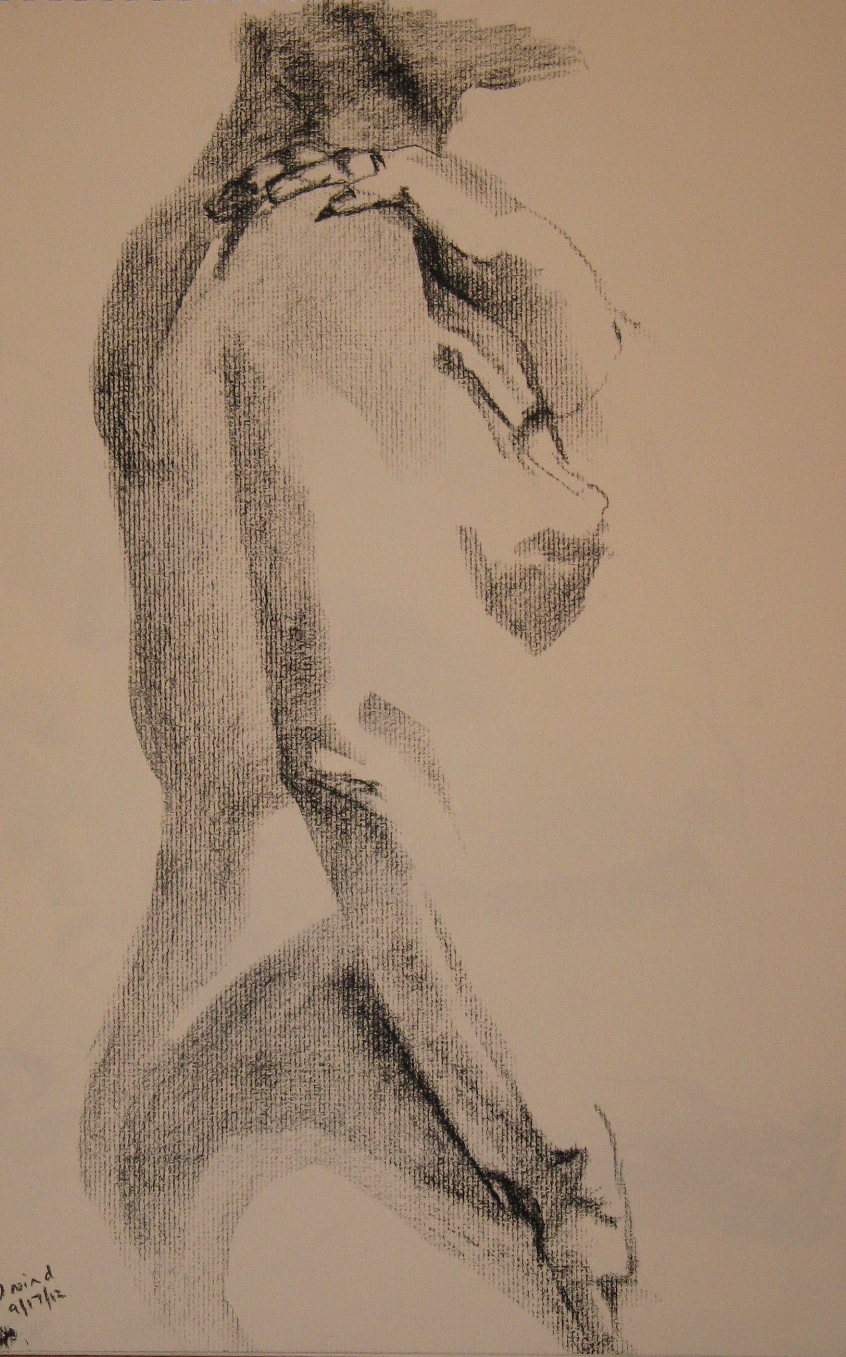
. . . which is a good reminder that progress isn’t linear (sigh). I’d learn more, though, if I looked at the previous week’s drawings before I went off to draw some more. They are the best reminders of what I’m doing that is and isn’t working.


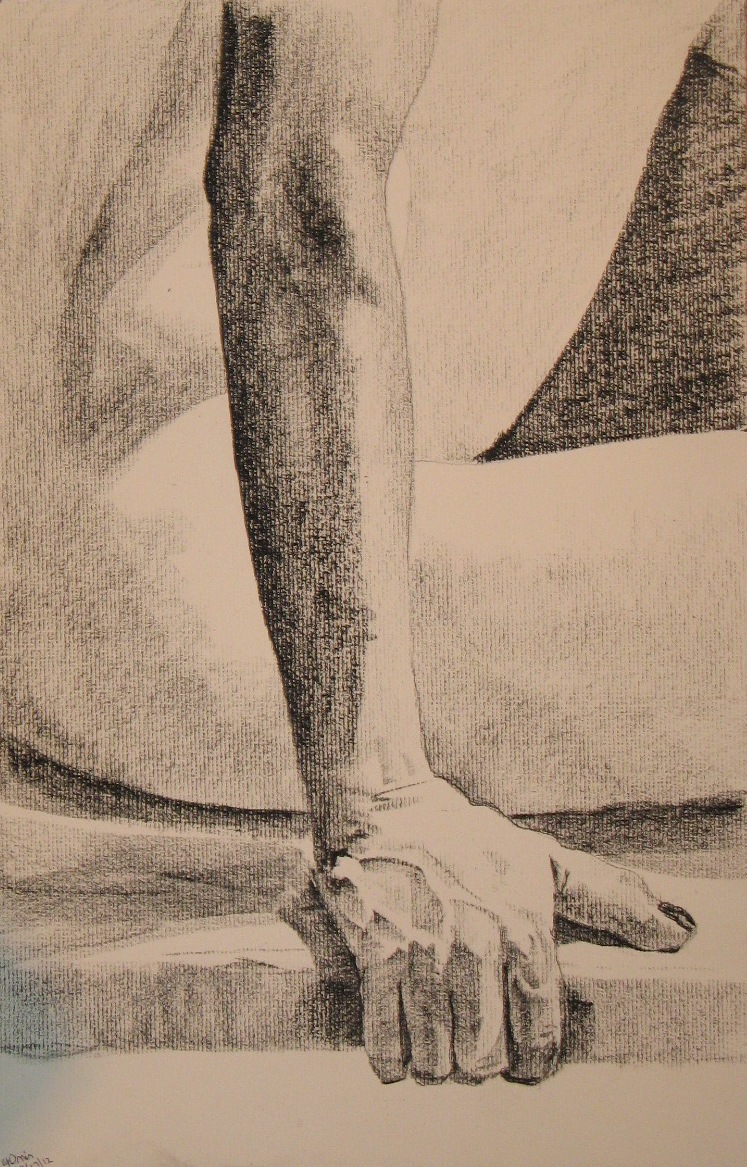
With the above drawing, I grabbed my darkest charcoal and avoided getting bogged down in delicate shading. Quick, dark, high-contrast. Seven minutes doesn’t allow for much more (yet–I’m speeding up), which is good; and I know how hard it is for me to sustain energy while getting into detail. On the next drawing, I lost my nerve, used the medium charcoal, and got picky again, and it shows. It’s not a disaster–there is some good light on the thumb and fingers–but all in all the first drawing has more of the energy of the person modeling.

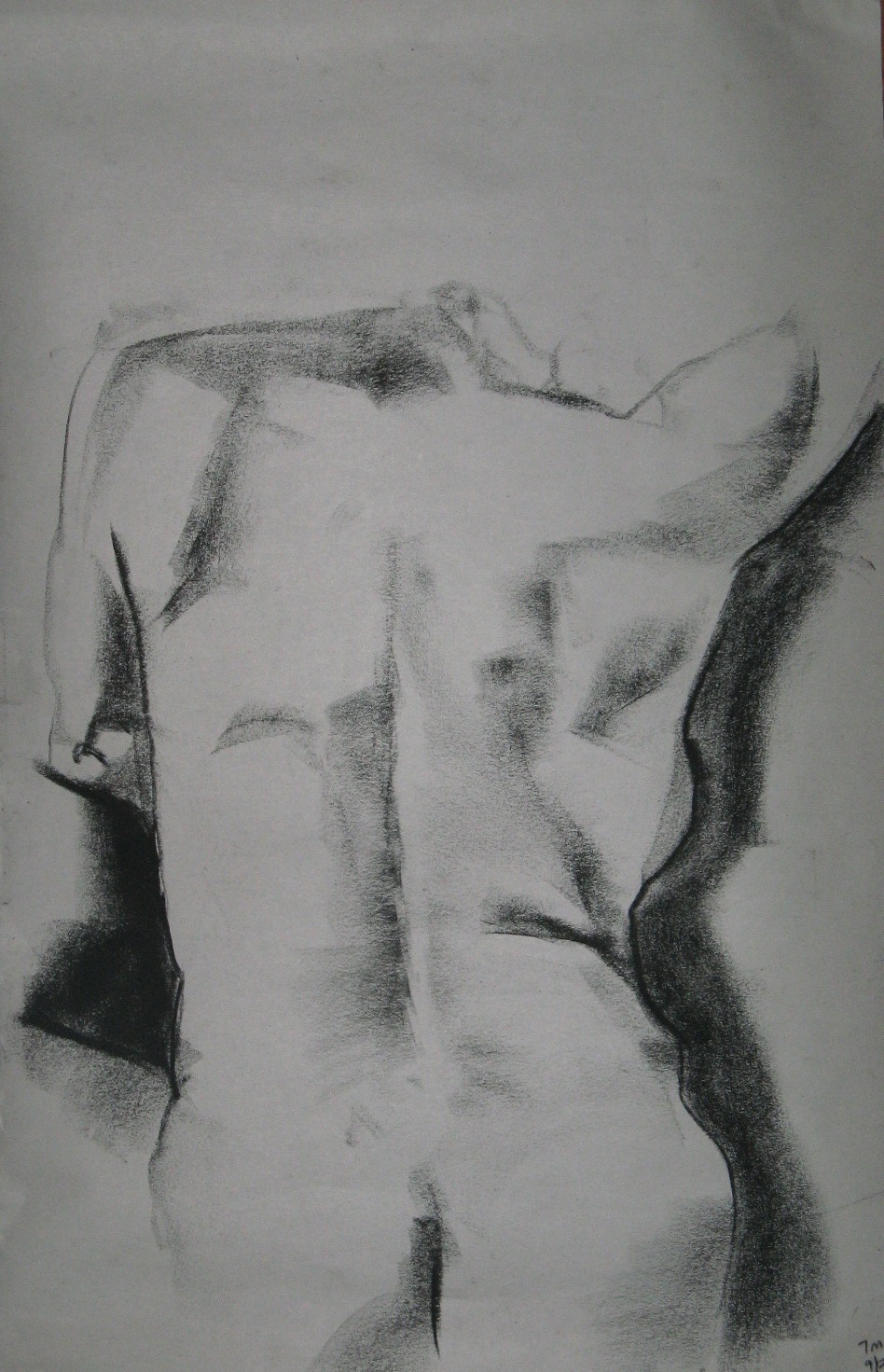
The most alive parts of the above are the elbow and the shadows cast by both arms.  I’m getting less intimidated by the subtlety of the contours of backs.

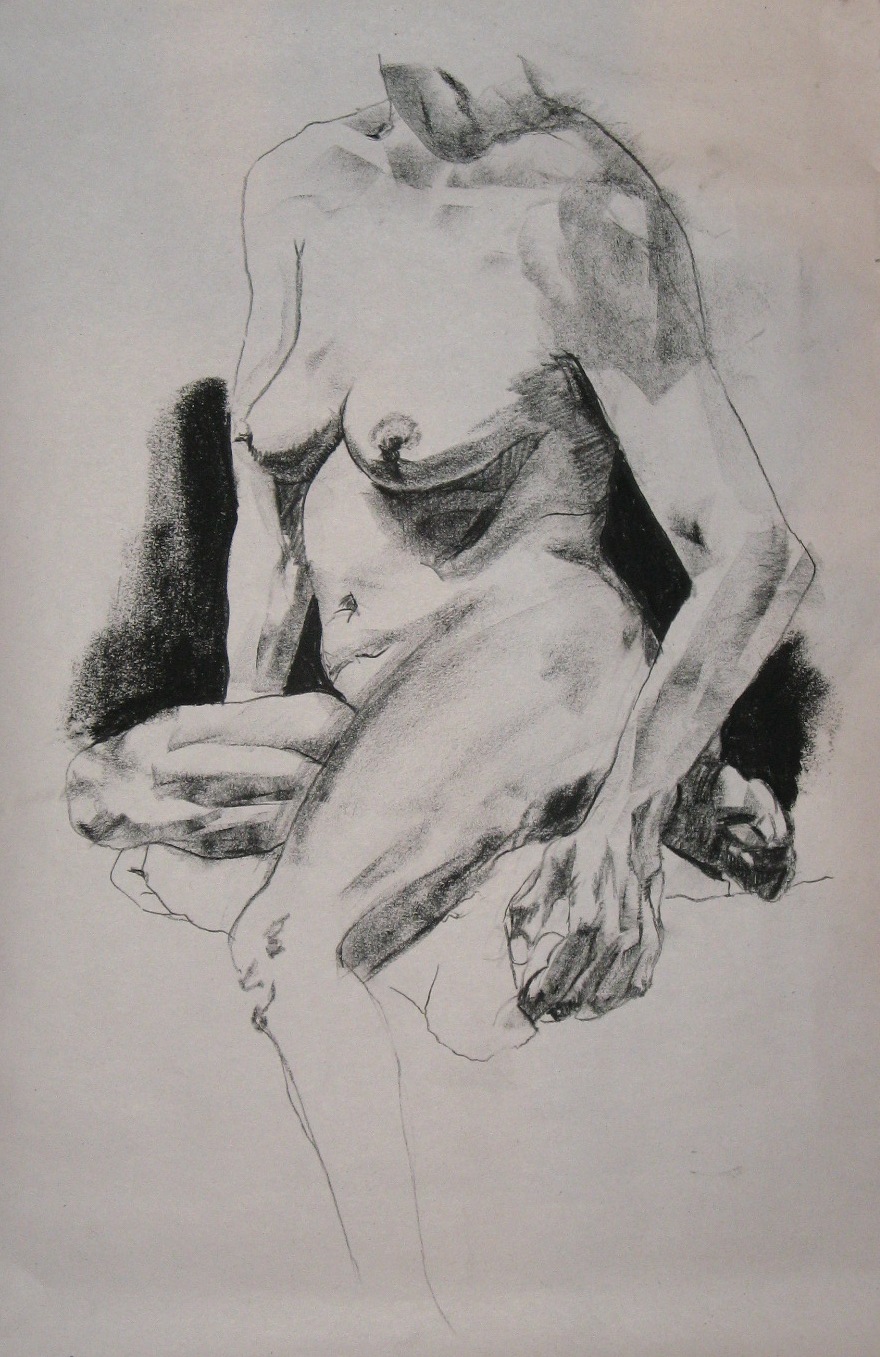
The first two drawings were on newsprint, but the above and those that follow are on paper with a lot of “bite” and texture. It is more forgiving when I make an unintentionally sharp edge: for example, on a shadow that actually fades into light more gently. On the newsprint, the sharpness will always show, but on this heavier, rougher paper it can be softened.

I don’t pay a lot of attention to composition in these sessions–I go by instinct and I don’t fuss if my composition gets messed up by my miscalculating how long the legs are or some such–but I like the composition on the above. Also, it’s an illustration of the importance of shadows. She would appear to just float if there weren’t those shadows anchoring her to the floor. That’s fine if you don’t want to evoke the space she’s in, but I do. I want to sense as I draw, and I want the viewer to sense, what she is feeling where her hand and arm and side touch the carpet. I didn’t realize that until I wrote it just now.

Back to the dark charcoal on the above, to good effect. I started to draw the face, also; it went all wrong; so I started again in the corner of the paper and drew the one that follows (you can see some of the gone-wrong face in the lower right). What success I had with this was due to keeping in mind what I try to remember when I’m drawing hands and feet: it’s just like the rest of the body, just pay attention and respond to what you see. (To misquote Annie Savoy from Bull Durham: “Drawing is like hitting a baseball. You’ve just got to relax and concentrate.”) There’s a freedom to this drawing that I’ve never achieved in a portrait before.

I’m happy with this last one because the hand and wrist convey a sense of the weight they’re supporting. It’s the first drawing I’ve made that I think is good enough to go into the future exhibit of hands that I sometimes think about putting up in the lobby at church.

Joy asked me recently if I were still finding figure drawing interesting. She knows I can be a little compulsive, and wanted to know if I would stop if I got tired of it. I will, but it’s hard to imagine when that could be. The subject is inexhaustible. Maybe if I were anything like satisfied with my ability to put on paper what I find so captivating, I’d move on to a different one. Maybe.

Today’s model was older than usual, which was a treat. Everyone’s living shows in their skin and faces and the way they hold their bodies, but I love the way experience shows in skin that’s become a little loose and tendons that have become more prominent. Of course, showing that kind of subtlety is beyond me, but it’s a pleasure to try. I’ve also ventured a little ways into the territory of faces in the past month or so, and did that here–with some success in the third drawing below, much less in another that I decided not to even post.


Two poems, a prayer, and a song for this Tuesday, September 11:

“110 Stories,” by John M. Ford

“Ashes to Ashes, Dust to Dust,” by Patrick Murfin

A Prayer, Rev. Molly Housh Gordon

and thanks to N. at UUCPA, who pointed me to the Mary Chapin Carpenter song “Grand Central Station.” Sorry there’s no link, but it’s the first hit on YouTube if you put in the title and singer. I agree with N’s recommendation: don’t watch the pictures, just listen to the song. No doubt you have your own pictures, as we all do who are old enough to remember that bright, beautiful, horror-soaked Tuesday morning.

Tomorrow evening, my family and I will be joining an anniversary celebration that raises some interesting questions. See, the folks we’re toasting have been married to each other twice. They married, divorced several years later, and several years after that, married each other again, on the same date that they were married the first time. So while the date for celebration seems clear, neither they nor anyone else is ever sure what number they’re celebrating. Is it the number of years that have passed since their first wedding? The number of years that have passed since their second wedding? The net number of years they’ve been married?

How one answers might depend on one’s philosophy of life (or possibly just on how many glasses of champagne one has had at the party). Counting only the years since wedding #2 suggests that the first marriage, well, doesn’t count. It’s reminiscent of the don’t-look-back, something-might-be-gaining-on-you approach to the past that I suspect all of us take at times. “Who wants to remember old failures,” we reason, tempted to throw all our imperfect experiences down the memory hole. In contrast, counting the net–all of the years married to each other–says that what matters most is the time spent together, both the happy days and the sad. That’s a nice thought, affirming in a larger sense that the plans we’ve had that didn’t work out quite as we dreamed are not failures. They contribute meaning to our lives.

But what about that time in between? Something in it led to the second, lasting marriage–so surely it’s important too. That way of counting affirms a philosophy that everything in our lives has worth. (“The thing about working with time instead of against it . . . is that nothing is wasted. Even pain counts.” [Ursula K. LeGuin, The Dispossessed]) Of course, if we want to take that approach, then maybe we need to go farther back than the first wedding date. Every couple knows that their life together didn’t begin on their wedding day. Nothing in our lives begins on the day we mark it. The first day of school, the first love, the longed-for or hated job, the life-changing discovery made at age 50, all have roots going back to our birth, or even further back than that, past our parents’ births.

I have also been married twice, but more conventionally, to two different people. In a very real sense, the first marriage is an essential ingredient of the second, because everything in my life is an ingredient of my marriage. That’s just a subset of the larger, almost tautological statement: everything in one’s life is an ingredient of one’s life. Some parts of it make happier memories than other parts, but they all made us who we are now.

Of course, if we go too far down that road, we might end up deciding that since all dates are important, we won’t celebrate anniversaries at all. And it would be a shame to lose an excuse to go out to dinner with beloved people and wish them many more years of happy life together.

Day 2, Poem 2

There is another sky,
Ever serene and fair,
And there is another sunshine,
Though it be darkness there;
Never mind faded forests, Austin,
Never mind silent fields –
Here is a little forest,
Whose leaf is ever green;
Here is a brighter garden,
Where not a frost has been;
In its unfading flowers
I hear the bright bee hum:
Prithee, my brother,
Into my garden come!

The way I read the poem, it is about two states of being: the one her brother is in, and the one she is inviting him into. They are words I would like to say when a friend is depressed, but I usually don’t, because what good would it do? They already know that not everyone is shadowed by gloom. Maybe she didn’t utter hers aloud either.

In some places, this poem is titled “The Cloud Withdrew From The Sky.” ED almost never titled her poems, and most editors who are compelled to title them just use the first line. Whoever chose this title imposes their own interpretation. It’s an interpretation that suggests that she was also under a cloud and now it’s gone, and I don’t see any support for that in the poem. Actually, its only references to the passage of time say outright that this state of sunniness never changes: “Ever serene and fair,” “ever green,” “Where not a frost has been.” All of which makes me think that she is referring not to happiness (hard to imagine ED asserting that melancholy never strikes her), but to love and acceptance he may find with her, or perhaps to the presence of God.

Photo by Kevin Burkett, Creative Commons Attribution, via Wikimedia Commons

The excitement about the blue moon leaves me with mixed feelings. On the one hand, the moon is doing exactly what it always does. Every 29.5 days or so, it comes to the full, and the fact that it has done it twice this month is simply an artifact of the artificial calendar. Invent a solar “month” to intersect with the lunar month, and occasionally there will be two full moons in the 30- or 31-day period we have designated. It isn’t bluer than usual, it doesn’t look bigger or brighter or any different than any full moon. It’s just the moon. There have been nine full moons this year. There will be another one next month.

That’s the curmudgeon grumbling. On the other hand, I’m delighted to see my Facebook feed and other media streams so intent on getting us to look at the moon. It’s like my moon-phases watch, which is no substitute for the actual moon, but reminds me to stop looking at clock-time and calendar-time and turn my eyes to our beautiful sister planet now and then.

My own feeling whenever I look at the moon is that I’m very lucky to live on a planet that has one. Many don’t. (If offered a trip to another planet, I’d ask to go to one that has more than one satellite. That sky would be a sight to see.) One of the loveliest surprises of my life was the first time I turned a pair of binoculars on the moon. I had had no idea that there was anything much to see without a telescope. All the ridges and craters were unexpectedly beautiful, and yet they’d been there all my life. Like discovering that Grace Kelly had been following me around all that time and I only had to look over my shoulder to see her up close.

And of course, I’m always glad of an excuse to listen to Billie Holiday.

I don’t know if I can really do this, or will want to after a while, but I had the idea of reading an Emily Dickinson poem each day, reading them in order (as set in The Complete Poems of Emily Dickinson, edited by Thomas H. Johnson). If I never missed a day, it would take close to five years. No doubt I will miss many days, and also come to poems that I want to spend a few days contemplating before I fill my mind with the next one. I also won’t try to write about every one. But I must write about this first one, because it’s the first, it’s unintentionally (?) funny and, well, let’s just say that if it were a typical example of her poetry, I would not be setting out to read all 1,775.

It is headed “Valentine week, 1850” and appears to be an exhortation to her brother Austin to get married already (he finally obeyed seven years later). Her argument is that “All things do go a courting,” and she lists examples, and I do mean lists. It gets a little tedious, and the hexameter takes on a singsong quality in too many lines. It also doth seem that every noun doth verb, instead of just plain verbing; it reminds me of what I think of as flight attendant-speak, in which the speaker says things like

We will be showing an in-flight movie.
We do ask you to keep your seat belt on while the aircraft is in motion.
We do offer complimentary soft drinks and juice.

and on and on with unnecessary emphasis, as if contradicting an earlier assertion, until I want to take off my seat belt, leap from my seat, hurl my flotation device, and scream, “No one’s arguing with you! Stop being so damn defensive!” I guess in ED’s case, it’s a scansion issue, but still.

ED even lists a half a dozen candidates for lucky bride (one of whom he did marry, if the Susan of the poem is Susan Gilbert). Still, it’s far from doggerel, and it has its moments, like “The wave with eye so pensive, looketh to see the moon.” I also notice that she is already spinning gorgeous images of death:

“The worm doth woo the mortal, death claims a living bride.”

Here’s the whole thing. I am also glad ED doesn’t do quite so much underlining in future poems; Johnson preserved it, and the italics don’t survive a copying and pasting from other websites, and are very tedious to put back in.

Awake ye muses nine, sing me a strain divine,
Unwind the solemn twine, and tie my Valentine!

Oh the Earth was made for lovers, for damsel, and hopeless swain,
For sighing, and gentle whispering, and unity made of twain.
All things do go a courting, in earth, or sea, or air,
God hath made nothing single but thee in His world so fair!
The bride, and then the bridegroom, the two, and then the one,
Adam, and Eve, his consort, the moon, and then the sun;
The life doth prove the precept, who obey shall happy be,
Who will not serve the sovereign, be hanged on fatal tree.
The high do seek the lowly, the great do seek the small,
None cannot find who seeketh, on this terrestrial ball;
The bee doth court the flower, the flower his suit receives,
And they make merry wedding, whose guests are hundred leaves;
The wind doth woo the branches, the branches they are won,
And the father fond demandeth the maiden for his son.
The storm doth walk the seashore humming a mournful tune,
The wave with eye so pensive, looketh to see the moon,
Their spirits meet together, they make their solemn vows,
No more he singeth mournful, her sadness she doth lose.
The worm doth woo the mortal, death claims a living bride,
Night unto day is married, morn unto eventide;
Earth is a merry damsel, and heaven a knight so true,
And Earth is quite coquettish, and beseemeth in vain to sue.
Now to the application, to the reading of the roll,
To bringing thee to justice, and marshalling thy soul:
Thou art a human solo, a being cold, and lone,
Wilt have no kind companion, thou reap’st what thou hast sown.
Hast never silent hours, and minutes all too long,
And a deal of sad reflection, and wailing instead of song?
There’s Sarah, and Eliza, and Emeline so fair,
And Harriet, and Susan, and she with curling hair!
Thine eyes are sadly blinded, but yet thou mayest see
Six true, and comely maidens sitting upon the tree;
Approach that tree with caution, then up it boldly climb,
And seize the one thou lovest, nor care for space, or time!
Then bear her to the greenwood, and build for her a bower,
And give her what she asketh, jewel, or bird, or flower—
And bring the fife, and trumpet, and beat upon the drum—
And bid the world Goodmorrow, and go to glory home!

Courage. It won’t be long before we get to the seriously good stuff.
Robert bid on the “you choose the text, I’ll give a sermon on it” item I offered in last year’s auction at church. His “text” was in fact an experience: his experience of having a sudden, irreversible diminishment of the use of one foot. He wanted to hear about adjusting to a “new normal.” I am so glad he asked. Writing this was a profound experience for me.

I gave the sermon on August 19–with a reflection by Robert, and another by Melissa, both of whom I hope will also make their texts available online–and post it here.

“The New Normal”

Some drawing days are better than others–who knows why. I take a day like today as a gift. I didn’t want to stop. On the second to last one (g), I particularly wished for a lot more time, as drawing the hands took about half the time and I would have loved to get into more detail elsewhere. There’s nothing wrong with leaving the studio hungry for more.

I’ve been experimenting with conté crayon a little, so the first one is conté. The rest are charcoal. Click to enlarge.

As a Universalist, I have a naturalistic view of hell. Actions carry their own consequences, which often create hellish conditions for ourselves or others. One sin that clearly comes pre-packaged with its own punishment is gluttony, as I learned last week.

We had a big family farewell dinner at a seafood restaurant in Seattle, and I ordered the two pounds of clams and ate them all. Every single one. If you’ve ever steamed clams yourself, you know that there are always a couple that don’t open up, and that that is precisely the way to decide which clams are okay to eat. The ones that emerge from the pot still closed should not be eaten. They are bad–again, not theologically, but biologically.

Well, when I came to a couple of closed clams, I pried them open and ate them. I wasn’t really thinking; I was immersed in conversation with my interesting in-laws, and I don’t think very well about anything else when I’m in an interesting conversation. And what vague idea did amble across my mind about discarding closed clams was shouted down by my desire for as many clams as I could eat.

At bedtime that night, I felt a little under the weather. At 1:30 a.m., I woke feeling distinctly ill, visions of those last few clams dancing in my head. The nausea and the knowledge that it was my own damn fault struck simultaneously, so I didn’t even have the consolation of self-pity. I looked up food poisoning on the internet and decided it was too late to do anything except drink a big glass of water and wait for the bug to tear through my system. On a travel day, too: no hope of lying in bed whimpering, since we had to pack up and fly home.

I seem to have gotten lucky, because I got back to sleep, and come morning, I had nothing worse than some tummy upset and a mild case of cold sweats, which didn’t lift until about 24 hours had passed, but stayed manageable. Some bacillus or staphylococcus fired a shot across my bow, and I learned a lesson. Gluttony isn’t worth it. Throw out the closed clams.

Enter your e-mail address to receive e-mail notifications of new posts on Sermons in Stones

Links I like