We leave for home in twenty days. Let’s see if I can post one thing per day I’ll miss about San Miguel.
Today: its walls.





Finding the sacred everywhere. Thoughts on religion, art, books, politics, philosophy, and life in general from a Unitarian Universalist minister.
We leave for home in twenty days. Let’s see if I can post one thing per day I’ll miss about San Miguel.
Today: its walls.
I’m getting those preaching chops back–guest-preached this morning at the Community Church of San Miguel, an interdenominational and quite liberal Christian church that was one year old this past Valentine’s Day. It’s been many years since I preached from the lectionary, and I enjoyed it. As with an art exercise or academic assignment, sometimes having to work within set constraints can be paradoxically freeing and inspiring.
Last night I was looking over all my drawings from the Tuesday life-drawing session and Joy said, “You know what I like best about these? How much you’re loving drawing them.” I couldn’t agree more. I did not set out to love drawing during this sabbatical; it didn’t occur to me that that was possible, people who draw for pleasure always seeming like another species. I just wanted to tackle my fear of it and, I hoped, reduce that fear. Now I go off to these sessions with excited anticipation, and the two hours fly by. I do feel some trepidation when I face the blank sheet of paper and the real live inexpressibly beautiful model, but it’s minor. Amazing.
I keep thinking of a repeated theme from a book my sister used to have (probably still does), Letters to Horseface by F. N. Monjo, which comprises fictional letters from the boy Mozart to his sister. He keeps encountering this and that musician and saying “The clarinet is such a beautiful instrument–I have to write a concerto for it” and likewise about violin, flute, etc. But in the last such remark, IIRC, he decides the human voice is the most beautiful of all. That’s how I feel about drawing people. Cats, trees, stone walls, the light falling on a rooftop, are all beautiful beyond words (and certainly beyond my capacity to draw them), but nothing inspires me like “the human form divine.”
Current project: collages/drawings to illustrate Emily Dickinson poems. I’ve been thinking about this one in particular–meditating on it as in lectio divina, trying out drawings, seeing what emerges.
The Soul should always stand ajar
That if the Heaven inquire
He will not be obliged to wait
Or shy of troubling HerDepart, before the Host have slid
The Bolt unto the Door —
To search for the accomplished Guest,
Her Visitor, no more —(No. 1055)
By the way, ministers and other users of online quotations pages, be wary. Looking for the text of this poem, I found many incidents of the paraphrase “The soul should always stand ajar, ready to welcome the ecstatic experience” passed off as something Dickinson herself said. Typically of her, the poem is subtle and complex, and typically of internet quotable quotes, the misquote isn’t. Of course, internet quotations pages are 99% copies of other internet quotations pages. If you can’t completely trust your ear to know when something sounds like 1860 and when 2010, when it sounds like something Nelson Mandela would say in his inaugural address and when it’s more like Marianne Williamson (and who among us has an infallible ear?), it’s best to confirm the quote with Bartlett’s or some other resource that actually identifies its sources.
More or less done. I might tinker with it; I’ve been thinking of adding a border, maybe of the same plastic that makes up the skin, but I need to stare at it for a few more days.
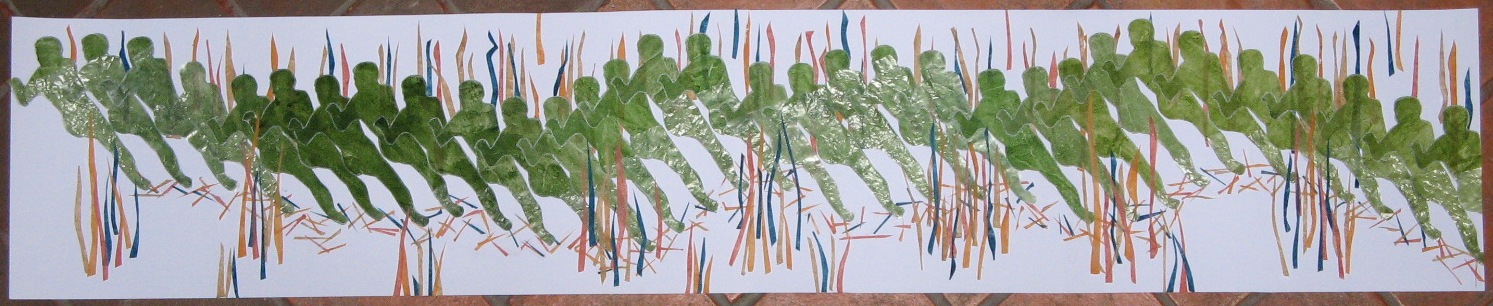
I’m happy with it. Tomorrow morning is my dedicated art time and I’m not sure what the project will be–maybe just drawing.
For a sabbatical blog, this one has been pretty thin in the “what I’ve been up to” category. So here, for the record, is what I’ve been doing vis-a-vis sabbatical goals.
Drawing etc. I report on fairly often. I was tempted by a ceramics class–actually, less a class than access to materials, studio space and kiln time, which were what I wanted–but the difficulty of getting the work home, and the delight I’ve taken in just working on 2D stuff, convinced me to skip it. Right now I’m working on collages, which Munchkin likes so much that I can easily do them while she’s home as well as while she’s in school (I give her paper and cut-out people and she makes her own c’lage, as she calls it, beside me). Two weeks ago I went to the local weekly, no-instruction, life-drawing session because drawing from a model was my favorite part of drawing class and I really miss it. I’ve gone twice now and hope to go every Tuesday that remains, which is only three more (not including the last week, when Joy will have returned to SF and evening excursions without the munchkin will be tough). I’ve already looked up similar sessions in SF and bookmarked the schedule so I can continue there.
A habit of art: A goal for my sabbatical, besides “make art,” was to get in a habit of making art that I’ll continue when I’m back in the busy life of full-time work for me, full-time work for Joy, full-time school for Munchkin, commuting . . . I got excellent advice from my dear colleague Chris, who is recently retired and still working hard at projects imposed by no one but himself, so he knows what he’s talking about. He recommended that starting during the sabbatical, I have a set time every week that is inviolable art time, and when sabbatical ends and all the other art time falls away, I will just continue, Mondays 9-11 a.m., without fail. Because of my Spanish class (see below) I haven’t started a weekly habit ’til this week, but I’ll try to keep it up for this last month.
No more morning internet: I realized that art time opens up if I break another habit. I tend to wake up and turn on the computer. Usually I have some excuse, like checking for a reply to an e-mail or tracking what I ate for breakfast (either of which, of course, could easily wait), and end up frittering away time on Facebook and Wikipedia and other idle pursuits. So I have two computer-related resolutions: (1) on Mondays, which are my day off and my sacred time home alone, have only a very specific, limited online time, if that (maybe 1/2 hour during lunch), and (2) not to turn on the computer at all on work days until I go into work. Morning tends to be an energetic and productive time for me, since I wake up before anyone else in the family, and I could do art then, or, if the Muse is still asleep, at least scrub the toilet instead of meandering in the internet wasteland. I’m trying to establish the new habit before leaving San Miguel, and doing about 50/50 on it. Um, today I’ve been on the computer all morning without even touching my almost-done collage. As soon as I finish this blog post, though, it’ s art time. 😉
Spanish: I came here with the intention not to study much Spanish. I thought intensive classes were the only way to go and if I did those, I wouldn’t have any art time. But I do want to learn Spanish–I started classes at community college two years ago because I want us both be able to speak to the munchkin in two languages, while she’s young and can learn two easily–and the opportunities of being in Mexico proved irresistible, especially after we found an excellent Spanish school that offers one-month classes, 3 hours a day. That sounded reasonably compatible with my art goals. I took Level 3 in April (3 hours plus an hour’s conversation) and was so thrilled by how much I learned that I decided to do Level 4 too, 3 hours only, in June ( May was our time for travel–a week in Mexico City, a few days in Michoacan). I could have done Level 5 in my remaining month, but even at only three hours a day, it does definitely eat up the only totally free art time I have. Enough. I did very well and got a good foundation in place, and I have ways to continue when I’m home. One thing I should do is blog in Spanish sometimes, so stay tuned / be warned!
Technically, my sabbatical ended June 10. The rest of my time is my annual vacation and study leave, which look pretty much the same as sabbatical. I have some study leave goals that I kept separate from sabbatical, so I’m pursuing them now: reading Theodore Parker in preparation for a sermon in August, the 200th anniversary of his birth; perusing some small group ministry topics in preparation for our new groups to be launched this fall (if congregational plans didn’t change in my absence); reading a couple of books on leadership and preaching, if the books will arrive. I’m even guest-preaching at a new interdenominational church (ten minute sermon–gotta love these Christians, whose communion service and many readings leave little time for ministerial musings), and, sad to report, giving support to a new friend by participating in the memorial service for a member of the UU Fellowship, Carol Veal, rest her soul.
–joining the UU Salon, with thanks to Lizard Eater for a great idea–
I’m sure I’ll return to this theme, because so many different threads of Universalism weave through my life and beliefs. The first one that came to mind when I saw the UU Salon question, the one that tells me I was a Universalist before I knew there was any such thing, was redemption: stories of conversion of the heart, which have captivated me from an early age.
I’m working on a piece that I think of as my “little green men.” Joy calls it my “little molting men.” They are, or rather he is, molting; it consists of many virtually-identical figures, each with a skin of plastic, and each skin in some degree or another of being shed.

Detail of work in progress (tentative title "Shedding")
I started work on it probably two months ago, with many hours of painting the papers, cutting out figures and then again cutting parts of them out of plastic, gluing the plastic on, outlining each figure . . . All a lot of fun. I worked on it only in short bursts over the last month while I was occupied with Spanish class and a little stumped about what to do next with this shedding person. For a long time, I’d planned on putting the figures in a spiral form, which kept me occupied with interesting technical problems; I had thought I wanted a Fibonacci spiral, which required a compass, so I’d bought one, leading to a fun afternoon of me and the munchkin drawing with the compass, but not much else, as the compass wasn’t really up to the task. What do you want for seventeen pesos. Besides, after looking at all the Fibonacci spirals I was drawing, I decided I wanted a spiral more biological and less mathematical, shaped like a snail’s shell. That didn’t work any better, though (the figures are too big–the piece would have to be something like 5’x5′ to hold them), and I didn’t have any other satisfactory ideas. So I fretted, and to make it worse, I fretted far from the piece, avoiding it as if it were the cause of all the trouble. This seldom works, and it didn’t work this time. To overcome a bout of creative sterility, I usually need to have the piece before my eyes and the materials in my hands. That’s why I’ve been doing art during this sabbatical; it was time to stop thinking about art and actually make it.
Finally, today, done with Spanish and free of parental responsibilities all morning, I sat down with the figures and within five minutes knew how they should go, which was not a spiral at all but an undulating path. Then I realized they needed to walk on something and I knew what form the ground should take too.
I love this part. I love it when the piece is starting to match the vision (with lots of surprises along the way, but pleasant ones) and I can just sit there contemplating the piece in progress as I cut paper into slivers and glue to my heart’s content. It occurred to me at one point to wonder whether rubber cement fumes can be fatal, but I thought, Well, I’ll die happy.
My friend Karen brought me the rubber cement (3 jars!) when she visited last month. I hadn’t thought to ask for any, but she’d read on here about how I couldn’t find it in San Miguel, and I’m so grateful for her thoughtfulness. I don’t see how I’d have made this piece without it. Now I’m in the home stretch and having so much fun it’s hard to stop and sleep, but I’m tired.
When Joy picked the munchkin up from school yesterday, she was informed that today would be a rare “don’t wear your uniform” day. Instead, the children are supposed to wear green. In fact, Joy told me, she and I should wear green too. “Why?” I said, trying to recall if there’s some kind of holiday on Friday, June 11. (In San Miguel, it’s about a 50-50 chance that any given day is a holiday.) “What’s happening at 9 o’clock in the morning tomorrow?” she hinted.
Oh! Right! Definitely wear green. Definitely do not wear yellow, if you don’t want to be pelted with rotten tomatoes. Mexico plays South Africa in its first game of the World Cup today and the whole country will be watching.
Except . . . we’ll be in Spanish class from 8:30 to 11:20. I was really ticked off when I learned the time of the match. It’s not that I’m a fanatical fútbol fan. I like it a lot–I used to go to Revolution games when I lived in Vermont, and enjoyed them even though it was way too cold because my then-husband was fanatical enough to go to an outdoor sporting match in Boston in October (the only event for which I would have suffered that kind of weather, left on my own, would have been a Red Sox playoff game). And the World Cup is of course even better. But to be in a football-mad country during the World Cup when that country’s team is playing–that’s excitement. I planned to be gathered around a TV, in a bar, in someone’s store, whatever, with Mexicans, for the first matchup. And then I asked when the game would be on and learned that during that time, I’d be diligently learning the subjunctive.
Fortunately, half the teachers in the school are football-mad, and there will be TVs set up at the breaks and probably right through some of the classes. I’ll get to catch at least a few minutes, and I hope the second Mexico match is better-timed.
And I’ll be wearing green. I don’t have any clothes here in bandera green (the green of the Mexican flag), but I do have a shirt with “Mexico” printed in light green and black. It’ll do. And I can practice my subjunctive: Vaya vaya México!
Being an environmentalist and a parent of a young child, in my stroll around the ‘net I naturally stopped to read a blog entry called “Six Ways to Raise Eco-Conscious Toddlers.” The most important thing I do to try to teach my daughter environmental responsibility wasn’t on the list, so midway through commenting I realized I needed to write about it myself.
It isn’t explicitly about ecology at all. It crops up, not when we’re brushing teeth and I turn the water off, or when she’s learning that buses are a fun way to travel. It’s an opportunity that occurs many times every day, and if you spend any time with children, it does for you too:
Teach them to clean up after themselves.
As I said, I’m the parent of a three-year-old, so I know it’s easier to clean up yourself than to get kids to do it. But children who find, “if I let it fall, it’s magically picked up and put away” grow into adults who think, “whatever mess I make isn’t my problem.” And that’s why they choose to believe that “The oceans / the air / the landfills have plenty of room” for whatever they throw “away.” They come to believe that there is such a thing as “away.” As grownups they assert, against the evidence, that “The earth can take care of itself” no matter what we do to it.
So when we say to our kids, “We need to put away the Legos before we get out the fingerpaints–here, I’ll help you,” we are teaching them sustainability and giving them a life skill that may keep our planet fit for human habitation. If it isn’t too late by the time they are our age . . .
I think about this as a religious educator (and yes, parish ministers are religious educators, which is why I belong to LREDA*) and I strongly believe that in our religious education (RE) programs, cleaning up should be part of the hour, unless we want to teach children that messes magically clean up themselves–or are someone else’s problem.
We Unitarian Universalists (UUs) frequently do include environmental education in RE, where it absolutely belongs, a lively part of a basic moral education whose principles include: don’t take more than your share; think ahead; think of others’ needs as well as your own; know the difference between needs and desires; take responsibility for the consequences of your actions. To give examples just from the congregation I serve, the kids have made recycled paper, cooked lunch in solar ovens, written letters to paper companies, and played with models demonstrating what happens to a town built on permafrost when the Earth warms up. They vote each year on where their collection money goes, and have voted many times to give it to rainforest protection.
That’s all good stuff. But even when the topic is “holidays and holy days,” “our religious heritage,” or “wisdom from the world’s religions,” an environmental lesson can be a part of every Sunday. The kids get that lesson when the teacher says, “Ten minutes left. Time to clean up, everyone,” and makes sure that everyone participates.
As with my three-year-old, who is much more motivated to throw her Legos in the box if I’m sitting beside her throwing too, we don’t have to make them do it all themselves. The teachers can help. The littlest kids don’t have to put things on high shelves. And we can explain that the kids’ parents pool their funds to pay our custodian to mop the floors and change the lights so that the kids have more time to learn (though I think a rotation of cleanup among all church members, children and adults alike, would be a good supplement to a paid custodian in any congregation). The important point is that they realize that the person who made the mess is ultimately responsible for getting things back to their original state. (Maybe I’m an environmentalist today because Montessori education, with its “everyone cleans up” philosophy, got its hooks into me when I was only 3. My preschool bears no responsibility for the cluttered state of my office, however. Hey, at least I live with the mess instead of expecting someone else to clean it up.)
As my UU colleague, Robert Fulghum, wrote in “All I Really Need to Know I Learned in Kindergarten,” the key lessons are there: “Put things back where you found them. Clean up your own mess. Don’t take things that aren’t yours.” The folks running BP, and the folks in Washington who let oil companies write environmental laws, and the folks all over the US who voted for them, and the folks all over the US who wrung their hands and stuck a “Don’t Blame Me, I Voted for Gore” sticker on their cars instead of taking action (I confess that I appear in that list), apparently didn’t fully absorb those lessons in kindergarten, but it’s not too late for today’s 5-year-olds. So, UU churches: who cleans up in your classrooms?
*Liberal Religious Educators’ Association


Generation yada yada
June 25, 2010 in social commentary | Leave a comment
Is there something typically Gen X about hating to be arbitrarily lumped together with millions of other people? Because I’m supposedly a Gen Xer, and I hate it.
It might be that the whole Generation X phenomenon got off on the wrong foot with me because, while I actually fall pretty much in the middle of the range by some definitions, when the term became very popular it seemed to refer only to people who were a solid ten years younger than I was and, frankly, were widely seen as such a bunch of slackers that “Gen X” and “slacker” were used interchangeably. As inward-focused as the Boomers (who were supposedly their parents–again, a misstep–my parents were born in 1938 and 1941), but out of cynicism instead of entitlement, we were supposed to be a bunch of 17-year-olds with garage bands and a growing obsession with online life. However, I was married, politically active, idealistic, and a chronic overachiever, and I didn’t have an internet connection yet. So I was predisposed to think the armchair sociologists were full of it.
Also, the name was insulting. It still is. Or maybe it reflects that even the generation-labelers can’t always find a catchall term. So if we are X, the Unknown, the Uncategorizable, maybe we shouldn’t be categorized.
Every time I read something about the characteristics of the generations, I feel like I’m reading astrology. You know how if you read your horoscope, you’ll pick up on the parts of the description that fit and ignore the ones that don’t? Unless you have at least a mildly scientific turn of mind, in which case you’ll notice how wrong, wrong, wrong it is? Guess which kind of reader I am. Here’s what popular culture says about my generation. “We”:
-are pragmatic and perceptive
-are savvy but amoral
-are more focused on money than on art (these three from Wikipedia)
-were transformed by, or at least aware of, the music of Kurt Cobain specifically and grunge generally
-liked hanging out in “the espresso bar, the record shop, the thrift store” (Time article, “Gen-X: The Ignored Generation?”)
-were latchkey children and are therefore self-reliant and neglected and feel alienated from our elders
-find the media obsession with Boomers really irritating
I’d say it’s got me about 40% right. Not impressive; my daily horoscope usually does better than that. For the record–I’m griping at the Time guy here–I’ve never heard the album that supposedly shaped my generation, Nevermind, and I love Boomer icon, Bob Dylan, who, please note, has released a hell of a lot of albums in the late 70s, 80s, 90s, and 00s for someone who’s supposedly the sole property of people who were teenagers in the 60s. (Also, he isn’t a Boomer. He’s going to be 70 next May.)
Horoscopes are fun only until you take them seriously. It’s absurd to think that everyone born between May 21 and June 21 has something significant in common, and it’s absurd to think that everyone born between 1961 and 1981 has something significant in common. Which I suppose points up the real problem. Just as astrology stops being amusing and starts being scary when people actually take advice from Jeane Dixon, generation-wisdom becomes foolishness, as do all generalizations, when you stop saying “Taken as a whole, people born during these years are more A, B, and C and less Q, R, and S than the people born during the previous twenty years” (a valid sociological analysis) and start saying “Gen Xers are like this.” Implying: all or most of them are like this. Right, and women are bad drivers and black people are lazy and white men are pigs. Can we stop with the generalizations?
Share this: