Inspiration: MoxieLife set herself a 40/40 challenge and is also tracking her list of 40 items on 43things.com. I have put a few items on 43Things before; for the record, I’ve accomplished the biggest and most uncertain, “become a parent,” and even “empty my e-mail inbox,” but still haven’t checked off “finish knitting that sweater,” and one, “see the Northern Lights,” is a life goal that I won’t realize this year unless someone surprises me with a free trip to Alaska. Reading MoxieLife’s entry, I thought, “Hm, maybe I’ll do 43 things next year for my 43rd year.” Then I realized that I’m already a ways into my 43rd year. So I’m going to try it right now.

While I find setting goals a very useful way to get things done, I’m acutely aware that one goal I have is to be a little less driven, and having a 43-item to-do list for 11 months could undermine that meta-goal. I am therefore being careful to include plenty of things that I think are important but that aren’t terribly burdensome–that are, in fact, things I would undoubtedly do anyway (such as tell my daughter every day that I love her)–and things that are already on my schedule, like next February’s CENTER Institute.  Nothing wrong with recording those among the things I want to do this year.

I’ve left myself three blanks for ideas that arrive in the next few weeks (Edited on 7/19 to add them).   I’ll bold tasks and add italicized comments as I accomplish (or abandon, or modify) items. In no particular order:

Read the rest of this entry »

(#6 of 20 things I’ll miss about San Miguel)

In mid-June, San Miguel celebrates El Día de los Locos.  I haven’t been able to sort out exactly how it originated, just that it is rooted in two religious celebrations and has turned into something like Carnaval.  So many people participate in the parade that I was surprised that any remained available to be an audience–it probably helps that people come into town from all over the area just to watch.  We walked half a mile along the route before finding a tiny spot to squeeze into.

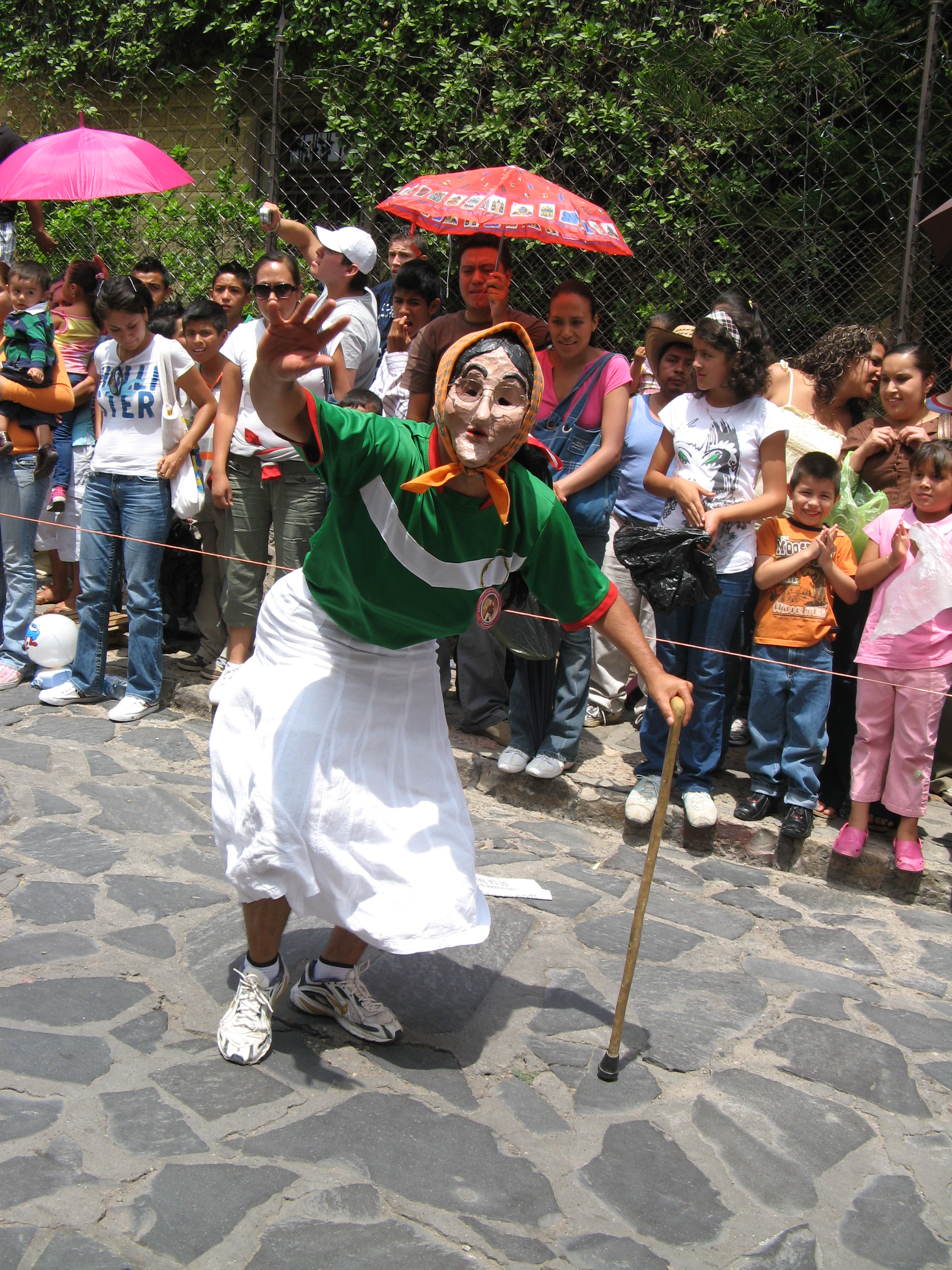
The traditional costume, apparently, is men in drag, but there is a tremendous variety beyond that.  This year’s official theme was the bicentennial of independence and the centennial of the Revolution; the unofficial theme seemed to be the World Cup; Mexico’s first game, vs. South Africa, was a couple of days off.

This man combined drag with support for Mexico’s team.  His old-woman-with-the-generous-posterior costume seemed typical, though we saw some very pretty young men as very pretty young women, too.

Now this would intimidate the South African team:

Joy took, I am not exaggerating, almost 300 photos (almost all of these are hers).  Here’s a tiny sample.

A couple of scary monsters on their way to the parade starting point.

Catrina, perennially popular

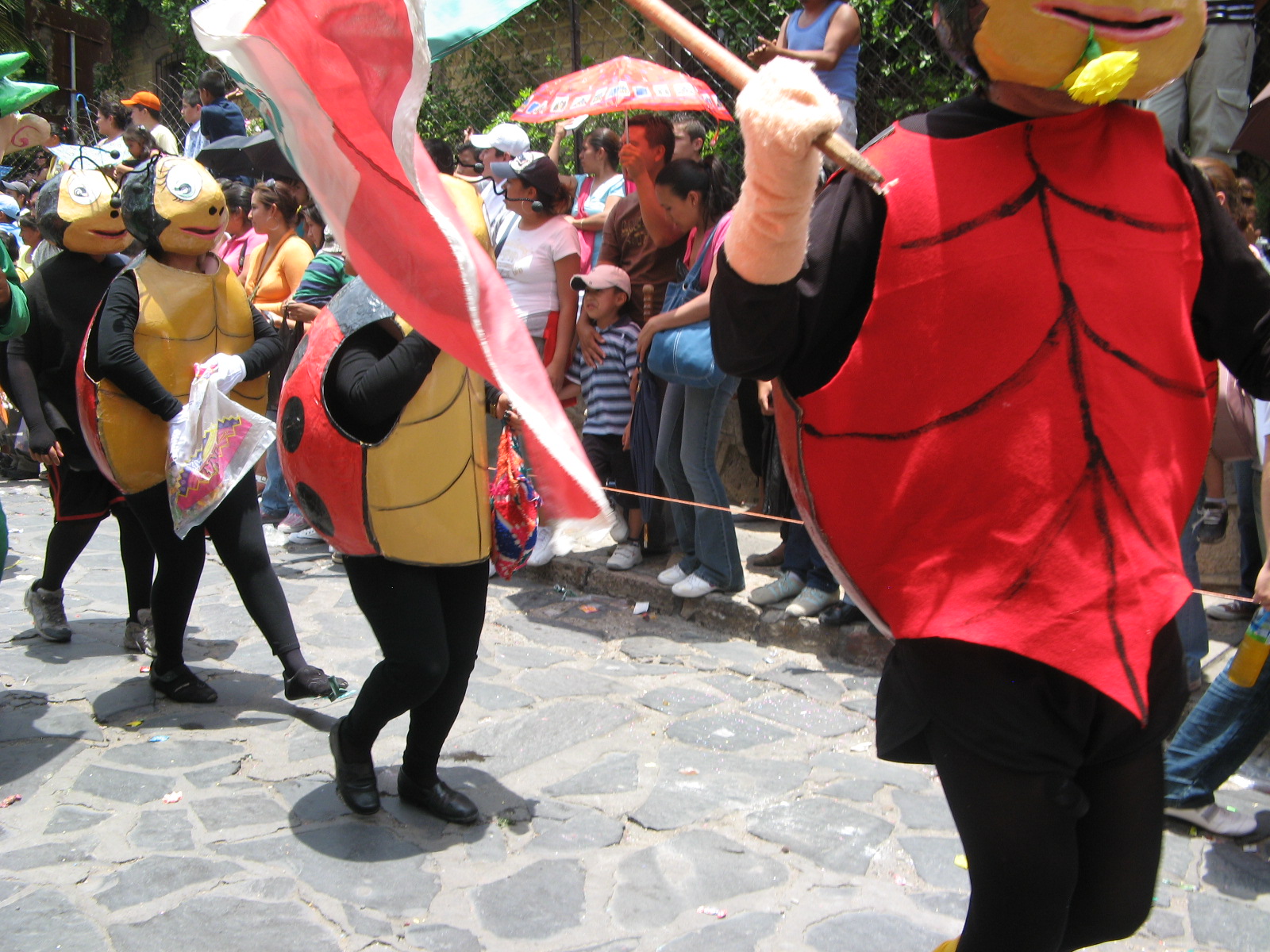
The contingent from Via Organica, the organic market, dressed as beneficial bugs.

I liked the decorations on this truck.

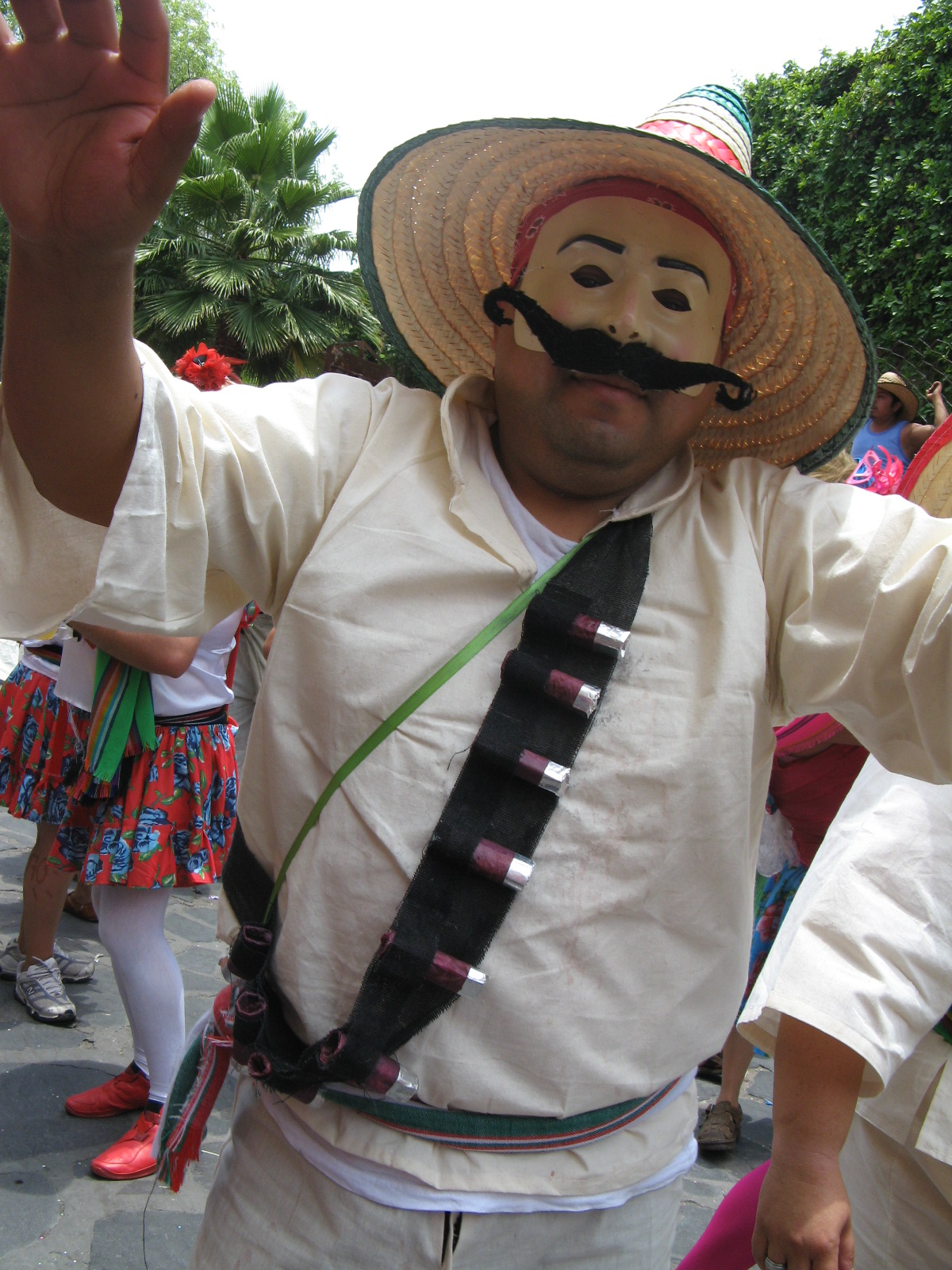
Oh, right, the theme! There were a lot of Pancho Villas...

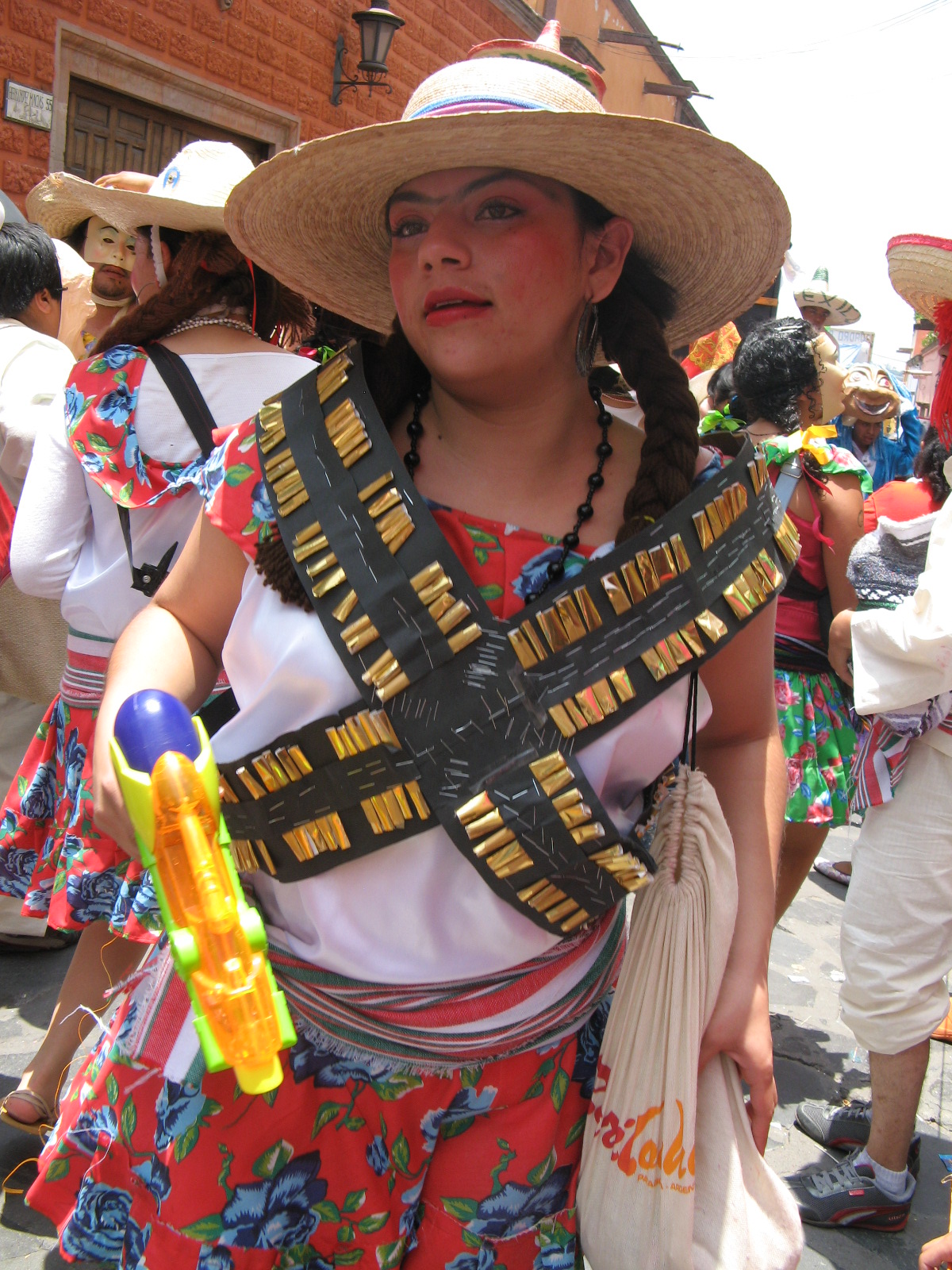
...and other revolutionaries. Was the Revolución won with squirt guns, do you suppose? She also has the bag of candy that many participants carried. They threw what must have amounted to a ton of dulces into the crowd.

The parade went about an hour too long and at about 20 decibels beyond my comfort level; I was in the early stages of a flulike thing that ended up being a very persistent sore throat and earache.  (I had terrible tinnitus for a few days, which was probably caused by a combination of my congestion and the unbelievably loud music from the floats and, the previous evening, the dance music at the related church festivities.  Judging from San Miguel, Mexicans must all go deaf at an early age, because they don’t seem to believe in setting the volume at anything below earsplitting.)  But just the same, it was an event to remember.  If we manage to be in San Miguel for another Día de los Locos someday, we’re going to find a friend (or a stranger who wants to make a few pesos) with a rooftop along the parade route, and I’m going to bring earplugs, and I’m sure we’ll take another 300 photos and have a great time.

#5 of 20 things I’ll miss about San Miguel:

I love how entrepreneurial people are in Mexico.  An old woman will spread out a sheet on the side of a road and sell jewelry; a house in our neighborhood seems to have a perennial yard sale going.  Lots of people who most likely have other jobs will earn a little extra by putting a table in their doorway in the morning to sell bread, pastries, jello, and juice to people on their way to work and school.  (Once I saw a guy drinking a raw egg & Tres Coronas sherry.  *shudder*)  One place right around the corner from us has been a great place to pick up a muffin on our morning walk to the munchkin’s school.  A couple of hours later, the table is gone, to reappear the next morning.

photo by Joy Morgenstern

One thing that makes this possible is the marked lack of permit requirements.  On balance, the lack of regulation in Mexico is a bad thing.   I’m sure lots of children die here every year from riding on their parents’ laps in the front seat of the car (there is a seatbelt law for kids, but clearly the cops don’t enforce it).  For that matter, I’m sure lots fall out windows, going by how flimsy our screens are, and in the US a house would not be legally put on the rental market, thank goodness, with the 18-inch gaps in the stairway railings ours here has (we filled them in with rope).   I’m sure Mexicans get very badly hurt from situations like the uncovered manhole I walked by (not, fortunately, into) that didn’t even acquire any warning cones until it had been that way for several hours.  In California, no one without a commercial, inspected kitchen can produce food for sale, while here, eating a paleta (popsicle) the vendor made with his tap water is a good way to get amoebic dysentery, even  if you’re a native and accustomed to the germs.  But the silver lining of Mexico’s laxness is pictured above.  I’m watching my weight, but I’m going to have to have one more of those chocolate-chocolate-chip muffins before I leave.

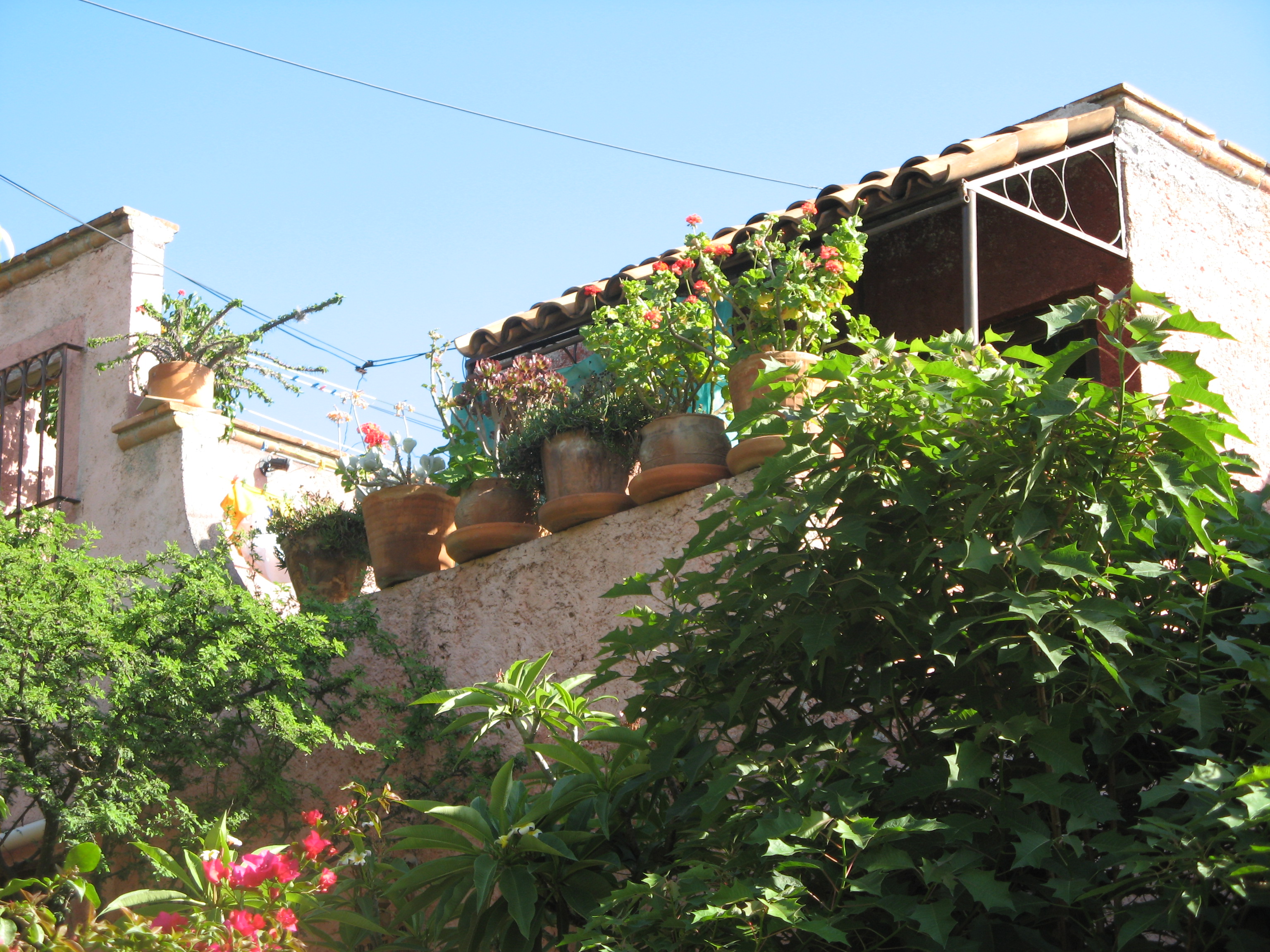
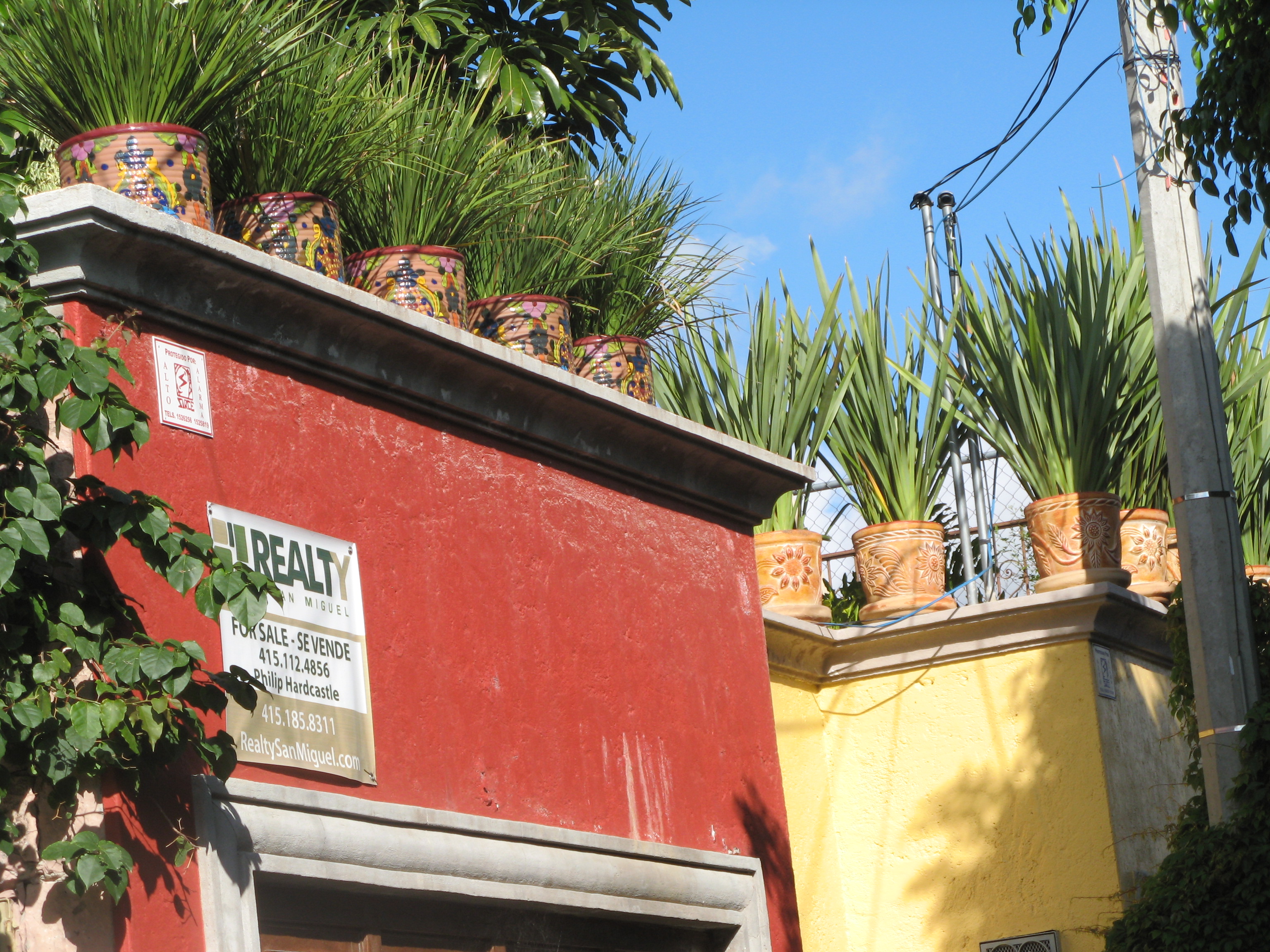
People here make full use of rooftop space. They eat, play, do the laundry, and plant whole gardens up there. Some gardens are quite formal:

This one has cypresses, for crying out loud! And looks lovely, if the building is a little rich for my blood:

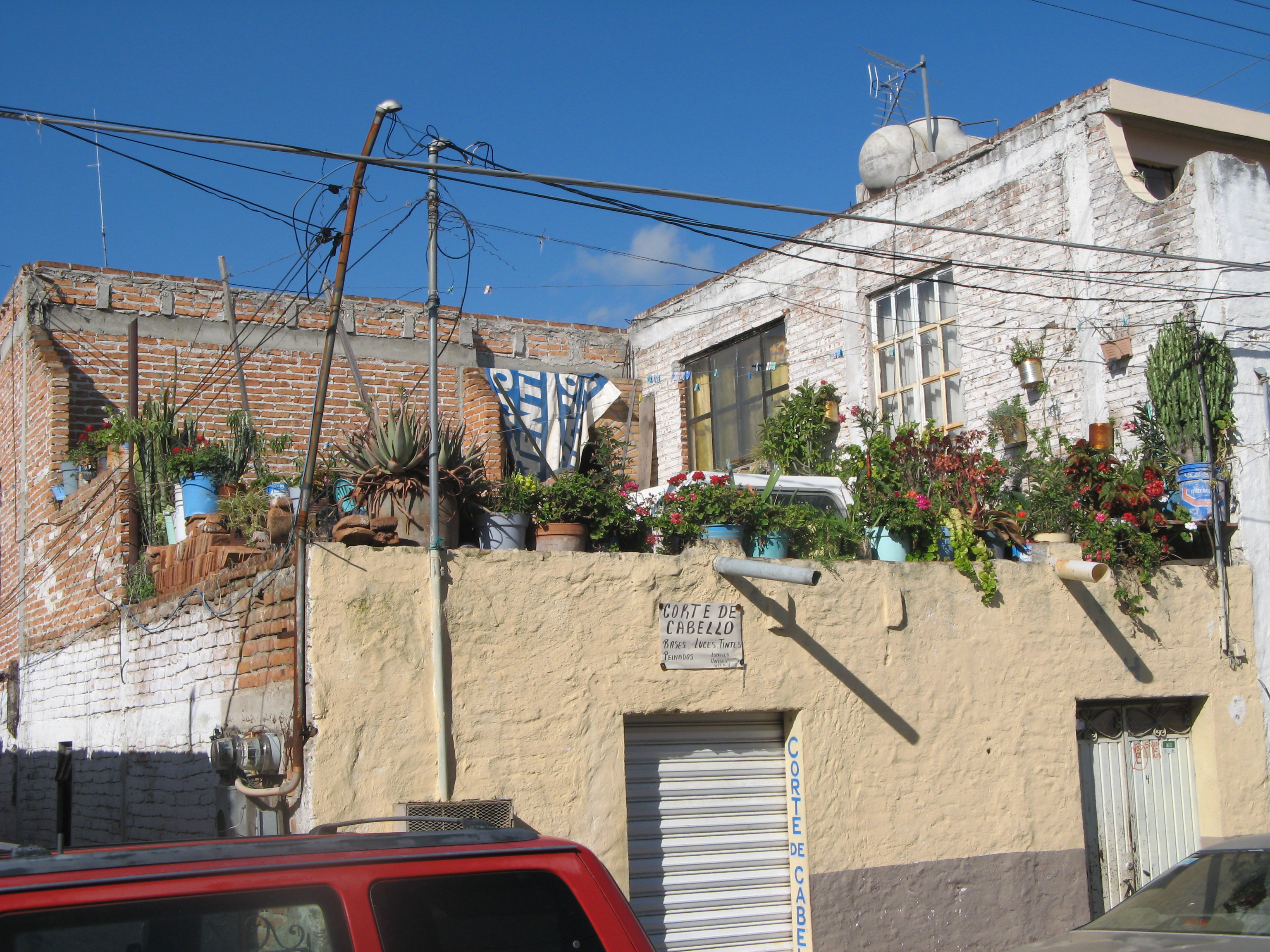
One of my favorites is this cram-something-into-every-can, let-it-all-hang-out demonstration of abundance right across the street from our house. The shop downstairs is where Munchkin gets her hair cut, and is owned by the same people who live here–actually, they don´t just live above but more or less in the shop, since whenever we go there the kids are hanging out watching movies in the same room where their mom cuts hair. She needs another trimming of the bangs; when we go, I’ll have to summon up my Spanish and ask about the garden:

(Things I’ll miss about San Miguel, #4 of 20)

Emily Dickinson, #1055 ("The Soul should always stand ajar")

The Soul should always stand ajar
That if the Heaven inquire
He will not be obliged to wait
Or shy of troubling Her

Depart, before the Host have slid
The Bolt unto the Door —
To search for the accomplished Guest,
Her Visitor, no more —

Emily Dickinson, #1055

photo by Joy Morgenstern

Our neighborhood, Colonia San Antonio, is pretty working-class, and residences and businesses are all mixed together. (Actually, this mix is typical throughout the city; only some new, built-for-gringos neighborhoods follow the pattern of US suburbs, with tracts of housing uninterrupted by anything as useful as a grocery store.) Add to these factors a relaxed attitude toward time and a welcoming attitude toward children, and you get a walk home from school that is utterly fascinating to a three-year-old who loves to watch people making things.

Her favorite stop is a carpentry/cabinetmaking shop two blocks from school, where the whine of machinery tells us we’re getting close, and then the smell of pine tells us we’re there. Munchkin wants to know everything: What are they making? What is he doing? What are these curly things on the floor? The man who seems to be the chief carpenter always stops his saw when he sees her and squats down to talk to her, and to give her some of the wood shavings.

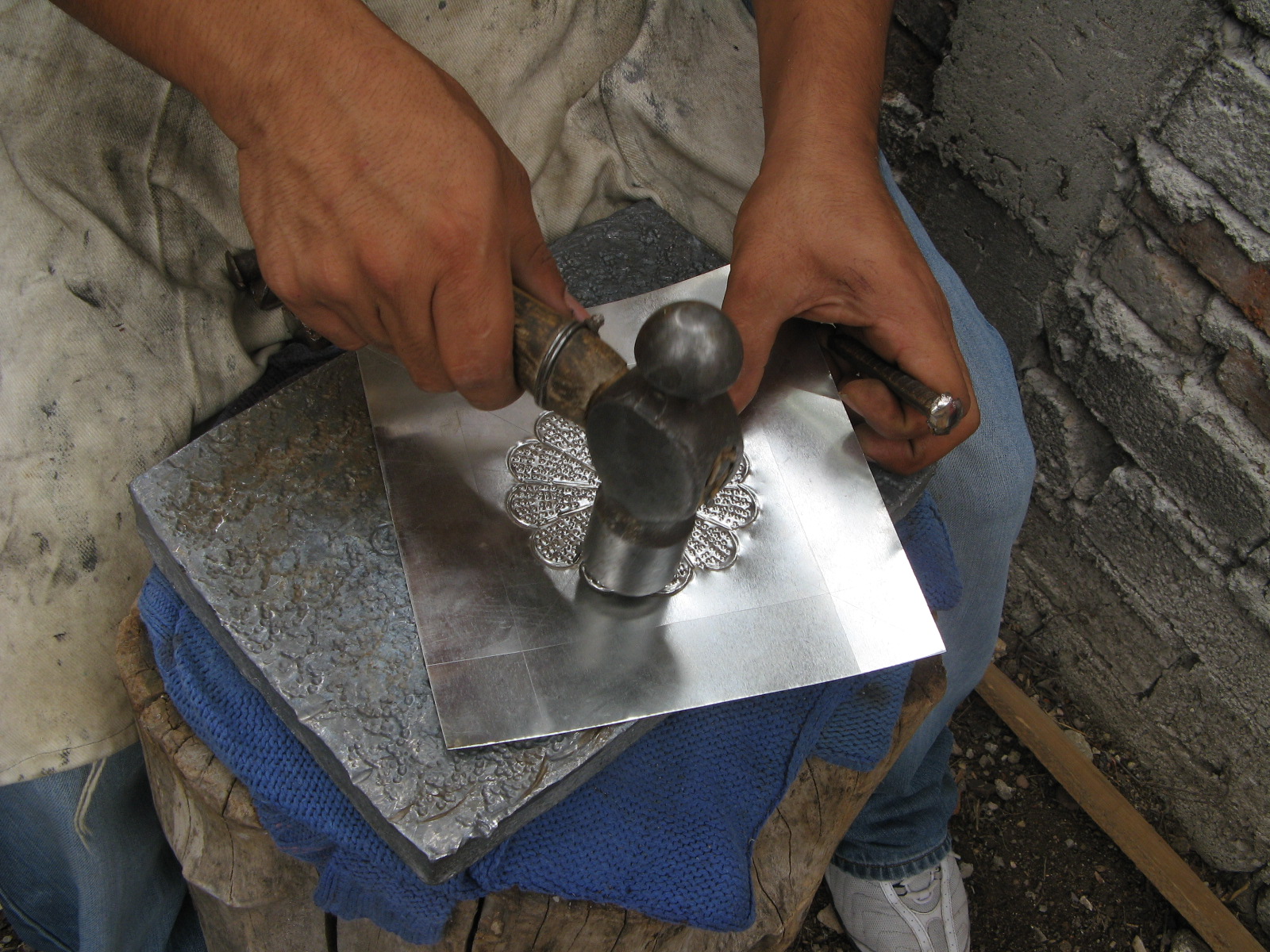
A few doors up from the wood shop is some kind of metalworking shop; we haven’t seen it open that often, but one time someone was welding inside, throwing exciting sparks, and we always hope to see it again.

If we take a different route home from school, we pass a mechanic who is just as willing as the cabinetmaker to stop and explain what he’s doing, and whose work is just as fascinating to the munchkin. She thinks it’s very cool that he can put cars together. I tell her maybe one day she’ll be able to do it herself, and she’s pleased by that idea. It will probably still be a useful skill in 20 years–or, if we dare to hope that private cars will be rarer than today, there will still be some kind of engines to repair.

On the street just by the San Antonio church, another mechanic shop seems to be right out in the street. It first caught our notice when there was a taxi out front in a sad state. We walked by it a few times, not realizing it was there to be repaired (I thought it looked like a car by the side of a New York City highway after the chop shop has gotten to it), and then one day a man was working on it and we realized that the whole street is the extension of a mechanic’s yard on the same block. Munchkin wanted to watch him work on the taxi, so we sat up on a wall next to the sidewalk for a long time and talked about what he was doing, which was soldering new parts onto the inside of the hood. He didn’t mind at all. The munchkin was very interested in all the things wrong with the taxi; I was impressed that with broken windows, no wheels, and a devastated front end, it was still going to be fixed up and put on the road again. It has long since left the mechanic street, so who knows, maybe we’ve ridden in it since.

We pass two tortillerias on the way home, one of which is right around the corner from our house. There are plenty of places where you can see women making tortillas by hand, or more often, gorditas (thick tortillas that are cooked, cut in half, and filled like a pita), but the tortilleria has a machine. If it’s running, we’ll stop and watch the tortillas come out of the machine onto a neat stack, just like the kids in a book the munchkin loves from the San Miguel Biblioteca, Sip, Slurp, Soup, Soup – Caldo, Caldo, Caldo. I think it looks like a big improvement over making each one by hand, but still a really hot place to work on a June day. The lady at the counter always gives the munchkin a warm rolled-up tortilla, even though we’re no one’s dream customers, the way we buy tortillas by the paltry quarter-kilo.

Munchkin loves to watch people work. So do I. Usually I’m shy about it except in the few situations where the workers expect an audience, such as at a crafts fair where someone is throwing pots on the wheel, or a factory tour. When I was a little girl, a big attraction of going to Pepe’s Pizza was how I’d spend the time waiting for the pizza to come: I’d watch the guys in the big open kitchen ladling sauce onto the dough, slapping down the mozzarella like they were dealing cards, and then sliding the pizzas in and out of the brick oven on their enormous wooden spatulas. When I went back as an adult and stood there watching, the nearest cook kept looking up in a disgruntled way. I hope he isn’t like that with kids, just with adults. Maybe the people in our colonia wouldn’t be so comfortable with my standing there if I didn’t have a three-year-old holding my hand, but all I know is they always seem happy to see Munchkin and to take a moment to chat.

Most of the places we’ve lived, this kind of work takes place behind closed doors and we don’t get to see it in action. Walking through this colonia makes me feel a little like Shevek, in one of my favorite chapters in one of my favorite books, The Dispossessed, when he first comes to Abbenay, and walks through the courtyards where people are building, dyeing, and doing all the other work of a city: “nothing is hidden.”

(#3 of 20 things I’ll miss about San Miguel)

Things I’ll miss when I leave San Miguel:

The fruits and vegetables. They’re just better here. We speculate that the produce isn’t bred for its ability to endure long trips or a perfect appearance, and so flavor can take precedence. The carrots are so sweet. Their ends soften quickly if you store them in plastic bags (paper bags are not a thing here, and we don’t have a crisper in our fridge), but oh, the taste. Also, their shape often has interesting bumps and turns; Munchkin was so amused by one curvy carrot last week that she asked me to put it into her lonchera (lunch bag) unsliced.

We had to take a photo of this grapefruit before we ate it.

They're not always this beautiful, but they're almost always delicious

You can buy fresh cut-up fruit on the street all over the center of town. The prices vary wildly from 30 pesos on the Jardin, the town square (40 on Good Friday–we were a captive market, not wanting to budge from the place where the procession was about to begin) to 15 a few blocks away, but always include a good three cups of cut-up mango, coconut, watermelon, honeydew, cantaloupe, and/or pineapple, in whatever combination you like. There are also veggies: jicamas, carrots, cucumbers, beets, garbanzo beans boiled in their shells. Some norteamericanos think street food is risky, but I figure if it’s just been peeled, it’s as safe as anything that comes out of a can, and a lot yummier. When I was taking classes in the morning, I’d often stop by one of the carts to pick up a fruit cup, eat half of it on the walk to get the munchkin, and share the rest with her as her after-school snack. Locals often like the fruit sprinkled with chili, salt, and/or the juice of the limes they call limones (they don’t use the big yellow lemons we grow in the US), but I ask for it “sin nada” and go happily down the street eating huge chunks of mango with a plastic fork.

Mexicans do love their junk food. The little abarrotes (groceries) that are on every block have a full assortment of chips and candy, and you see kids on their way home from school munching on deep-fried snacks, also sprinkled with chili. The little bags from these snacks, stained red from chili powder, litter doorways, windowsills, and the boxes holding utility meters (despite the trash cans right on the same block–the litter here is not something I’ll miss). But, unlike in the US where “fast” is pretty much synonymous with “junk” and the convenience stores don’t even carry snack-size milk cartons, here the fresh-fruit pushcarts mean there’s always one source of nutritious fast food, at least in the center of town.

What’s hard is finding organic produce. There is one small organic store in town, and if we lived in that neighborhood we’d buy all our produce there, but the little produce tienda around the corner from our house has no organics. I’ll be happy to get back to our farmers’ markets and our habit of buying mostly organic, local produce. But even when it’s locally grown, as we are lucky to be able to buy in California, we’re eating fruits and veggies that are meant to be shipped to the East Coast and around the world, and it shows in their (lack of) flavor. I wish I could bring some of these Mexican carrots back with me.

We leave for home in twenty days. Let’s see if I can post one thing per day I’ll miss about San Miguel.

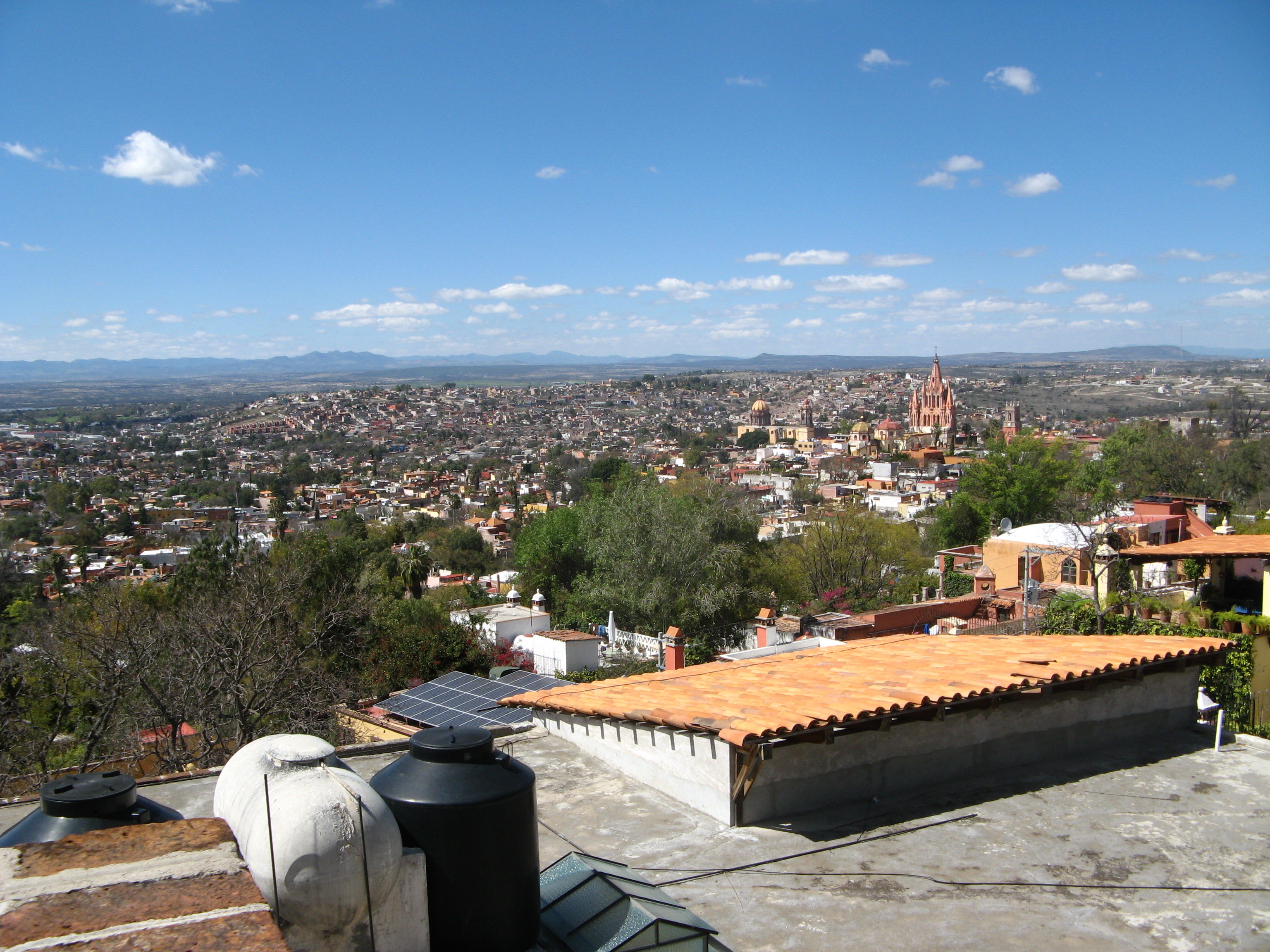
Today: its walls.

I’m getting those preaching chops back–guest-preached this morning at the Community Church of San Miguel, an interdenominational and quite liberal Christian church that was one year old this past Valentine’s Day. It’s been many years since I preached from the lectionary, and I enjoyed it. As with an art exercise or academic assignment, sometimes having to work within set constraints can be paradoxically freeing and inspiring.

The sermon

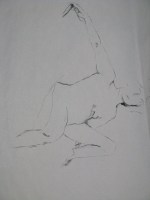
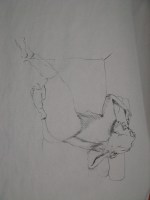
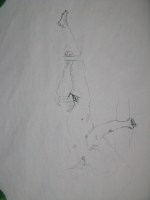
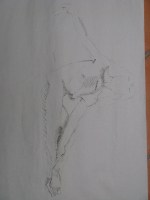
Last night I was looking over all my drawings from the Tuesday life-drawing session and Joy said, “You know what I like best about these? How much you’re loving drawing them.” I couldn’t agree more. I did not set out to love drawing during this sabbatical; it didn’t occur to me that that was possible, people who draw for pleasure always seeming like another species. I just wanted to tackle my fear of it and, I hoped, reduce that fear. Now I go off to these sessions with excited anticipation, and the two hours fly by. I do feel some trepidation when I face the blank sheet of paper and the real live inexpressibly beautiful model, but it’s minor. Amazing.

I keep thinking of a repeated theme from a book my sister used to have (probably still does), Letters to Horseface by F. N. Monjo, which comprises fictional letters from the boy Mozart to his sister. He keeps encountering this and that musician and saying “The clarinet is such a beautiful instrument–I have to write a concerto for it” and likewise about violin, flute, etc. But in the last such remark, IIRC, he decides the human voice is the most beautiful of all. That’s how I feel about drawing people. Cats, trees, stone walls, the light falling on a rooftop, are all beautiful beyond words (and certainly beyond my capacity to draw them), but nothing inspires me like “the human form divine.”

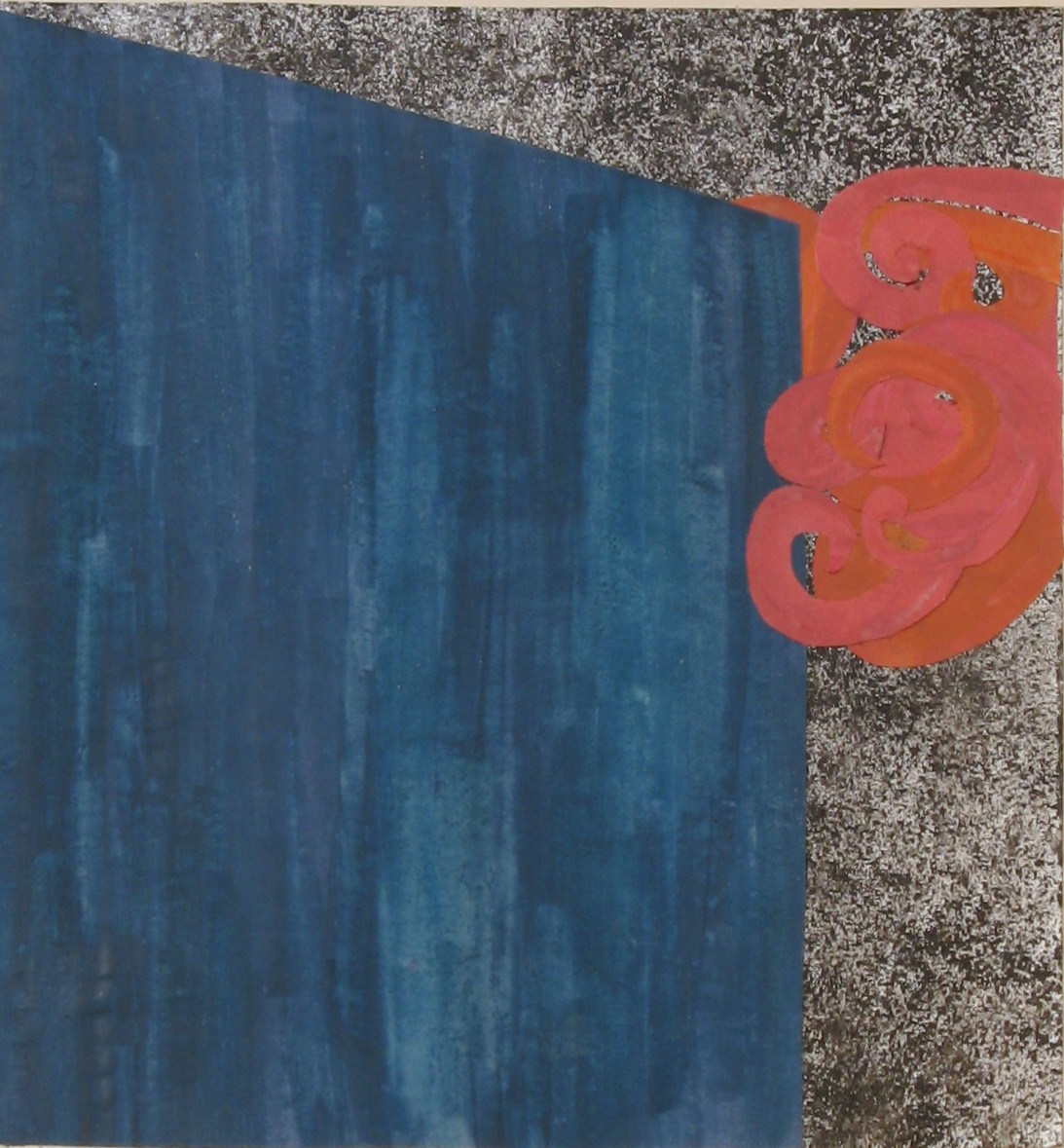
Current project: collages/drawings to illustrate Emily Dickinson poems. I’ve been thinking about this one in particular–meditating on it as in lectio divina, trying out drawings, seeing what emerges.

The Soul should always stand ajar
That if the Heaven inquire
He will not be obliged to wait
Or shy of troubling Her

Depart, before the Host have slid
The Bolt unto the Door —
To search for the accomplished Guest,
Her Visitor, no more —

(No. 1055)

By the way, ministers and other users of online quotations pages, be wary. Looking for the text of this poem, I found many incidents of the paraphrase “The soul should always stand ajar, ready to welcome the ecstatic experience” passed off as something Dickinson herself said. Typically of her, the poem is subtle and complex, and typically of internet quotable quotes, the misquote isn’t. Of course, internet quotations pages are 99% copies of other internet quotations pages. If you can’t completely trust your ear to know when something sounds like 1860 and when 2010, when it sounds like something Nelson Mandela would say in his inaugural address and when it’s more like Marianne Williamson (and who among us has an infallible ear?), it’s best to confirm the quote with Bartlett’s or some other resource that actually identifies its sources.

Enter your e-mail address to receive e-mail notifications of new posts on Sermons in Stones

Links I like