
You are currently browsing the category archive for the ‘religion’ category.
From taking my car in for its oil change on Friday, I learned something about how to welcome people to a place that’s unfamiliar to them. I’ve never gone there before and it is rather a big sprawling place. When I went to pick up my car, the service manager, without so much as a question from me, did not tell me the way to the billing desk but escorted me there, told me my car would be driven up to the front door in just a moment, told the person at the billing desk who I was, and gave me a friendly pat on the arm as she said, “See you in three months.” I felt like she was really happy to have my business (paltry though it was, especially for a car dealership whose bread and butter is definitely not oil changes) and I’ll be happy to go back there. So simple. No, I am not suggesting congregations provide valet parking (unless your parking lot is not in sight of your building, in which case you should seriously consider it). I’m saying, since I hope that we are happy to see newcomers and want them to be comfortable and come back, we should take a page from a Toyota dealership and treat them that way.
From donating blood, also on Friday, I was reminded that being able to give is deeply satisfying. The keys to feeling that way are the knowledge that the gift is within my capabilities and concrete, vivid evidence that it is making a difference. I am never going to go into a burning building to save a life; knowing that I can save a life by giving a pint of my blood gives me the sense of being critically important that I imagine firefighters experience daily. Oh, and a third key was that it was a challenge, not something I could do so easily that it meant nothing. Translation, for us congregational leaders asking for time or money from members: (1) Don’t ask for so little that the donation requires no real generosity from the giver. Being generous is a wonderful feeling, and they only get it when they’ve stretched. (2) Don’t ask for so much that they can’t manage it, or they’ll feel terribly discouraged and as if they don’t belong. (3) Have a vision for our congregation, a vision of something of great worth that is realizable only by their donations, and show them the connection. (If we don’t have such a vision, we shouldn’t be asking for their money or time.)
From going to the Maker Faire Saturday, I learned that if we lose sight of our deep purpose, people will drift away. I enjoyed it, but it seemed much less focused on what it used to be all about, empowering people to make things, and more on showing them (or selling them) the things others had made. Boo. I can get that at any shopping mall. I’ve proudly told people that my daughter has gone to every Maker Faire since her birth, starting at age two months and excepting only the year we were in Mexico. If it surrenders much more of its vision, I’m not so sure I’ll care anymore about preserving it as a family tradition.
Ah, the UU blogosphere’s a-popping with things I want to respond to at length, too much length for a comments box. Actually, one I want to respond to is a recent post by James Ishmael Ford, whose Monkey Mind blog doesn’t have comments boxes. I’ll get to that one next. Right now I’m meditating on my Palo Alto colleague Dan Harper’s post “Liberty and democracy in liberal religion.” It touches on a topic I think about a lot: the balance (or, equally, the tension) between individual liberty and the demands of community. My candidating sermon for the first church that called me, the Unitarian Universalist Church of Rutland, Vermont, was about this challenge, titled with the words of the Vermont state motto: “Freedom and Unity.”
Dan writes, and I hope he won’t sic Righthaven on me,
[T]he major attraction to Unitarian Universalists for many people in our congregations is that no one can tell them what to believe or do, and this too is enshrined in the bylaws of the UUA, in the claim to a free and responsible search for truth, which is often restated in colloquial terms as “no one can tell me what to believe.” This last attitude is in close emotional alignment with the attitude that the government shouldn’t tell individuals what to what to do with their property.
In close alignment with it, but not at all the same thing. After all, I accept limits on what individuals can do with their property, while insisting on radical liberty to decide what I will believe (I’m pretty sure Dan does too). They are, however, two things we conflate often, and at our peril.
Dan thinks that many of the people who identify as UU theologically but don’t join a UU congregation–there are, by some counts, twice as many of them as actual members of our congregations–stay away because they “find themselves unwilling or unable to submit any of their individual theological liberty to the demands of being part of a democratically organized congregation.” I think this is probably true. Those who do not wish to submit in any way to the strictures of community–I’m thinking of extreme libertarians–will not want to join a congregation, even if they identify themselves as theologically UU.
But I see the congregation as a workshop, as rehearsal space, as practice fields, as a laboratory for the larger democracy, and so I’m focused more on the people who do come to our congregations, and yet who expect that they can pretty much have things the way they want them in that micro-society because of that “free and responsible search” stuff, and of course, that “inherent worth and dignity” stuff. I’m not sure if they are wrongly extrapolating from our freedom of theological belief. It is just as likely that the reason they aren’t very clear on the costs and benefits of different kinds of freedom is that the larger culture has so much trouble accepting a concept such as “Your right to swing your fist ends where my nose begins.” We certainly don’t get “Your right to pour poison onto ‘your’ land ends where ‘your’ land includes an aquifer that lies under others’ land,” or our environmental laws would be very different. We are a much more civil-libertarian than communitarian society.
The distinction between things that are truly no one else’s business and things that do affect others substantially enough for them to deserve a say (namely, via government) is an essential one to make no matter what kind of society one lives in. It’s one with which our democracy, the democracy of the United States, still struggles. After all, it is not easy to agree on the answers to questions such as “Is whom one marries entirely a private choice, or do others get to restrict it?” “Is whether to carry a pregnancy to term entirely a private choice, or do others get to weigh in?” or even “Do I get to say anything I want to at Annual Meeting, or is some of what’s on my mind so destructive that I should bite my tongue?” That’s why we keep debating them. I don’t think we will ever resolve these questions once and for all, but if we accepted that they are not simple, but arise out of the tension between important values, we could approach them with a lot more clarity. Helping people to do that is very much in the job description of pastors, religious educators, and congregations.
Have we UUs given more attention to democratic structures than to theological liberty? I don’t think so. In any case, we definitely haven’t given them enough attention to make up for the confusion that reigns in a nation that is supposedly democratic but in which the prevailing definition of liberty is still license. No wonder people come into our churches saying “I can believe anything I want here!” and thinking it means “I can do anything I want here.” What are we here for if not to help them sort out the difference?
Tonight and tomorrow our congregation’s choir (and various other musicians, most of whom are congregation members and staff) is putting on a concert, A Nation of Immigrants. The centerpiece is a mass by our music director, Henry Mollicone, a noted composer who is also, this year, a composer-in-residence here at the Unitarian Universalist Church of Palo Alto. Ever since Henry became our music director, he has forged a connection between social justice and music. This piece, Misa de los Inmigrantes, alternates the elements of the Latin mass (here sung in Spanish) with narration, in English, telling the true story of a recent immigrant from Mexico. Another concert a few years ago featured his Beatitudes Mass, which also integrated interviews with real people, in this case homeless people; Henry stipulates that all proceeds from performances of this piece benefit the homeless. Tonight’s concert splits the proceeds between the Day Worker Center of Mountain View and UUCPA.
Music and justice are a natural fit for our congregation, and Henry has helped put them together in other ways, for example enthusiastically generating a list of pieces for a Coming Out Day service in which I requested that all of the music be by LGBT composers and librettists. I’ve been thinking about other ways to use our love of music, and the power music has to change hearts, to take it out beyond our worship services. How about a congregation-based Threshold Choir? Sending small groups to sing or play at hospitals, assisted-living facilities, shelters, or hospices? (As a teenager, I was very moved by caroling with my mom and a few other members of the New Haven Chorale at Yale-New Haven Hospital on Christmas Day.) Creating a group that sings songs of work, struggle, and peace? Creating musical groups whose membership intentionally combines members of the congregation and other groups such as recent immigrants (our area has a zillion), veterans (ditto), or people without homes (ditto)?
Pope John Paul II, it is now clear, put enormous effort into covering up the sexual abuse of children by Catholic priests, which enabled it to continue. Then the Vatican invited Cardinal Bernard Law, of all people, to lead one of the Pope’s funeral masses: a great honor to Law, a rebuke to those who dared criticize him for actively covering up child molestation in his archdiocese of Boston, and an unmistakable message that he had the late Pope’s full approval. And now the church, including Pope Benedict, is rushing to make John Paul II a saint.
“Saint” has a very specific meaning in the Roman Catholic Church. To be canonized, one must be a confessor of the faith, martyr and/or miracle worker. But even so, the word also carries its common meaning of “person of extraordinary virtue or benevolence.” Apparently that meaning is being suspended in this case.
Leadership is a partnership. Just as some of my peak moments occur when I am helping to bring out the best in my congregation, others occur when the people of the congregation are bringing out the best that I have to give. I had one of those moments this past Sunday. I’d changed my topic the moment I heard the news (and oh, how glad I was that I’d turned on the computer. I could have found out about Tucson on Sunday morning on my way in to church . . . ). I didn’t have the kind of time for reflection and writing that I usually do, but that was how it had to be.
Looking down at the mishmash of paragraphs and margin notes and don’t-forget-to-mentions in my hand as I came to the pulpit, I was very tempted to preface the sermon with an apology, which was really an excuse: “Please bear with me if this isn’t as cohesive as I’d like. I was up most of the night, I’m sure you understand . . . ” But that would be a disservice to the listeners.
So I just plunged in. I spoke from the heart, and a bruised and uncertain heart it was, and I could do that because my congregation values it. Sure they want the preacher to make sense, but they care most about passion and are willing to bounce over the rough spots. Because they’ve made that clear, I could let go of my own nerves about wanting to give a more polished presentation than was possible, and give them the passion. They are making me a better preacher all the time. I’m so happy they’re my partners in this ministry.
Our Sunday morning worship theme for the month of January is “home.” We kick off the canvass this month as well, so I’m thinking a lot about the idea of one’s congregation as one’s home. It’s a common enough metaphor, but what does it mean? It depends on what “home” means. If it means “comfort,” I’m not crazy about that being a primary quality of any congregation I belong to (and/or serve). I want it to be comforting, absolutely, when we need to be comforted. But not entirely comfortable.
Tangentially, but not unrelatedly, I’d like to pass along this New Year’s wish from the blog of a favorite writer of mine, Neil Gaiman: “May your coming year be filled with magic and dreams and good madness. I hope you read some fine books and kiss someone who thinks you’re wonderful, and don’t forget to make some art–write or draw or build or sing or live as only you can. And I hope, somewhere in the next year, you surprise yourself.”
I wish all those things for myself in 2011, and for anyone who reads this. And now I am going to turn off the computer, go kiss two someones who think I’m wonderful (the feeling is mutual), and get some sleep in the hope that tomorrow morning I’ll be able to say some words as only I can say them, and so help my dear, beloved co-congregants to live as only they can.
On Saturday, we went to the annual Our Family Coalition multifaith holiday party, held at St. Gregory of Nyssa in the Potrero Hill neighborhood of San Francisco. Aside from the pleasures of getting together with lots of other LGBT parents and their kids, I was looking forward to seeing the inside of this church again.
In the center of the rotunda is the table where they serve communion, and carved on it are words about Jesus welcoming sinners to his table. (On their website, they say, “We welcome all people–especially strangers—to communion.”)
Then, up above, all around the inside of the rotunda, is a gorgeous mural of several dozen dancing figures, led by Jesus, Lord of the Dance. These “Dancing Saints” include actual saints of the Episcopal Church and many other saints chosen by the congregation in partnership with the artist, Mark Dukes. Malcolm X holds hands with Queen Elizabeth I; Charles Darwin’s hand is on Saint Symeon’s shoulder. Cesar Chavez dances along in front of Anne Frank. Many of the dancers are barefoot (if not totally naked, as is King David); many wear sandals; Eleanor Roosevelt wears loafers. All have haloes. It’s almost enough to make me want to convert to Episcopalianism and join this church.
Okay, to be honest, it doesn’t come close. I am just never going to be a Christian. But I can’t stop smiling when I look up at those dancers. What I love about St. Gregory’s is not only that this beautiful mural reminds me of the people I also wish to emulate, but that they have done three things any religious community needs to do to thrive: they have proudly laid claim to their tradition; they have given that tradition a form particular to their time and place; and they have declared in a beautiful, striking, and literally indelible way what they stand for. Walk into St. Gregory and you know that their religion is about joyously welcoming everyone into a circle where all may eat and, more, celebrate.
And they do dance in their services . . .

Dancing along with the saints (c) 2006 David Sanger
. . . and from the reports of those who’ve gone to services there, they keep the promise made on their altar and their website–all are welcome. They host a weekly food pantry and it is held around the altar, under the dancing saints in the rotunda. And of course they welcome our families every year.
Fun assignment for membership committees (worship committees, altar guilds, buildings and grounds committees, etc.): pretend you are a visitor to your congregation. What do the architecture and art, the chosen or accidental icons of your space, communicate about the congregation’s purpose? Do they get it right?

Icon of Sojourner Truth by Mark Dukes; Photo (c) 2006 David Sanger
San Miguel is a great place for a religion junkie, a category to which I definitely belong. By all accounts, this town has even more fiestas and religious holidays than most places in Mexico. This week, Semana Santa, is peak season, but there’s a lot to celebrate even before Holy Week gets going.
We deliberated for several days about what to do about Pesach this year. Our ideal is to host a Seder and invite friends, but most of our friends are 1500 miles away (or more), and we had trouble reaching the few we do have here. We looked into the San Miguel Jewish community’s Seder, but their response to “would a three-year-old enjoy it?” was not very encouraging. So we decided to just have a Seder for the three of us, with Joy cooking and me in charge of creating an abbreviated Haggadah.
Then, a few hours before the Seder, Joy saw an e-mail from a woman looking for a child-friendly Seder for her and her six-year-old son, K. We always have more food than we need, so we called them, they came, and we were so glad they did. They were really nice, interesting people; they’re UUs too; the munchkin and K hit it off (what a find, a six-year-old who’s happy to play with a three-year-old!); and having them here made our holiday complete. Eating dinner with just our family is lovely, but for the holidays it doesn’t feel quite right.
It was a funny business, creating the Haggadah. I’ve done it almost every year for several years now, for our church Seder, but having to really cut out most of it brought home to me what a crazy conglomeration and compilation it is. It shows all the signs of having been built by accretion; not just the recent, feminism-inspired additions like the orange and Miriam’s cup, but many elements, have been incorporated in response to some need or political moment that’s fallen into the obscurity of history. The four children, for instance; when did that come along, and why? All the lists and formulations, like the singing of the order of the Seder itself, and the “matzah, maror, pesach” bit—where did they come from? Why the four cups of wine? What does Chad Gadya have to do with Passover? Reading a typical Haggadah is like a walk through Jewish history. I’d love to see one that includes the works, with annotations about how each element entered the flexible canon that is the Haggadah.
What follows is what we considered essential and absorbable by our daughter. She has been to four or five Seders in her three years, starting with the one we held with close friends at home when she was a month old, but I don’t think she remembers anything from any previous ones. If she remembers anything from this one a year from now, I’m betting it will be playing with K, and the prizes they won.
(ETA that I notice a lot of people are finding this entry via searches for “unitarian haggadah” or “abbreviated haggadah” or the like. So if you’re wondering if you can use this, yes, and if your family doesn’t do “mad face” or blessings in Cat, adapt it to your own kids. Just please credit me, and make it clear to whoever uses it that it is drastically edited out of the vast realm that is the Haggadah.)
At home, before we eat, we all take hands and say “Thank you for the food.” The speaking of the words usually falls to the munchkin, who delights in adding variations: “Thank you to Mommy/Mama for this wonderful dinner,” “Thank you for the shrimp and the noodles and the carrots,” and the like. When we got to Mexico Joy and I proposed saying it in Spanish as well every time. Munchkin responded by adding a third language, one in which she is fluent, and after she’s informed us as to which one will be said by whom, the family meal now begins something like this.
Joy: Thank you for the food!
Me: ¡Gracias por la comida!
Munchkin: Meow!
In such ways do we make rituals our own.
Speaking of which, we went to a fabulous fiesta Friday night, where the image of Jesus “Señor de la conquista” is carried out of the Parroquia (parish church) amid fireworks, dancing, and drumming. The article in the local paper says the fiesta is held “porque el catolicismo conquistó a los indios,” but, while I’m not dismissing the real, frequently devastating impact of Catholicism on native religion, the overall impression I got from the festival is that los indios and their pre-Catholic religious practices are going strong.
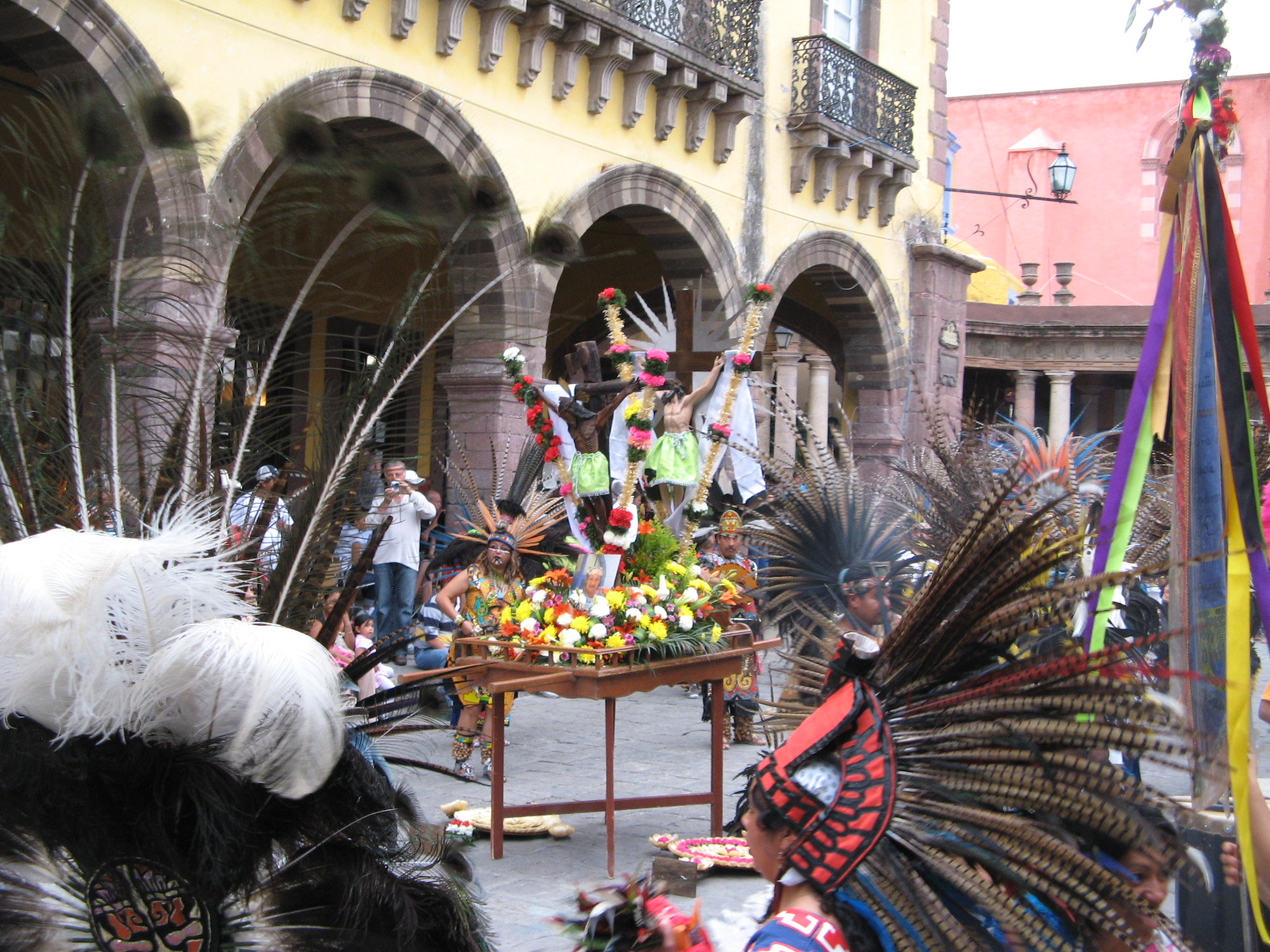

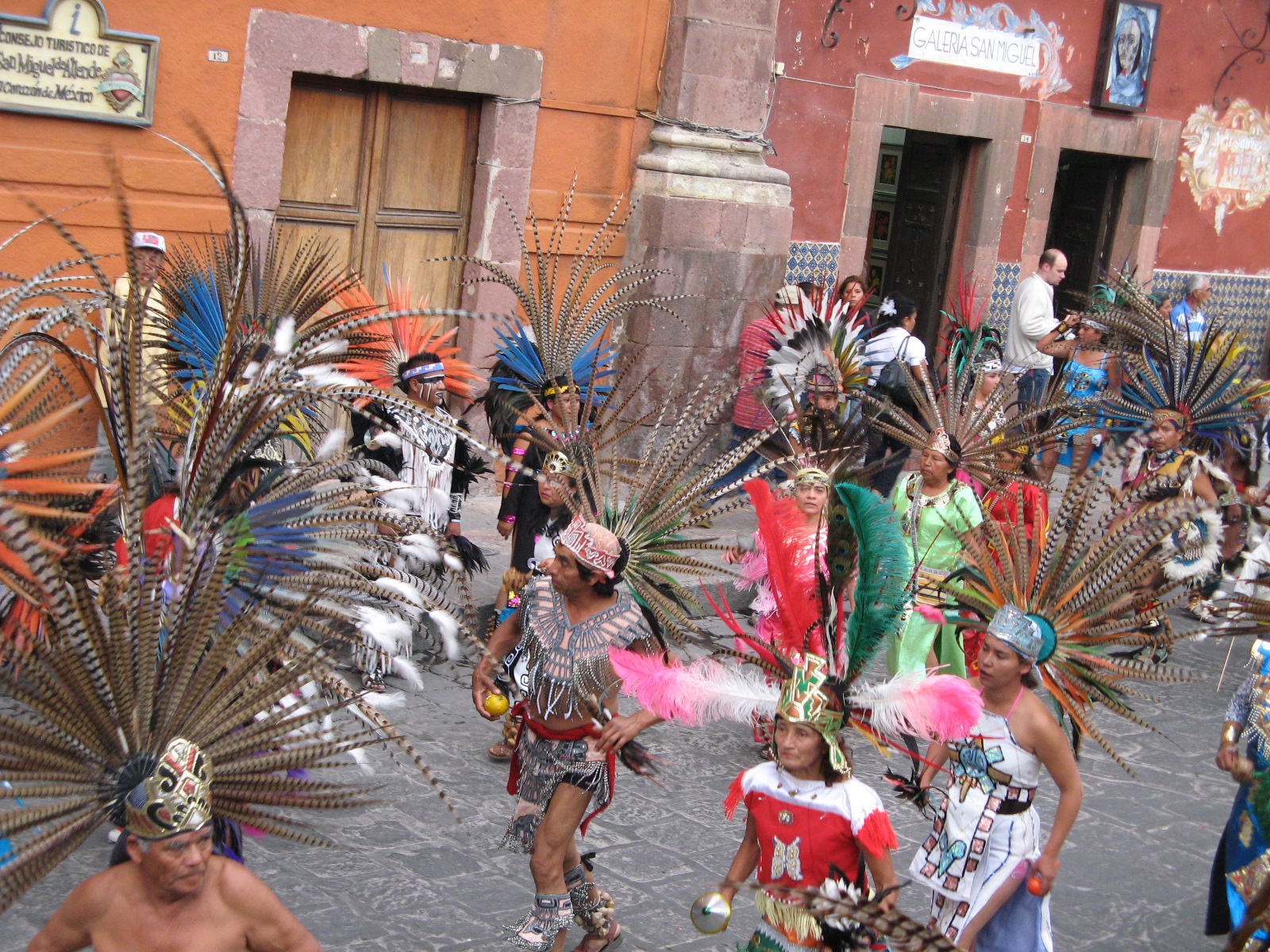
People of all genders and ages danced and drummed. The munchkin declared this guy “scary” but loved the whole event. We thought she’d want to watch for a few minutes and then eat dinner; an hour later she was still mesmerized.
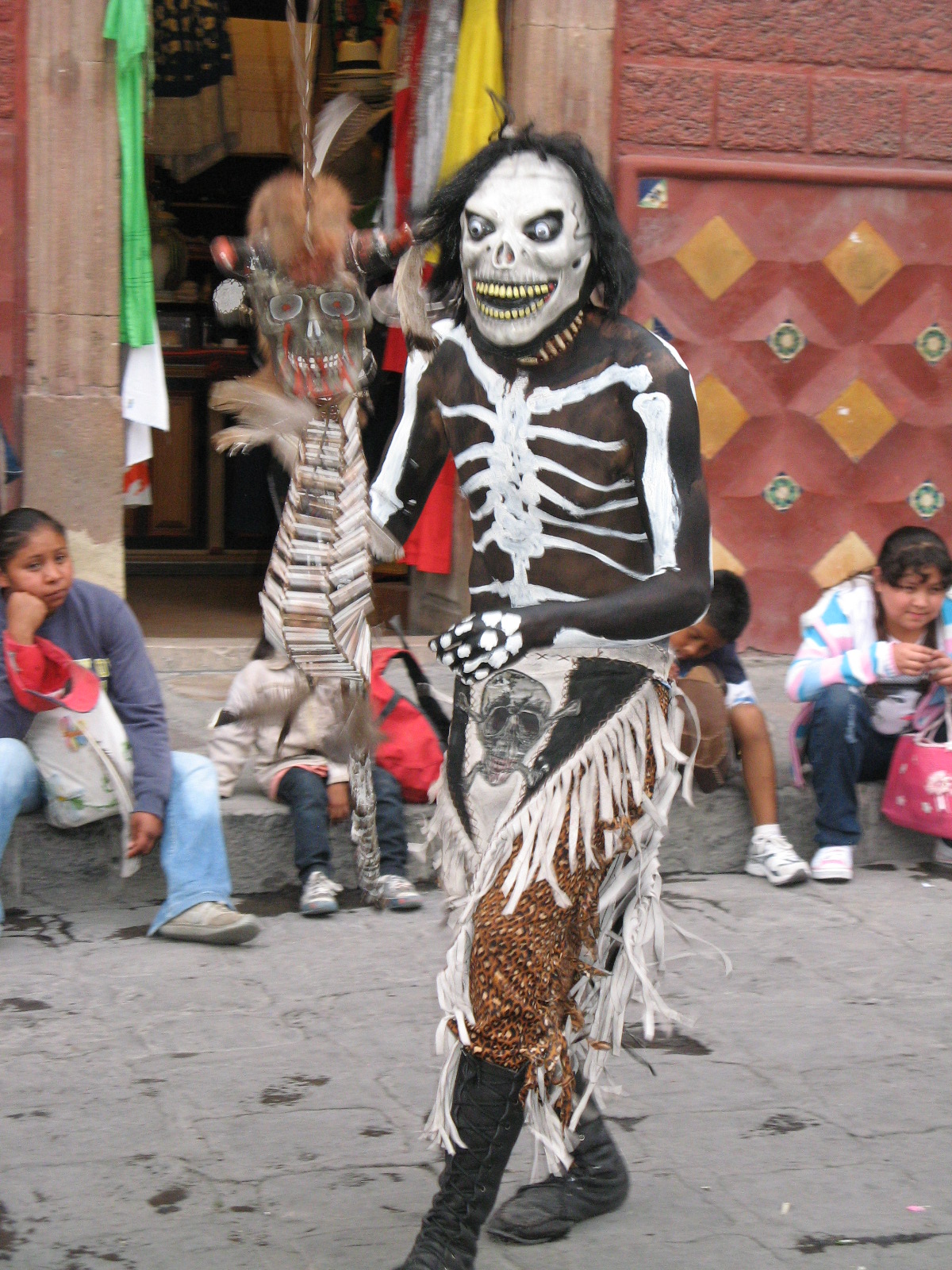
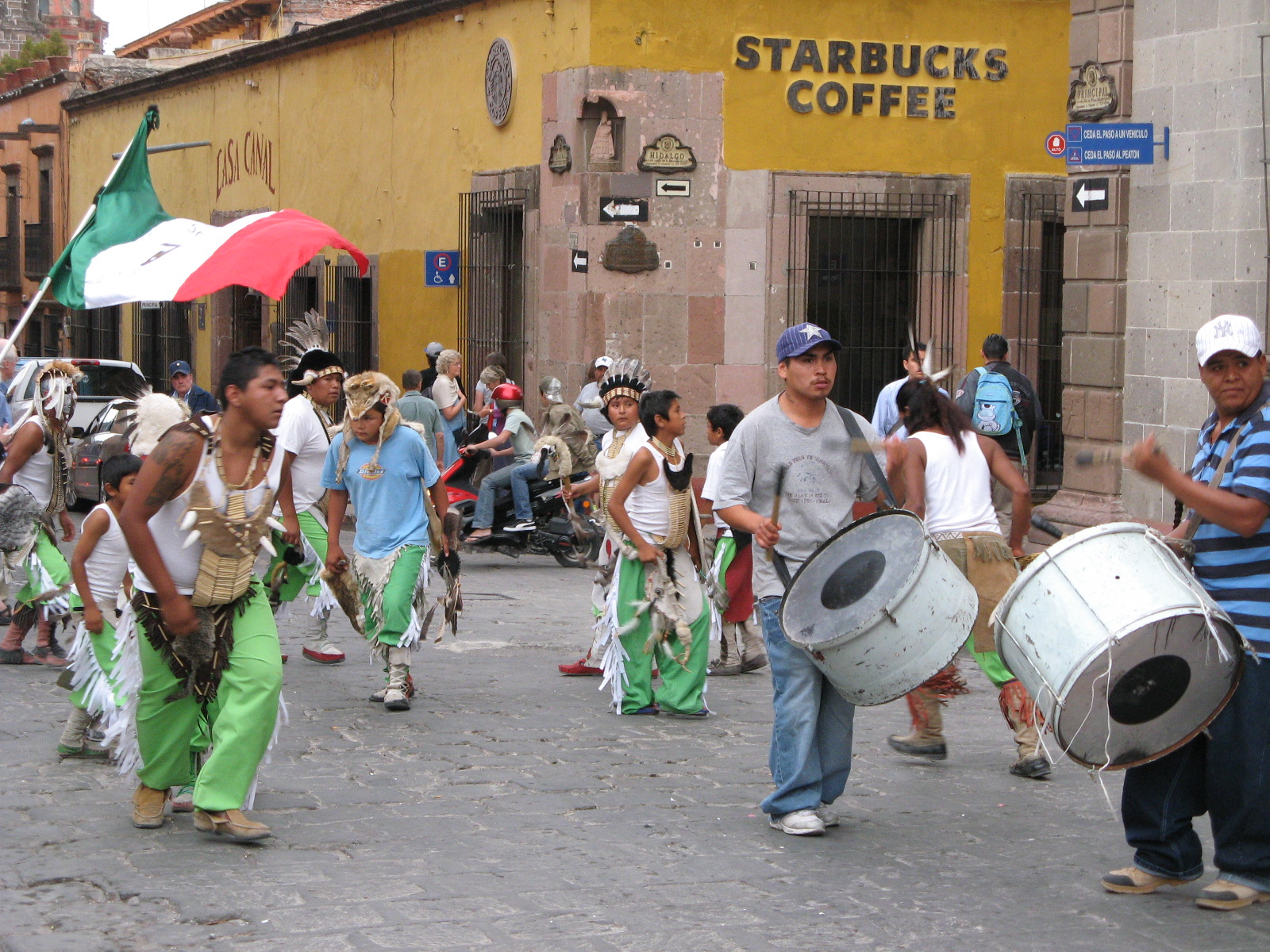
The good old Catholic church. “Fine, keep your feathers and your drums and your heathen dances, as long as you add Jesus into the mix.” (Mexican national pride is part of the mix too, as you can see from the dancers carrying the flag.) I’m betting this relaxed attitude toward syncretism is a more successful way to spread the word than uptightly insisting that indigenous people wear trousers and sing Wesley’s hymns–in short, imposing European cultural forms that are not inextricable from the religious concepts.
I make this assertion knowing almost nothing about missionary history. However, I think it’s a point to ponder for people concerned about church growth and diversity. What would Unitarian Universalism look like if we (meaning those who currently “own” it, a term I use ironically) relaxed a little more about the forms it takes on as it comes to different cultures (or subcultures) than the white, English-speaking, Calvinist-descended people among whom it largely originated? I don’t want us to conquer the natives, but I would like everyone who feels the call of Unitarian Universalism to be able to respond, and meet with a warm welcome instead of skeptical looks from those who are at home with the Protestant worship structure and European classical music that dominate today. It will look different in other hands. They will change it for themselves and, in some part, for everyone. If that means dancing like we saw Friday night, it sounds like a win-win to me.

 Sermons in Stones
Recent comments