
You are currently browsing the category archive for the ‘family’ category.

A sanitation worker in downtown Lima. Photo by Manfredwinslow (public domain)
“We are challenged on every hand to work untiringly to achieve excellence in our lifework. Not all men are called to specialized or professional jobs; even fewer rise to the heights of genius in the arts and sciences; many are called to be laborers in factories, fields, and streets. But no work is insignificant. All labor that uplifts humanity has dignity and importance and should be undertaken with painstaking excellence. If a man is called to be a street sweeper, he should sweep even as Michelangelo painted, or Beethoven composed music, or Shakespeare wrote poetry. He should sweep streets so well that all the host of heaven and earth will pause to say, ‘Here lived a great street sweeper who did his job well.’”
My daughter (age 4 1/2), this afternoon, on seeing a street sweeper:
“That man is being good to the earth. He’s picking up the garbage . . . his mind is like our minds. He says the earth is for walking on, not the earth is just a garbage can.”
To a mind free of prejudice, heroes are everywhere.
In my “43 goals for year 43” I promised myself I’d fly a kite this year. I bought one, ostensibly for the munchkin, almost two years ago; Joy and I were enjoying a lovely couple-alone weekend in Bodega Bay, freed by our dear friend Wendy’s taking our daughter into her home for a couple of days, and of course we mostly talked about Munchkin and bought her a couple of presents. She was really too young for a kite, but I picked out one I thought she’d like–a ladybug–and explained to her what it was. We brought it to the beach on one glorious day several weeks ago, but it was so glorious that there wasn’t enough wind to raise a kite. Yesterday we took a trip to Venice Beach, in Half Moon Bay, and this time the kite flew.

photo by Joy Morgenstern
It was so simple, so unthrilling, really. The munchkin gave it a single smile and then went on with the more exciting business of writing in the sand. Joy said, “Yep, it’s a kite.” I’d deliberately bought a very simple kite, fearing that a two-string trick jobbie would be beyond us. Once it was flying and I’d admired it for a moment, there was nothing to do but tie up the string and read my book or look at the ocean (which meant turning my back on the kite, since of course the wind was coming from the water).
But I kept looking up at it, feeling very moved, and it wasn’t until then that I realized why I had even cared about flying a kite, and why I’d thought of it as a difficult thing to accomplish. It has to do with the kite that hung in the back of my closet through all of my growing up. I have no recollection of ever flying that or any kite in my life. Maybe I did at some point and have forgotten, but what I chiefly remember about kites is frustration. We bought it and tried it at a local park; it didn’t fly; it came back home and sat in the closet for the next umpteen years, a silent reminder of a bit of fun that, literally, didn’t get off the ground. At some point a friend and I made another one of paper and string, but of course that had even less of a chance of working. We probably only had bad luck at that day at the park, but kite-flying stuck in my mind as something tricky and elusive.
It wasn’t a big deal; I haven’t borne a kite-shaped scar on my soul for 35 years; but clearly it was a little piece of unfinished business. Yesterday it was finished, and a small sorrow was replaced with a small, sweet blessing. A lot of my life with my wife and daughter is like that.
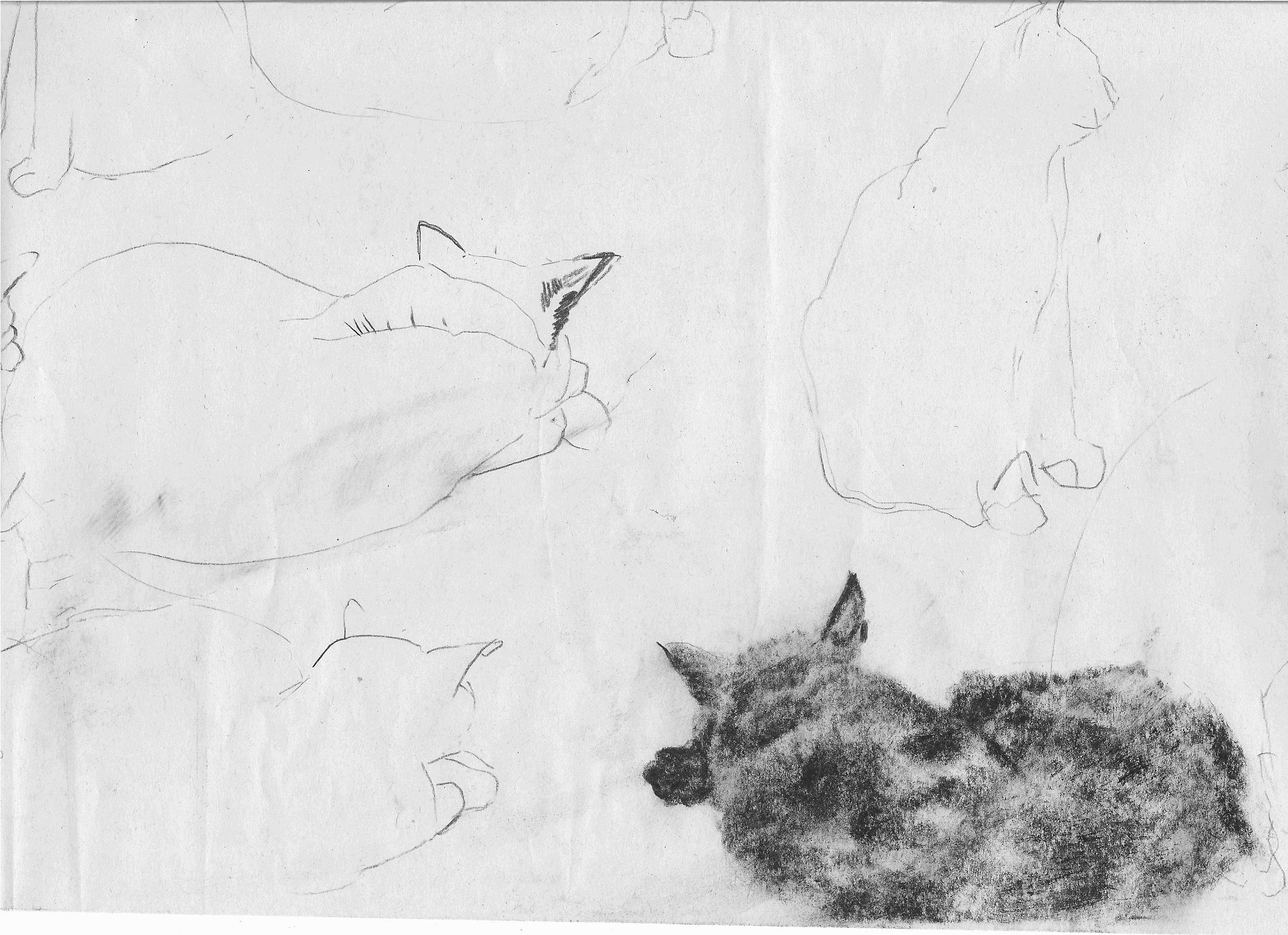
I did draw on Monday as I promised myself, though not as intensively as I do when I’m face to face with a model and surrounded by other artists hard at work. At home, there are the siren temptations of the kitchen (I’ve been drawing for ten minutes! I deserve a pot of chai!) and Perry v. Schwarzenegger (no, I can’t just listen to the radio and draw–I have to leap up and argue with the attorneys!). And this model does not sit still very long, so it was largely an exercise in 10-second gesture drawings. However, she finally slept in one position long enough for me to draw the one on the bottom right. Using the broad edge of a charcoal stick instead of a pencil was the key to showing fur in a way I’ve never managed before. Joy really likes this, so I’m going to dig out the fixative and give it to her for her office.
The Putting America to Work Act has been putting people to work in our town, or so say the signs alongside the barriers on our street, where they’ve been fixing sidewalks for the past few weeks. This week they got to the sidewalk outside our house. One square of sidewalk had risen up (we think due to a tree root) so that you’d trip over a three-inch immovable block of concrete if you weren’t looking at the ground. At some point the city jerry-built a kind of ramp between the adjacent square and the raised edge, which was an improvement but still left a section of sidewalk uneven enough to be a trip hazard. I have no idea how this new crew handled it–not through cutting down the tree, since I’m happy to say it’s still there–but there is now a nice fresh, perfectly even sidewalk in that spot. If Barack Obama accomplished nothing else in these four years, we could still point to our sidewalk, on which the munchkin, exercising a new skill, has inscribed her name.
There’s a lot about San Miguel that makes it a good place for small children: the frequent fiestas, the great playground at Parque Juarez, the annual puppet festival, religious celebrations that involve confetti or blowing things up, sheer architectural detail (Munchkin’s fond of the cobbles in the streets), the atmosphere at the Jardin (town square) that’s an equal mix of family gathering and birthday party. Beyond and through all that is something even more important: children are a part of things here, welcomed as if they’re actually members of the human tribe.
Lots of tiles here, including those covering the downstairs of our house, are made of a kind of terracotta and, when they are made, are left to dry out in the sun, where animals can step on them.
The sharp-eyed munchkin found this one under our table:

And the other day, when we were in the living room (which we seldom use), she came over to me and said, “Mama, close your eyes.” I did. “Come here.” I took her hand and followed her to the corner. “Look!” And this is what I saw:

And then I looked at her. I took photos of the tiles (we’re going to see if we can identify them using our book on tracking), but I couldn’t capture in a photograph her face in that moment, lit from within at the delight of being able to share delight. Fortunately, that’s something I’ll always have with me.
The attentive find that the universe has scattered gifts for them everywhere, and that’s something I hope she’ll always have.
(#7 of 20 things I’ll miss about San Miguel)
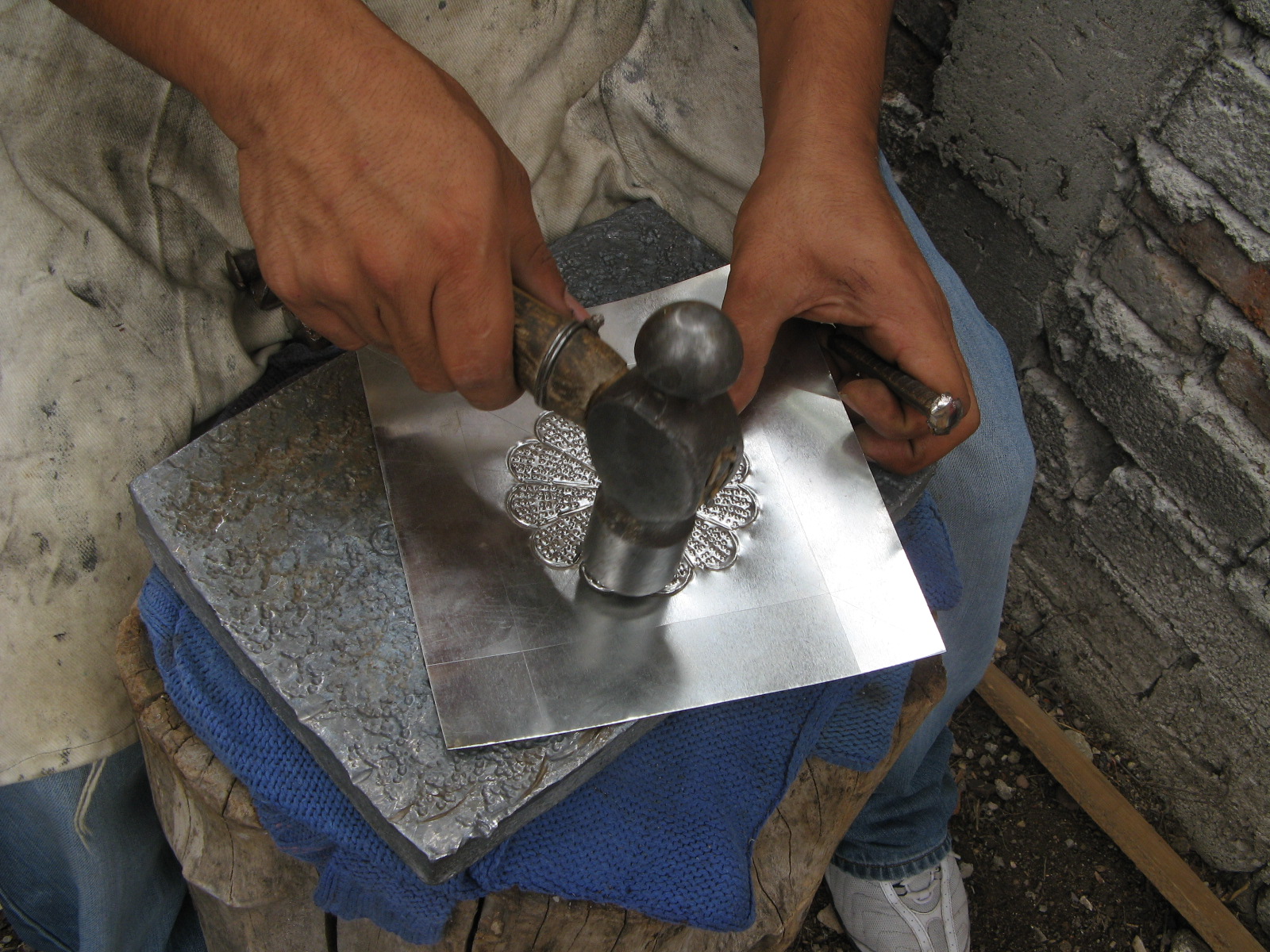
photo by Joy Morgenstern
Our neighborhood, Colonia San Antonio, is pretty working-class, and residences and businesses are all mixed together. (Actually, this mix is typical throughout the city; only some new, built-for-gringos neighborhoods follow the pattern of US suburbs, with tracts of housing uninterrupted by anything as useful as a grocery store.) Add to these factors a relaxed attitude toward time and a welcoming attitude toward children, and you get a walk home from school that is utterly fascinating to a three-year-old who loves to watch people making things.
Her favorite stop is a carpentry/cabinetmaking shop two blocks from school, where the whine of machinery tells us we’re getting close, and then the smell of pine tells us we’re there. Munchkin wants to know everything: What are they making? What is he doing? What are these curly things on the floor? The man who seems to be the chief carpenter always stops his saw when he sees her and squats down to talk to her, and to give her some of the wood shavings.
A few doors up from the wood shop is some kind of metalworking shop; we haven’t seen it open that often, but one time someone was welding inside, throwing exciting sparks, and we always hope to see it again.
If we take a different route home from school, we pass a mechanic who is just as willing as the cabinetmaker to stop and explain what he’s doing, and whose work is just as fascinating to the munchkin. She thinks it’s very cool that he can put cars together. I tell her maybe one day she’ll be able to do it herself, and she’s pleased by that idea. It will probably still be a useful skill in 20 years–or, if we dare to hope that private cars will be rarer than today, there will still be some kind of engines to repair.
On the street just by the San Antonio church, another mechanic shop seems to be right out in the street. It first caught our notice when there was a taxi out front in a sad state. We walked by it a few times, not realizing it was there to be repaired (I thought it looked like a car by the side of a New York City highway after the chop shop has gotten to it), and then one day a man was working on it and we realized that the whole street is the extension of a mechanic’s yard on the same block. Munchkin wanted to watch him work on the taxi, so we sat up on a wall next to the sidewalk for a long time and talked about what he was doing, which was soldering new parts onto the inside of the hood. He didn’t mind at all. The munchkin was very interested in all the things wrong with the taxi; I was impressed that with broken windows, no wheels, and a devastated front end, it was still going to be fixed up and put on the road again. It has long since left the mechanic street, so who knows, maybe we’ve ridden in it since.
We pass two tortillerias on the way home, one of which is right around the corner from our house. There are plenty of places where you can see women making tortillas by hand, or more often, gorditas (thick tortillas that are cooked, cut in half, and filled like a pita), but the tortilleria has a machine. If it’s running, we’ll stop and watch the tortillas come out of the machine onto a neat stack, just like the kids in a book the munchkin loves from the San Miguel Biblioteca, Sip, Slurp, Soup, Soup – Caldo, Caldo, Caldo. I think it looks like a big improvement over making each one by hand, but still a really hot place to work on a June day. The lady at the counter always gives the munchkin a warm rolled-up tortilla, even though we’re no one’s dream customers, the way we buy tortillas by the paltry quarter-kilo.
Munchkin loves to watch people work. So do I. Usually I’m shy about it except in the few situations where the workers expect an audience, such as at a crafts fair where someone is throwing pots on the wheel, or a factory tour. When I was a little girl, a big attraction of going to Pepe’s Pizza was how I’d spend the time waiting for the pizza to come: I’d watch the guys in the big open kitchen ladling sauce onto the dough, slapping down the mozzarella like they were dealing cards, and then sliding the pizzas in and out of the brick oven on their enormous wooden spatulas. When I went back as an adult and stood there watching, the nearest cook kept looking up in a disgruntled way. I hope he isn’t like that with kids, just with adults. Maybe the people in our colonia wouldn’t be so comfortable with my standing there if I didn’t have a three-year-old holding my hand, but all I know is they always seem happy to see Munchkin and to take a moment to chat.
Most of the places we’ve lived, this kind of work takes place behind closed doors and we don’t get to see it in action. Walking through this colonia makes me feel a little like Shevek, in one of my favorite chapters in one of my favorite books, The Dispossessed, when he first comes to Abbenay, and walks through the courtyards where people are building, dyeing, and doing all the other work of a city: “nothing is hidden.”
(#3 of 20 things I’ll miss about San Miguel)
Some people thought this trip was a little crazy. The nurse pricking my finger at the blood donation clinic commiserated about the fact that I was about to spend six months in Mexico, and I had to explain that I was going completely on my own initiative and was anticipating it with great excitement (though I do regret that I may not be allowed to donate blood for a while after returning) . . . . A couple of people asked whether we were bringing our daughter along (reply: “Um, yes, she’s THREE”), and we weren’t sure whether they thought we were bringing her into mortal danger, or were just worried that we were going to warehouse her with a babysitter for six months. . . . We got quite a lot of disbelieving “You can just leave your jobs for six months?” . . . . One person intelligently asked, “Have you ever been to San Miguel?” (reply: “Nope”) . . . . Others asked, “Do you have a house lined up there?” (reply: “No, that’s what we’ll do during our first ten days”). And even Joy and I looked at each other a few times as moving day drew near, saying “Are we really doing this?”
A lot of luck converged to make this trip possible. First and foremost, I am in a rare vocation, and rare denomination, that builds in sabbatical as a part of professional development. And then, most people who get a sabbatical have spouses who can’t just take off, or kids who would founder if they left their routine for six months, and so taking the whole family on a sabbatical journey is not an option for them. Joy’s workplace has to hold a spot for her for this leave. And the munchkin is at a very portable age and will benefit a lot from this time, even if none of it stays in her conscious memory. We live in an attractive area where a family might want to sublet a house (crucial to our affording the trip), and one such family needed to be in our town for the same six months we wanted to be away. They even like cats, so they didn’t balk at taking care of ours.
We are lucky, in short, but the luckiest thing, the one that made it all possible, was how well-matched Joy and I are in our sense of adventure. When I said, “I’d like to travel during my sabbatical,” she said “Right, this is our big chance.” When she suggested Mexico as a place we could live on just my salary—and specifically, San Miguel de Allende as a place rich in art and Spanish schools—I trusted her to know what kind of place I would love. It would have been simpler to stay home and not have to find a place to live in another country, find subletters for our house, clear out enough of our stuff so the subletters could actually move in, get all our documents in order, etc., but we were both more committed to exciting, challenging, beautiful, than to simple. It would have been a lot simpler for Joy to keep working, but she calmly did all the preparation to hand off her projects and clear her desk for six months. When we asked each other, “Are we really doing this?” both of us meant not “We must be crazy,” but “This seems too good to be true.”
I have a spouse who, instead of saying “No way,” says “Why not?” whenever possible. She’s left her home of ten years and moved 3,000 miles to live with me. To be with me, she’s come out to some people who thought she was straight, and admitted she was dating a minister to others who thought that was pretty funny. She’s gone through the whole complicated, rollercoaster process of becoming parents with me. She’s shared her wildest dreams with me, and listened to mine with the attitude, “Let’s make them come true.” And five years ago tomorrow, she took possibly the biggest plunge, and married me. Happy anniversary, my love!
The munchkin often talks about “zooseums,” and I mistakenly thought that it was simply her word for “museum,” so early in our time in San Miguel I told her about a “zooseum” (gallery, actually) I’d been in that I thought she’d like. We all went there and she looked around at the colorful art and said, in a voice that was made somehow more heartbreaking by its simplicity and lack of drama, “I thought we were going to see animals.” My maternal guilt-meter went off the scale. I’d deprived my child of her beloved Coyote Point for six months, plus I’d misled her into thinking she was about to see otters! Joy and I both rushed to tell her that there’s a great zoo in Mexico City and we’d go there soon.
So Sunday we took the long-awaited trip to the zoo in Chapultepec Park. The munchkin did enjoy the zoo very much, but I think in the end the highlight of her day was not the polar bear or hippo or even the terrifyingly agile snakes she adored, but the Spider-Man (-Men, I should say) who hung out in a booth along one of the park pathways and shook her hand. Here they are, only asking 10 pesos each for the photo, with a lesson in the proper hand position for web-spinning thrown in for free.

I’m ambivalent about zoos, to put it mildly. No matter how nice the enclosures (and this one’s are very good), they’re still cages, and the only kind of zoo I could feel 100% happy about would be populated entirely by animals who couldn’t survive elsewhere. (In fact, most of Coyote Point’s animals, and all of their mammals, were found injured and would die if released to the wild.) But it is still amazing to see them so close. And the Chapultepec Park zoo costs . . . zero. Yep, absolutely nothing. Incredible.
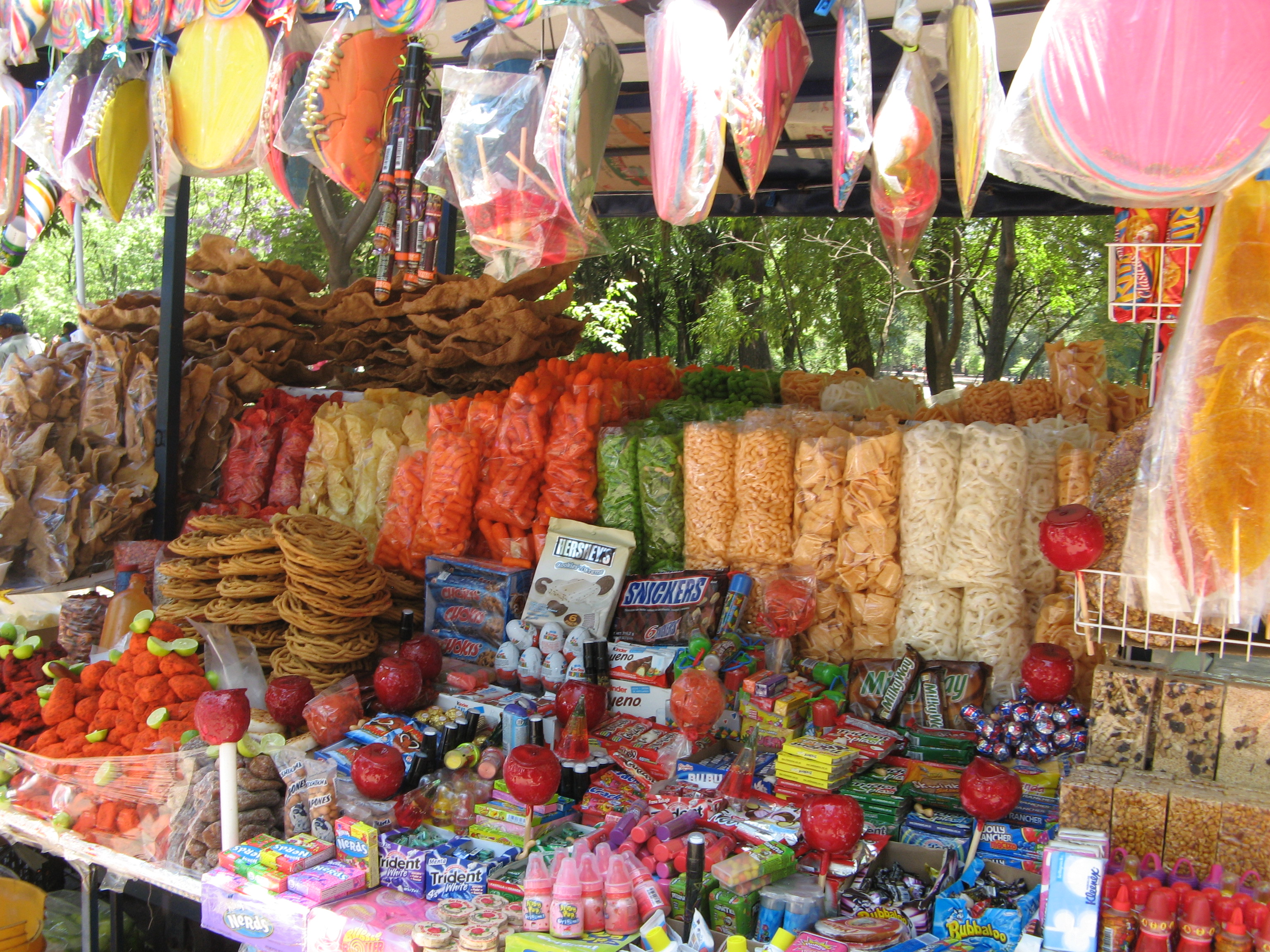
The approach to the zoo had approximately ten zillion things for sale besides photo ops with Spider-Man. Shoes, junk food, a skyscraper of cotton candy . . .


(all three photos by my multitalented spouse, Joy Morgenstern)
Our other visit on Sunday was to El Museo de Arte Moderno. The munchkin (who had a hard time the whole week) was melting down at that point, so we didn’t get to spend much time in the exhibit that interested me most, on the creation of Mexican identity. That’s travel with kids for you, even one who has remarkable museum-staying power for a three-year-old. In fifteen years we’ll come here with her and she’ll want to spend more time in museums than we can stand, plus she’ll want to race us to the top of the Pyramid of the Sun. Actually, she did suggest going to the top, but I thought a few steps were enough.
But I’m getting ahead of myself. Teotihuacán was Day 3, so I’ll write more about it tomorrow.

 Sermons in Stones
Where the girls aren’t
August 25, 2010 in gender, social commentary, the munchkin | Leave a comment
My daughter the munchkin, age three, has begun to sort out the world into boys and girls. “I a girl,” she explains, and asks other people, “Are you a girl?” We do let her know that there are people who don’t fall into either category, but as everyone who’s been asked so far has responded as expected, she might not grasp that concept yet. She is starting to assign her stuffed animals fixed sexes. We ask her sometimes about one or another of them, and get answers that are charmingly clueless about the linguistic implications:
“What’s Doggie?”
“He’s a girl.”
(She has also been known to tell us that she has a husband and that “She’s”–the husband’s–“sick. She has to go to the doctor.”)
You can almost see her drawing conclusions about all the possibilities open to her as she watches movies and notices that Coraline of Coraline* is a girl, as is Violet of The Incredibles–both with blue hair, so that she has already declared the intention to have blue hair too; I think she sees it as a badge of big-girlhood. And we pay attention to what she watches, trying to ensure that what she’s seeing doesn’t narrow down her world while it should be opening it up. Coraline and Violet are smart, brave, and eminently capable. The princess model is everywhere–to Munchkin, the basic requirements, and benefits, are that you have long hair and wear swirly dresses–but she doesn’t balk when I tell her a story about her taking a hot air balloon to a castle in the clouds and being shown around by, not the Princess, but the President. (I specified that the President had long hair. I didn’t comment on what she was wearing, and the munchkin didn’t ask.)
Things have definitely improved in the media since the days of Bambi and Winnie the Pooh, in which the only female characters are introduced in order to be someone’s mother or girlfriend. Not wanting to deprive her of the classics nor give her the message that the world is populated entirely by boys and men, with books I freely change the pronouns sometimes. It’s quite easy to turn Pooh and Piglet into girls if you just pay attention as you read aloud. But you can’t do this with movies, and I’m dismayed to observe that Hollywood is stuck at the tokenism stage.
Here are several movies we’ve watched recently, all of which I’ve enjoyed very much, but that collectively tell my daughter, who loves them too, that she lives in a world where almost everything interesting is done by the boys and the men.
Madagascar: Four main characters. So what do you figure the breakdown is–two male, two female? Nope. Three female, one male? Don’t make me laugh. Naturally, one is female and the other three are male. Gloria the Hippo is also the least important of the four, the sidekick’s sidekick. All of the other major players–the penguins, the lemurs–are male. I’m not sure about the bush baby.
Madagascar Escape 2 Africa: Gloria the hippo gets a plotline! Naturally, it’s about her love life.
Monsters, Inc.: Great movie! And the little kid is a little girl! She’s supercute, too, and brave. Plus, as in Madagascar II, a small juicy part goes to a woman. But the characters we spend the most time with are all male. (It’s a kind of buddy movie, and one of moviedom’s rules is that two women can’t be buddies, at least not without committing suicide by the closing credits.)
Shrek: Another buddy movie, another pack of writers who seem to think that if you create one spunky female character, you’re done paying attention to girls and women. My daughter loves this movie. How I wish I could show her a version where the hero is a girl. Or the hero’s sidekick is a girl. Or half the minor characters are girls.
Robots: Male robot (not sure how that works) goes off to land of male robot hero to redeem male robot dad, teams up with male robot friend, defeats male robot villain. This one has a slightly larger sprinkling of female characters than the above, but the central story is once again about one-half of the, um, species.
Ratatouille: Has a great female character, Colette. She really holds her own–which she has to do, because every other named character is male. Naturally, her main role is Love Interest.
The Incredibles (or, as Munchkin calls it without intentional humor, The ‘Credibles): This one actually has four significant female characters (and a black one! Hallelujah!), and everyone in the family regardless of sex has superpowers, but I’m putting it on the poop list for two reasons: Although Mom and Dad are both superheroes, the story isn’t Elastagirl’s, it’s Mr. Incredible’s. (Of course she becomes Mrs. Incredible when she gets married.) And when they have three kids, of course two are boys and one is a girl, because the rule is that the girls may never, ever outnumber the boys, except in the real world we’re all actually trying to live in.
None of these would ring alarm bells on its own, but looked at as a trend, they make a depressing one. Who is making these movies? As young as they are–as much as they grew up in a world where women weren’t just nurses, secretaries, moms and girlfriends–they seem to bring to writing and directing a worldview no different than the male writers a generation or more older, like Ray Bradbury or J. R. R. Tolkien, both of whom I also adore, but who write about worlds almost exclusively male. (Don’t tell me about Eowyn. I’ve read the book and I know all about Eowyn. And about Arwen, Galadriel, Goldberry, Sam’s girlfriend Rosie, and Shelob. There you have it, the complete list of named female characters in a book of 1400 pages. It takes even less time to list the ones in The Hobbit, since there are none whatsoever.)
Does no one in the entire production process look at the cast list and say “There’s something odd about this picture”? Do any of them imagine watching it with their daughters? I wish that before the script moves on past its first draft or casting begins, everyone involved would consider whether it would pass the Bechdel test: the story has two named female characters who talk to each other about something besides a man. It doesn’t sound like that onerous a requirement, but it would be a huge leap forward.
Our little girl is just becoming aware of the fact that she is a girl, and as she sorts out what that might mean, the message she gets from almost all of the movies we show her–when they don’t just stare past her as if she doesn’t exist–is that it means her role in life is Minor, or at best Secondary, Character. I feel as if we are doing her a terrible disservice.
*A movie that passes the Bechdel Test with flying colors, and more
Share this: