You are currently browsing the category archive for the ‘art journal’ category.
I’m drawing a cityscape in pastels, a new medium for me, and not really knowing what I was doing, I sketched the outline in black and then filled in the buildings as blocks of color. It looked pretty cartoonish. My teacher came and looked at it and said, “Now put the shadows in,” and once the buildings had shadows, pop! They suddenly looked real. I think a lot of things work that way.
My daughter loves her shadow. Like Robert Louis Stevenson, she thinks of it as a friend. I hope that’s always true.
Back in my first post, I wrote about my intention to draw leaves that are worn down to their skeletal forms. It actually proved very difficult to find any near my home in California, though I did find one with a lot of exposed veins and did some sketching shortly after writing that post.
This week, I’ve been drawing a different kind of skeleton leaf: the pad of a prickly-pear cactus (opuntia), or nopal. Prickly-pears grow here like weeds, and are currently blooming with pink buds that open to bright yellow flowers. I’d be hard pressed to say which is more beautiful, the living plant or its fallen, decayed pads. Here’s my subject, with the drawing underway.

Last week, I was doing a negative-space exercise with my drawing teacher. It’s a good, basic art practice that helps you to really pay attention to what is before your eyes instead of what you think something looks like. (Betty Edwards calls this a shift from left-brain thinking to right-brain thinking and uses this exercise, along with many other good ones, in her Drawing on the Right Side of the Brain.) When I sat down with my nopal skeleton, there was no doubt that I was going to focus on the dark shapes in between the veins, not the veins themselves. It’s not because I have white paper and black charcoal; I could use dark paper and draw the lines in light gray and white. It’s because the spaces are what attract me.
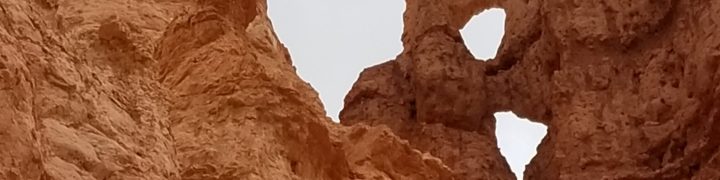
So there I was, drawing my empty spaces, humming happily away at my new friend the nopal, and thinking once again about lacunae, the absences that have such presence. (I wrote about them here on Feb. 11.) I’m just fascinated by the way we are shaped by absences, gaps, the spaces in between. I often think of this phenomenon in psychological terms: for example, how one’s personality takes shape around the things one is anxious to avoid. In my previous post on Barbara Kingsolver’s The Lacuna, I was thinking largely in terms of political history. But when I see a piece of art like Goldsworthy’s “Roof” (to give one example–he has many works that use a similar hole motif), its impact feels like something spiritual. That space draws me out, into itself–not at all in a scary, oh-no-I’m-falling-into-a-black-hole way, but in an intriguing, welcoming way. I recognize that space; it has a counterpart within me, something for which I don’t have any words, but which I know is there the moment I look at Goldsworthy’s piece. (I suppose that for some, these pieces must be disturbing, if they were locked into the cupboard under the stairs as kids. But like a cat, I’ve always liked small, dark spaces.)
Two poems that I had in my notebook back when I was working on a similar theme in college still resonate. One is “Anecdote of the Jar,” by Wallace Stevens. I usually can’t make head or tail of Stevens, but that year, when I read this poem, I thought he’d written it for me and the vessels I was making. My art thesis show was all large hand-built abstract sculptures, not wheel-thrown pottery, but I still made them all vessel forms because of the way vessels evoke that sense of the space inside and around. I thought I knew just what Stevens meant: put a jar in a space and suddenly the space without is shaped around, shaped by, the space within. (All these commentators mentioned in the Wikipedia article could be right about industrialization and Keats, too. But that isn’t what the poem means to me.)
The other poem is the eleventh chapter of the Tao te Ching, Lao Tse: pick your translation. Here’s Gia-fu Feng and Jane English, and here are about a dozen others.I started to write, “the spaces in the nopal make it what it is,” but that implies that “it,” the cactus, is the veins (or “bones” or whatever they are), while the spaces are just air, or emptiness. That would be as nonsensical as a jar that was made only of clay, not of space. The nopal is all of it, stuff and space alike. Drawing the spaces helps me feel that in my own bones.
Switching gears, here’s the other drawing I’ve been working on for, oh geez, a few weeks now, an hour or two most afternoons while the light is right. It’s the view east from my roof. (The view, ha. It’s just a few degrees of the whole view, of course. The rest is absent . . . most of artmaking being the decision about what to leave out. More on this aspect of lacunae soon too.) I think it’s almost done. It quickly turned out to be about texture more than anything else. The variety of textures of walls and trees in this little chunk of city is incredible. One thing I notice as I look at this smallified version is that I might want to fix up some of the verticals with a t-square. There’s nothing wrong with parallel lines not being quite in parallel (look at van Gogh’s city streets and interiors), but it might distract from what I want to be the focus here.

I’m making a collage involving an image of shed skin, having been captivated by a passage in a book on reptiles that said most “higher land animals” shed their skin, but whereas mammals like us do it so gradually that it’s mostly imperceptible, snakes are unusual in shedding in “one elegantly complete operation.”
I’ve been thinking a lot about continuity and change (that Mary Catherine Bateson chapter, the one I quoted in a somewhat different context on February 5, tugged on some threads that have been in my mind for a long time), and the idea of changing oneself in “one elegantly complete operation” is intriguing. Do we ever do it? So many radical changes feel paradoxically like returning to our real selves, the person we’ve known we were or wanted to be for a long time . . .
Anyway, for this piece I need something that looks like what a person would leave behind if we shed our skin the way a snake does. After a couple of false starts–draw it? use tissue paper?–I realized that the perfect medium was white glue, white glue as it appears when it’s dried on your hands and you’ve peeled it off, as we all did in school. Well, maybe some of you washed it off with warm water. I reveled in peeling it off, and in fact, my friends and I would deliberately spread a little extra on the backs of our hands for the pleasure of doing it some more.
So I spread a 3- by 8-inch swath of glue on the inside of my left arm this morning, waited twenty minutes, and peeled. OUCH. Swath is right. A swath is what it felt like it was taking out of my skin. I couldn’t even take the advice I’d given to the munchkin just the day before when she was fussing about band-aid removal and pull fast!, because I didn’t want it to tear. Ow ow ow.
Joy said, “You’re suffering for your art.” Glad to do it, but if there’s a next time I might sacrifice the texture (which will probably be invisible in the final piece anyway) and just spread it on a piece of plastic.
Only one more week remains of my drawing class, and I think I’m going to take another. I’m having a great time, I’m learning a lot, and I think it will take a few more months of daily practice for me to really learn, deep in my bones, that I can pick up the pencil and make good things happen—that it’s still a joy to do even when I don’t like the results. Right now, on my no-class days when I’ve promised myself I’ll draw, I still have a reluctance to start. I have done two drawings on those days that I’m happy with, though, a portrait of my daughter and one of myself. The latter is old hat—all art students draw themselves a zillion times—but drawing the munchkin was a big step. I have often wanted to, but the prospect of falling short, as I would inevitably do, and (so I imagined) messing up this face I adore so much . . . *shudder.* It was a breakthrough to give it a try. The drawing and the falling-short.
It’s amazing to discover how much fear I have around art. I knew I was scared of drawing, but I’ve been sobered by how intimidating it is even to make collages–as if I have forgotten how to play when it comes to art. This morning before art class, I had a chat with a woman who’s teaching a collage workshop in the studio next door, who said several things I know to be true and want to keep in mind re: making art, all in the friendly tone of someone who faces these demons all the time herself:
-It’s all an adventure, full of surprises. Just follow things where they lead you and don’t be too attached to any one version, or too dismayed by dead ends.
-The unexpected places the pieces will lead you are what make art so rewarding to do.
-Fear is a sign that you’re in new territory, not staying in a rut.
-Everyone has these doubts about their abilities. We know from Michelangelo’s writing that he was dissatisfied with his work.
-Being afraid isn’t necessarily a problem, but thinking there’s something wrong with being afraid is.
Something else that has helped dispel fear over the past couple weeks has been the love that’s welled up as I look so closely at some little piece of the world. I fell in love with a plant in the grounds as I drew it, and was sad when I came in this week and found that the gardeners had pulled it up! (Another student said “But you memorialized it!”) Drawing people, even the strangers who model for us, makes me feel like I love them. Their bodies are so beautiful! (Do they know it? Can they possibly look in the mirror and see themselves with that appreciation for how wondrously made they are? I hope so . . . ) I find myself, not only thinking “I have to get that curve of shoulder right, it’s so gorgeous,” but feeling like it’s personal: that I want to do right by these people and their beautiful humanness. That feeling last week made it possible to go home and draw my daughter.
This morning I started my drawing class, my first since 1986. When I sat down, blank paper and oh-so-subtly-shaped model in front of me, I was very nervous and excited. Now I’m just excited. It was so much fun. And it is so clear that nothing but committing to a class would get me to draw for three hours straight three days a week. I feel a great unblocking happening, like a river of ice breaking up. So this is what I’ll be doing on Monday, Tuesday and Wednesday mornings for the next four weeks. (Morning classes are perfect because the munchkin is in school 9-1. Bilingual preschool, two hours of each day in Spanish, two in English—perfect.)
Drawing is so magical. I can never get over the small miracle that occurs when I manage to just draw what I see. (Getting eye and hand to align is, of course, at least half of the challenge.) It takes a leap of faith to do that, not to draw what I think is there but to draw the weird, foreshortened shapes appearing to my eye, and then a few minutes later, when I pause to look at the whole thing, lo and behold, I’ve drawn toes that look like toes. That foot looks tucked under the other calf. Those shoulders look like one is close and the other is far away and like they could actually hold up that head. These are the moments that make the hard work worthwhile. What a strange practice, just to strive to put on paper what anyone could see if they took a few moments to gaze at the body itself. But I see it more clearly for having drawn it, which is part of the point.
Thursday and Friday mornings will be collage time for the time being. I’ve just learned that the secret to the color-saturated, textured surfaces of two collage artists I admire, Eric Carle (of children’s picture book legend) and Jan Richardson, is painted tissue paper. And Carle, bless him, explains on his website what kinds of paint he uses, etc. so that someone like me can try it out. I was so jazzed after class, felt so much more freedom to carry out the visions in my head, that I went to the art supplies store and got tissue paper, watercolors and brushes.
The quote from which I take this blog’s title is from As You Like It, and I usually edit it to read like this:
And this our life . . .
Finds tongues in trees, books in the running brooks,
Sermons in stones, and good in everything.
The speaker is an exiled duke, and because he is wandering the forest instead of presiding over his dukedom, he actually says:
And this our life, exempt from public haunt,
Finds tongues in trees, etc.
I usually take out those words because I’m very much established in public haunt. But I soon will be exempt, thanks to the generous and wise practice of granting Unitarian Universalist ministers a sabbatical, one month for each year of full-time service to the congregation. My first sabbatical begins a week from today, and for several months I will be free to find sermons in stones without actually jotting them down to turn into Sunday sermons, in that devilish way of ministers. I will be devoting my sabbatical time to making art.
I’m not going to commit to blogging during this time. This may be a great art journal, but it’s also public, and many of my ideas may need time just to be my ideas, without having to turn into anything interesting to anyone else. And I will keep comments shut off for the sabbatical period, so that I can tell the members of my congregation about this blog without our continuing to chat all through this time that is supposed to be Away. They are very interesting people and it would be irresistible.
I have other blogs for keeping in touch with friends and for informing a network of my daughter’s fans what she’s up to. This space is for theological, spiritual, philosophical, and artistic musings, and as I was musing this morning I knew it was time to wake up the blog and post my first post.
I was thinking that when I start drawing, next week, I want to draw leaves that are eaten away to a skeleton.

Vein skeleton of a leaf
And that got me thinking about the beauty in decay. Leaves are beautiful that way. So are cliffs eroded so that you can see the striation of the rock. And human faces? Sure. The very word “decay” implies that the peak, even the normal, state is in the past and that this new state is inferior. But is that true of the leaf? Is it less beautiful this way than when it had all its skin?
Is it true of us, that our best time is when we are at our peak of health and strength? Some elements of our selves grow, not only while other elements decay, but because they decay. Certainly many of my strengths come directly from loss and the wearing-away of things that used to be essential to me. I think a series of pieces on this might be one of the projects of the next few months.
The image came to my mind, and only then the idea. And that, in a nutshell, is what I treasure about the activity my daughter calls “arting.” What other revelations will my “sabbatical of art” bring? I’m breathless with wondering. The only way to find out is to get arting.

 Sermons in Stones
Recent comments