You are currently browsing the category archive for the ‘art journal’ category.
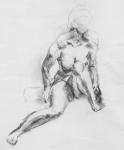
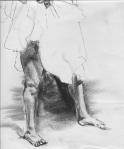
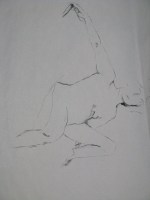
A few drawings from today’s session, ranging from seven minutes (the first two, which are two parts of one drawing too large to scan in one piece) to thirty (the last two, ditto).
Last week I only brought charcoal and graphite, as distinct from actual pencils of same, which had a wonderful effect: I had to draw more in planes and broad strokes. I am trying to do this more instead of focusing so much on lines and fine detail, so this was good. Today I brought the charcoal pencils along too, and used them along with the charcoal sticks, when sharper lines were called for.
Click thumbnails to see larger size.



It took several weeks, but I finally checked out one of the non-instructional figure drawing sessions nearby. The session is held every Monday morning for three hours, and it’s a pleasant walk from the 24th and Mission BART station. If all the models are as good as today’s, I’m going to want to go every week. The lighting on strong musculature, and the props (ropes for the model to hold on to, allowing for very interesting standing and leaning poses), took it to a whole new level. Based on the owner’s warm welcome today and his teaching philosophy as outlined on his website and an American Artist interview, I’d love to take a class with him sometime, too, but the available times aren’t good right now.
So this was my day off so far: I went and drew for three hours, walked back to Mission Street, and finished reading Cat’s Eye over a lunch of ceviche tostadas. Yum on all counts.
Along the way, I stopped to browse at the outlet of a favorite clothing source, which I discovered by chance is right here a couple of blocks from that same BART station. The last thing I need is more clothes, but I do like them, and I’m going to use it as a reward: when I’ve gotten rid of those boxes full of old papers and stuff that are clogging up the garage, I can buy myself a few things there. It’s funny how we create these little games for ourselves. “Write for half an hour more and you can play a computer game.” It worked for my clean-out-the-e-mail-inbox project a couple of years ago (reward: fancy new planner), and just thinking about the clothes I saw today, I can feel my motivation to get into that garage rising.
Oh, I love me this figure drawing. I just went to my last session in San Miguel, but San Francisco offers plenty of opportunities (albeit several dollars more per session). I need to find a session that includes a couple of really long poses. The longest we did here were 15-16 minutes. It was frustrating, but forced me to work faster, which is a discipline of its own. I also realize, looking at the drawings, that I unconsciously compensated for the brief time by focusing on one thing in one drawing, one in another. So some of these have the gesture just right but I didn’t do anything on the hands and feet; some have a lot of shading in one area, a limb completely ignored elsewhere; etc. Still, I look forward to some 45- or 90-minute poses so that I can really get into more detail and not have “not enough time” as an excuse.
It’s good to see these all in chronological order–I realize I really am learning something. It’s reassuring, because at the beginning of each session I feel all thumbs and it takes me several drawings before I can get a gesture down on paper to any kind of satisfaction. They are very short poses, of course, but the source of the problem is not that I only have two minutes, it’s that I need to get my hands and eyes and brain all into drawing mode afresh. Well, right, that’s why life-drawing sessions always start with these warmups–because centuries of art students have had the same challenge, and their wise teachers have figured out that making them do long, “supposed-to-be”-more-polished drawings when they aren’t warmed up is just going to frustrate them.
Here are some of my favorites from each session. You can see larger versions by clicking on the images.
-
- 7/20. Something exciting happened when I paid attention to the sharp shadows the light threw: a more varied, expressive outer line.
-
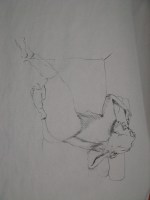
- 7/20. Oh how I struggled with that spine, and still couldn’t get its shadow right (I never can). But I like the drawing overall.
-
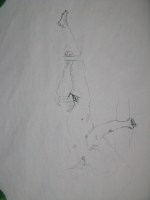
- 7/20. Spent most of the time on her feet and right hand. So disappointed when time ran out before I could do the left hand.
-
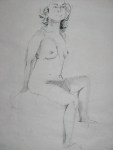
- 7/20. I just like this one. I really wished I could spend another hour on it.
-
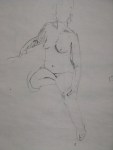
- 7/20. I got a lot on paper in only five minutes. I like the overall gesture, and that right arm.
-

- 7/20. I put this one in even though the proportions are wrong (she wasn’t this stocky) because the overall gesture works and I like the knees.
-

- 7/13. Short pose, but expressive.
-

- 7/13. I knew halfway through that I’d made the back too long, but with no time to erase half the drawing, I just carried on. I like the turn of the head and neck, and the subtle shading I started on the back.
-
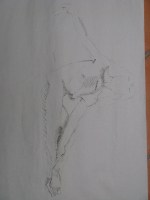
- 7/6. Each pose seems to suggest a different place, or places, to focus. Here they were the collarbone and the feet and hand.
-

- 7/6. Another great pose. It made me want to get the weight of all those limbs right: one leg resting on the other, hand resting on leg.
-

- 7/6. This woman did such inventive poses–it was really fun to try to capture her gestures. I think I did here, and I like the arms.
-

- 6/29. I think all the time went into the left hand and left foot. I don’t usually spend time on faces–that’s not what I’m there for, yet–but this time it worked out.
-

- 6/29. Only the vaguest outline gives the gesture (it works!)–the left hand is getting somewhere though.
-

- 6/29. Proportions are off and I don’t like the fuzzy outlines, but I’ve included this here for his right foot.
-
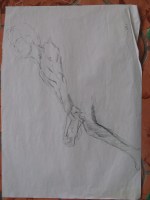
- 6/29. Included for the gesture, which works pretty well. Interesting pose to draw.
-
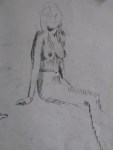
- 6/22. As in the first picture, I like the shading where it gets heavy and will try more of that.
-

- 6/22. I did the shading differently than usual. Will have to try that more.
-
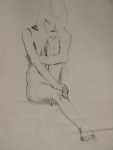
- 6/22. Nice use of line; if I’d noticed, I’d have practiced that more. It reappears, by accident, on 7/20 (last picture in this post).
-

- 6/22. Left leg and right arm are flat, but I love the toes.
-
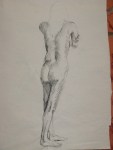
- 6/22. I like the shading, which is bolder than I usually attempt.
Last night I was looking over all my drawings from the Tuesday life-drawing session and Joy said, “You know what I like best about these? How much you’re loving drawing them.” I couldn’t agree more. I did not set out to love drawing during this sabbatical; it didn’t occur to me that that was possible, people who draw for pleasure always seeming like another species. I just wanted to tackle my fear of it and, I hoped, reduce that fear. Now I go off to these sessions with excited anticipation, and the two hours fly by. I do feel some trepidation when I face the blank sheet of paper and the real live inexpressibly beautiful model, but it’s minor. Amazing.
I keep thinking of a repeated theme from a book my sister used to have (probably still does), Letters to Horseface by F. N. Monjo, which comprises fictional letters from the boy Mozart to his sister. He keeps encountering this and that musician and saying “The clarinet is such a beautiful instrument–I have to write a concerto for it” and likewise about violin, flute, etc. But in the last such remark, IIRC, he decides the human voice is the most beautiful of all. That’s how I feel about drawing people. Cats, trees, stone walls, the light falling on a rooftop, are all beautiful beyond words (and certainly beyond my capacity to draw them), but nothing inspires me like “the human form divine.”
Current project: collages/drawings to illustrate Emily Dickinson poems. I’ve been thinking about this one in particular–meditating on it as in lectio divina, trying out drawings, seeing what emerges.
The Soul should always stand ajar
That if the Heaven inquire
He will not be obliged to wait
Or shy of troubling HerDepart, before the Host have slid
The Bolt unto the Door —
To search for the accomplished Guest,
Her Visitor, no more —(No. 1055)
By the way, ministers and other users of online quotations pages, be wary. Looking for the text of this poem, I found many incidents of the paraphrase “The soul should always stand ajar, ready to welcome the ecstatic experience” passed off as something Dickinson herself said. Typically of her, the poem is subtle and complex, and typically of internet quotable quotes, the misquote isn’t. Of course, internet quotations pages are 99% copies of other internet quotations pages. If you can’t completely trust your ear to know when something sounds like 1860 and when 2010, when it sounds like something Nelson Mandela would say in his inaugural address and when it’s more like Marianne Williamson (and who among us has an infallible ear?), it’s best to confirm the quote with Bartlett’s or some other resource that actually identifies its sources.
More or less done. I might tinker with it; I’ve been thinking of adding a border, maybe of the same plastic that makes up the skin, but I need to stare at it for a few more days.
I’m happy with it. Tomorrow morning is my dedicated art time and I’m not sure what the project will be–maybe just drawing.
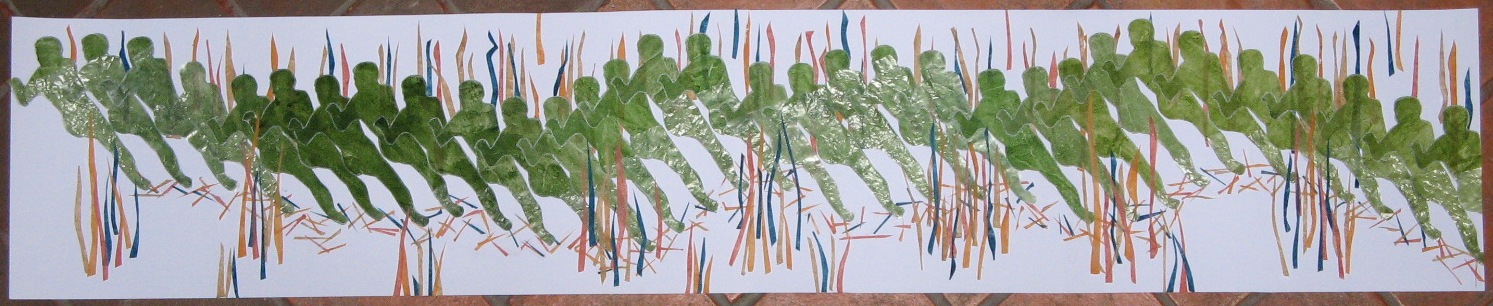
I’m working on a piece that I think of as my “little green men.” Joy calls it my “little molting men.” They are, or rather he is, molting; it consists of many virtually-identical figures, each with a skin of plastic, and each skin in some degree or another of being shed.

Detail of work in progress (tentative title "Shedding")
I started work on it probably two months ago, with many hours of painting the papers, cutting out figures and then again cutting parts of them out of plastic, gluing the plastic on, outlining each figure . . . All a lot of fun. I worked on it only in short bursts over the last month while I was occupied with Spanish class and a little stumped about what to do next with this shedding person. For a long time, I’d planned on putting the figures in a spiral form, which kept me occupied with interesting technical problems; I had thought I wanted a Fibonacci spiral, which required a compass, so I’d bought one, leading to a fun afternoon of me and the munchkin drawing with the compass, but not much else, as the compass wasn’t really up to the task. What do you want for seventeen pesos. Besides, after looking at all the Fibonacci spirals I was drawing, I decided I wanted a spiral more biological and less mathematical, shaped like a snail’s shell. That didn’t work any better, though (the figures are too big–the piece would have to be something like 5’x5′ to hold them), and I didn’t have any other satisfactory ideas. So I fretted, and to make it worse, I fretted far from the piece, avoiding it as if it were the cause of all the trouble. This seldom works, and it didn’t work this time. To overcome a bout of creative sterility, I usually need to have the piece before my eyes and the materials in my hands. That’s why I’ve been doing art during this sabbatical; it was time to stop thinking about art and actually make it.
Finally, today, done with Spanish and free of parental responsibilities all morning, I sat down with the figures and within five minutes knew how they should go, which was not a spiral at all but an undulating path. Then I realized they needed to walk on something and I knew what form the ground should take too.
I love this part. I love it when the piece is starting to match the vision (with lots of surprises along the way, but pleasant ones) and I can just sit there contemplating the piece in progress as I cut paper into slivers and glue to my heart’s content. It occurred to me at one point to wonder whether rubber cement fumes can be fatal, but I thought, Well, I’ll die happy.
My friend Karen brought me the rubber cement (3 jars!) when she visited last month. I hadn’t thought to ask for any, but she’d read on here about how I couldn’t find it in San Miguel, and I’m so grateful for her thoughtfulness. I don’t see how I’d have made this piece without it. Now I’m in the home stretch and having so much fun it’s hard to stop and sleep, but I’m tired.
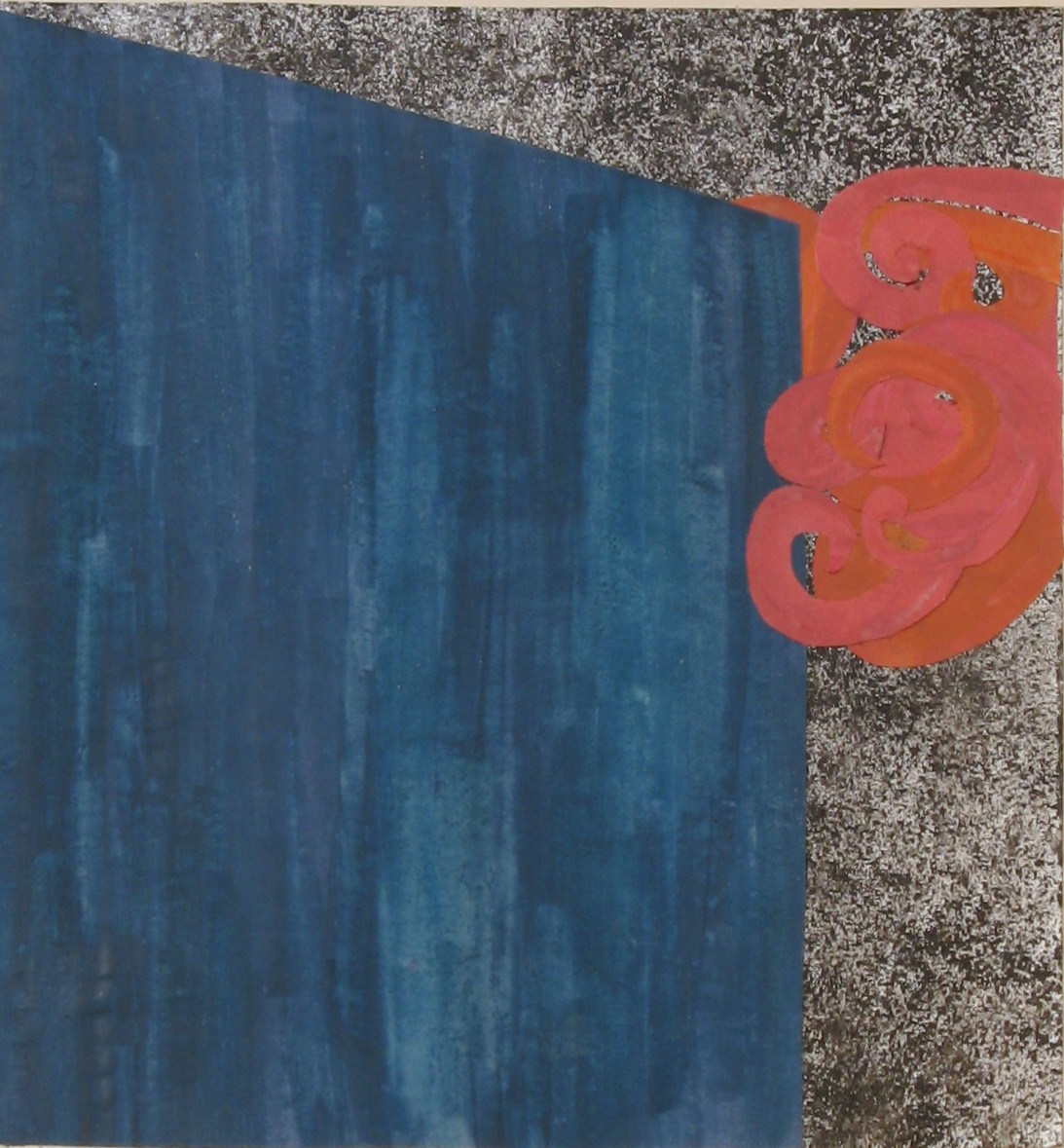
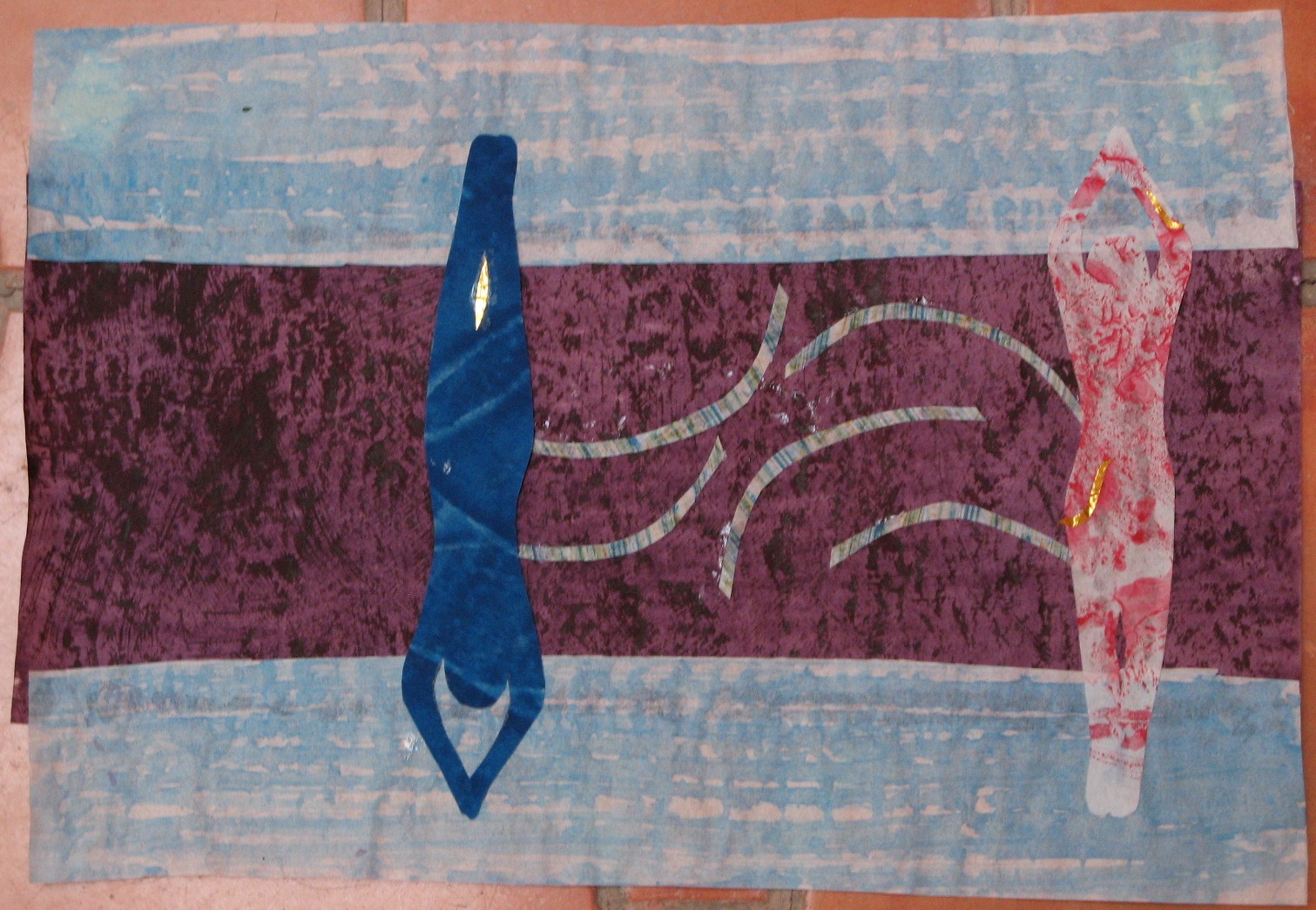
I’ve been doing less drawing and more collages over the past two weeks. I’m almost done with the tree drawing, but I’m waiting to be able to meet with my teacher, who has some advice on it but who has been out working on a mural every morning for the past few weeks. I’m glad for the impetus to spend more time on these abstract pieces, because their topic is important to me: the tensions and balance between continuity and change.
The one I’m working on now has a long way to go, but here are two from earlier this spring on the same theme (weak quality–the best I can do with my little camera). I looked up skin in the encyclopedia for the second one and loved what I found: “The basic function of our skin is to protect the organism from infection and the introduction of foreign materials, yet at the same time, it is an organ of respiration, secretion, the regulation of body temperature, sensation, and excretion.” In other words, our skin has the responsibility to be a barrier–quite an incredible one, flexible and impermeable to water–and also to allow exactly the right things out and in. It’s a model to emulate in the life of the soul, trying to maintain equilibrium while being open to the new and releasing the no-longer-necessary (which, as in the bodily metaphor, can quickly become toxic).
Continuity and change, #1
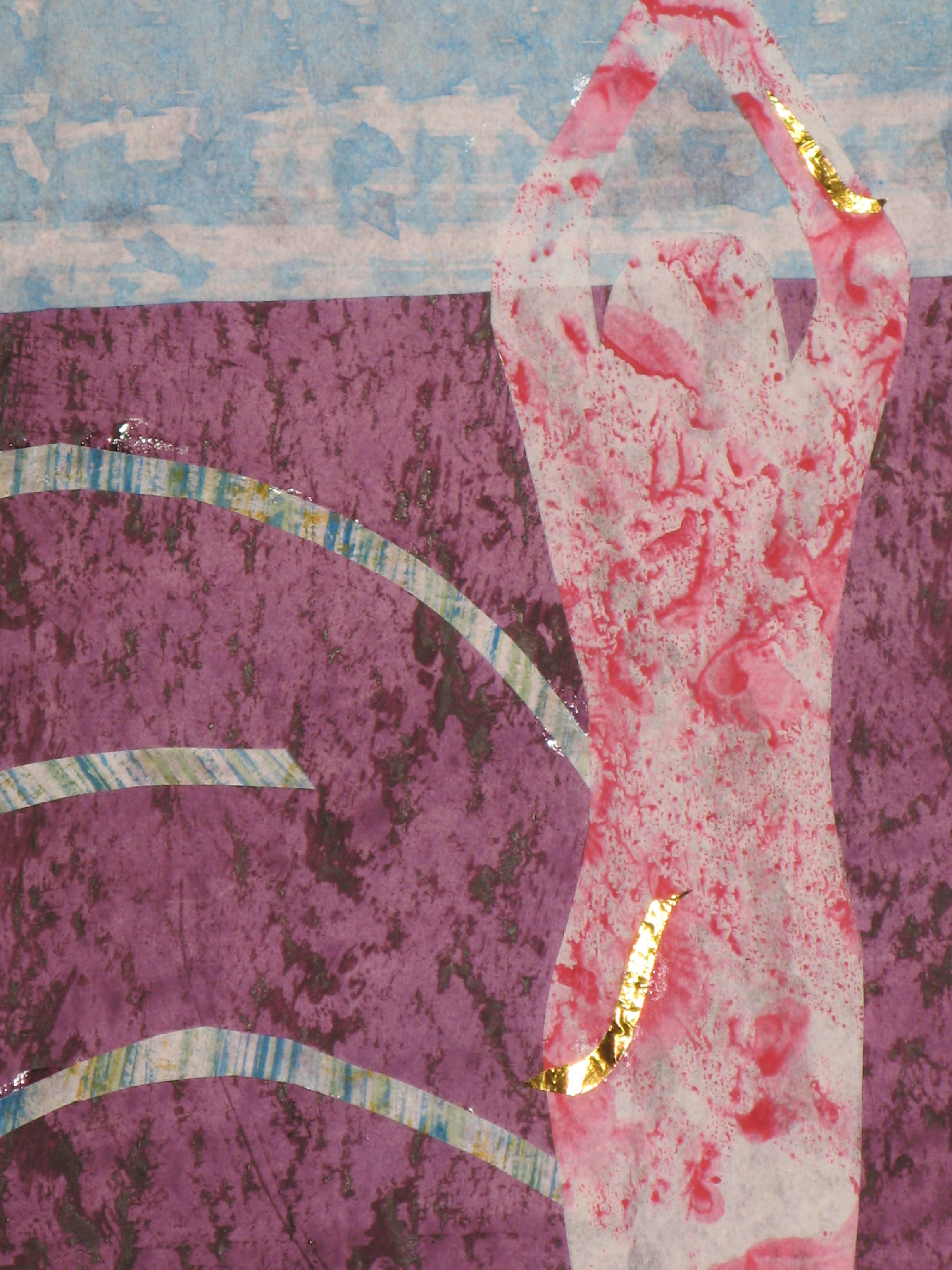
detail

Continuity and change, #2
I really love collage, and in fact I’m drawn to all sorts of art forms that reassemble scraps of other things: quilts, mosaics, stained glass, and sculptural assemblage. I only took one collage class in high school (I went to an arts high school, the Educational Center for the Arts in New Haven–which, BTW, needs a better website), but it has stuck with me as a favorite medium.
However, it’s not easy to get the materials I have in mind here. I don’t have a big pile of things to cut up, and although I could probably get one by soliciting people’s old magazines on the local Yahoogroup, I’d then have to get rid of them again in a few months (no curbside recycling, or even any recycling center in town). I don’t have access to high-quality printers or copy machines. I haven’t even been able to find rubber cement. Plus, unlike when I was doing collage in high school, I’m very aware of copyright issues (tip of the keyboard to the creator of beautiful collages and digital collages, Alicia Buelow, for the link) and I don’t want to steal other people’s work to make my own. And on top of that, as much as I like the physical cut-and-paste of making traditional collage, there are other wonderful collage possibilities there that require darkroom or computer technologies. Here I am with the gift of time in which to explore them. So in addition to using painted papers and detritus (tape unraveled from cassettes, foil candy wrappers), I thought this was a good moment to learn to use an image editing program.
So I’ve downloaded GIMP, a “software libre” product from the Free Software Foundation. (My term. They prefer “free software” to “open source,” but the problem with the term “free software” is it implies the issue is “no cost,” when what they mean is “free as in speech.” The solution? Turn to a language in which there are two words for these two very different meanings of “free.” Spanish would use “gratis” for “free beer,” “libre” for “free speech.” Hence, “software libre,” which has the advantage of sounding like a cocktail.) It works like Adobe Photoshop, as far as I understand Photoshop; the price put Photoshop itself right out of my range. I looked it up when I first had the plan to learn digital collage, but the version I would want was $650, and that’s one of the cheaper ones. I’m not willing to pay that much for something I may or may not use much, and now that I know there are “software libre” alternatives, I’m not willing to pay it even if I end up using it a lot, unless GIMP proves to be inadequate to the task. So, Adobe, you’ve just driven another potential consumer into the arms of non-proprietary software. Proprietary software creators, be warned.
We interrupt this Mexico City travelogue to bring you a few drawings (click to enlarge).


The landscape in charcoal pencil is now finished. I had intended the picture to be framed by the two largest cupolas, but the composition drifted as I drew, so I cut off the leftmost couple of inches to restore it.
While I was drawing the charcoal-pencil picture, I got fascinated with the colors of the jacaranda, purple doors, and bright turquoise door slightly south of where I was drawing, so the next one made them the focus. I learned a lot about working with soft pastels on this one. I think it’s finished now.
I started drawing this tree, which is in the garden of my drawing teacher, Silvia Velasquez, on Tuesday. I love the way the biography of the tree is written in its shape and skin. It not only grows out of the rock, it’s carried one stone with it. I’m not sure you can make it out yet–to distinguish between the texture of the stones and of the tree itself (and the ivy, and the birdhouse) is one of the challenges I’m setting myself with this drawing. I’m amazed by how many different textures are in the bark–it’s as if it’s several trees, or has lived several lives. Another thing I’m working on is to focus on volumes and planes as I draw, more than on outline; I’ve filled in a lot of linear detail now, but the broader strokes, done with charcoal, are still evident in the stones below and the right-hand branch. Today will be my third morning drawing it, so I’ll post an updated version. I should record stages like this more often–it’s easy with the digital camera, and I’d probably learn a lot.
I can’t wait to get back to this tree!

 Sermons in Stones
Recent comments