You are currently browsing the category archive for the ‘a leaf a day’ category.
The pitfalls of using a 42-year-old field guide to the trees may be few, but occasionally one does stumble into them. When I started looking for redberry juniper photos, I quickly realized that there are two trees commonly called by this name: Juniperus pinchotii and Juniperus coahuilensis. So I went back to the guide, looked up the Latin name of the redberry in question and discovered it is–neither one. In the field guide, it is J. erythrocarpa, which seems not to exist anymore. Process of elimination made it clear that it has been renamed J. coahuilensis (which seems to have previously been the name of one variety of erythrocarpa), since tomorrow’s tree, Pinchot juniper, is, yes, J. pinchotii.
I wonder why the name changed, but I don’t wonder enough to do any research. I just enjoyed drawing some of its leaves, complete with two of the said berries.


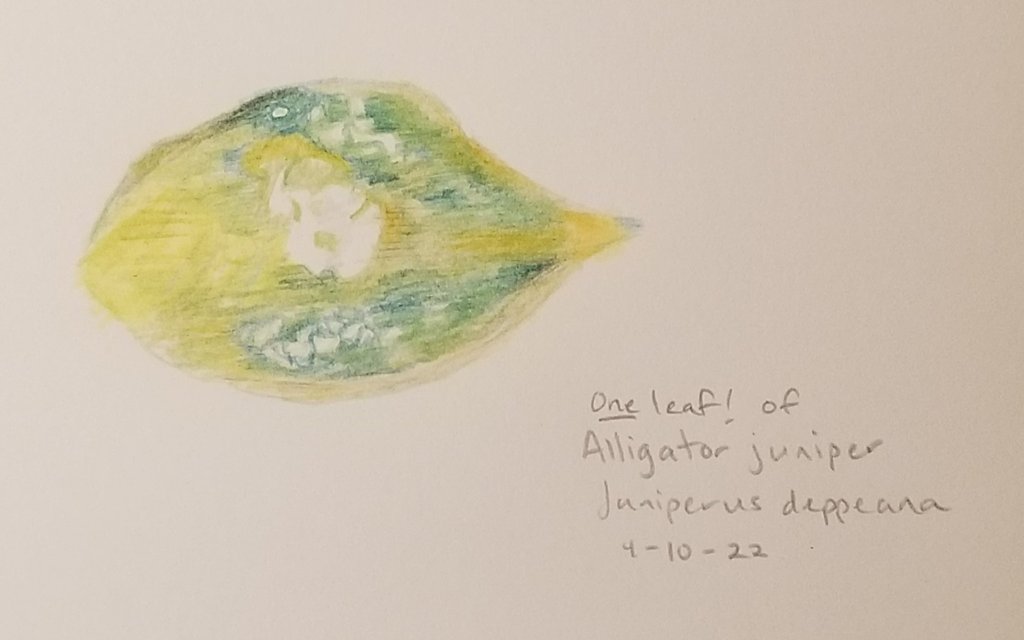
Usually I draw a bunch, especially with these scale-like leaves, each so tiny. But here is a single leaf of alligator juniper. Each exudes resin, which appears white.
The common name comes from the bark’s resemblance to alligator hide.

Like the other trees I’ve been drawing for the past couple of weeks, the Western juniper has tight, scale-like mature leaves. But when the leaves (and seedlings) are young, they are more needlelike. This is the case of most if not all of these trees, but I haven’t always found photos of that juvenile stage. Here is Juniperus occidentalis on its way from juvenile to adult.
The tree is common, but mostly in Oregon; in California, it’s found up in the Sierras, not here along the coast.


I have not been keeping to my posting schedule! So I will post the last three drawings now.

I fell asleep at 9:30 last night. Lovely. So I didn’t draw, and have made up for it with two trees today.
Baker cypress–sigh. I’m getting a little tired of these cypresses. No, they aren’t all alike, but still. I’m ready for something completely different.

But the Tecate cypress! Its range is limited almost entirely to San Diego County, and it is the only home of the Thorne’s Hairstreak butterfly. Between that and the fact that my inspiration for this yearlong project was my friend Janet’s year of butterflies, of course I had to draw the two species together. They are intertwined–the larvae of the butterfly, which lays her eggs on the cypress, look very much like the tree’s leaves–and both endangered.
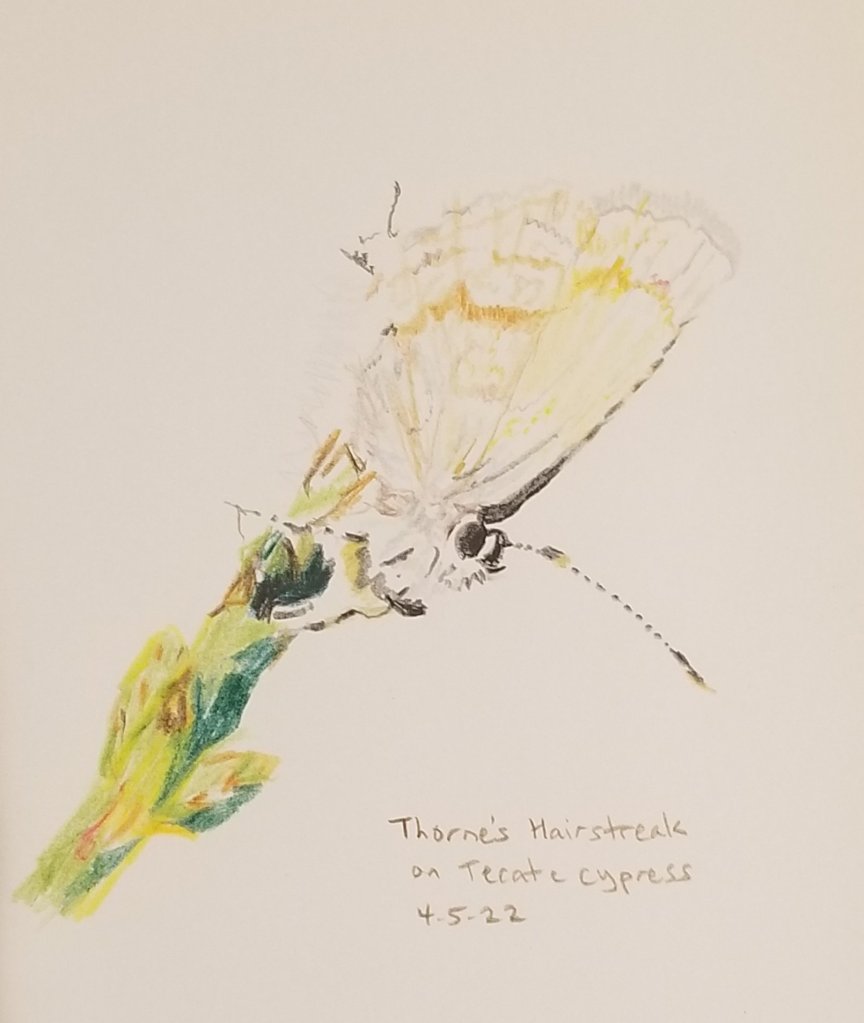
I hope they both make it.
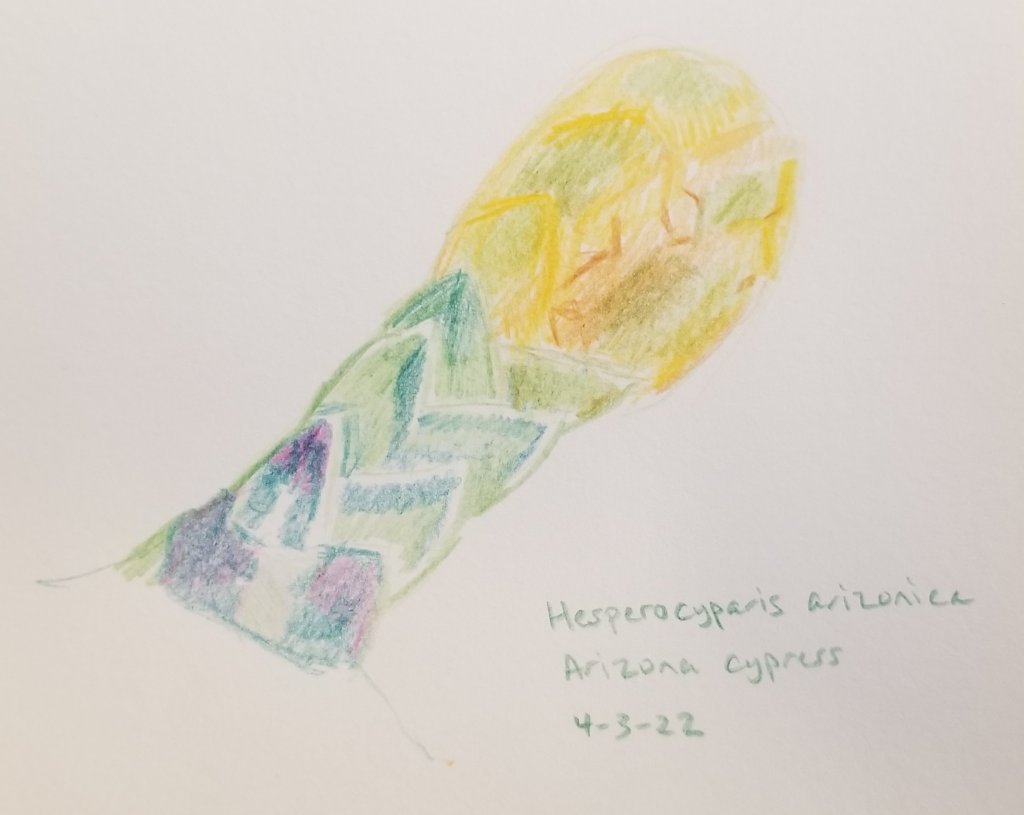
With an early-rising morning of travel behind me and a big service ahead of me, I’m too tired to do more than make a quick sketch and note that like yesterday’s tree, the Mac Nab or Shasta cypress is endemic to California, which means it is found only here.

Glad to meet you, neighbor.

 Sermons in Stones
Recent comments