
You are currently browsing the monthly archive for February 2022.
My father-in-law, Marty Morgenstern, died on Saturday. I can’t believe he’s gone. I know the unreality will fade with time, but I will keep on missing him. Marty was very special to me, and although I’m glad to say I had many opportunities to say why before–such as at his “I’m really, really retiring this time” parties, his 80th birthday party, and each time I saw him–I want to say it here, for all to read.
The single best thing Marty ever did for me, it goes without saying, was to be the parent of the child who would become my wife. He and Joy’s mom divorced when she was very young, and times being what they were, she was raised mostly by her mom, but by the time I met her, she and her dad had the close relationship of adults who trust each other and love being in each other’s company. In him, I could see so many qualities I admire and love in her: their honesty, their open affection, their commitment to public service and making the world better through their jobs, their trustworthiness, their humor, and of course their incisive intelligence. Marty was a big fan of our family, openly admiring our child (who is indeed the most terrific child ever) and the relationship the three of us have, and yet he seemed not to realize how much of it was due to his influence on Joy.

COVID-forced separation (photo by Joy)
I’ve often joked that I was in Marty’s good books before we met. On my account, his only child relocated from the East Coast to within easy visiting distance of him. Not only that, but thanks to our relationship, she was planning to give him a grandchild, something for which he had probably long since stopped hoping. (In his toast at our wedding, he said, “I always thought Joy was never going to get married, because she told me, ‘Dad, I’m never going to get married!'”) So although I was nervous the night we went to Rose Pistola (alas, now permanently closed) in San Francisco for our first dinner with him and Joy’s stepmother Sylvia, I figured I had a lot of points in the win column already. They both proved to be easy to talk with, easy to love. I really won the in-laws lottery with Marty (and the whole family): he accepted me into the family without hesitation or judgment, celebrated my relationship with his daughter, and showed me unfailing respect and kindness. As recently as the past year, when Marty ordered branzino at a restaurant where we were having dinner, he reminisced that that was what he’d had that night at Rose Pistola. I was touched that he recalled that evening as an important moment, as I did–and more vividly, since I don’t remember what I ate.
Marty would scoff at the idea that he could be anyone’s hero, and I’m not given to having them, but he had one remarkable, rare quality that I particularly long to emulate and will probably never achieve: although he was firm and passionate in his own convictions, he could engage with people with whom he strongly disagreed, listening and speaking respectfully. If he felt hot and flustered the way I do at such times, it didn’t show. No doubt that was part of why he was so successful at labor negotiations. He was unswervingly in workers’ corner, but I can imagine all parties in a conflict being confident that he was paying attention to their needs and treating them with respect, because he was.

age one day (photo by Joy)
So it was utterly unsurprising, but deeply gratifying, to listen in on his conversations with our child as she got old enough to talk politics with him these past few years (she is almost 15). Not that she was arguing with him; she was just learning and asking lots of questions. She, Joy and I talk plenty about social problems and public policy over the dinner table, but of course when one of her questions came up when we were at Papa and Grandma’s house, we would say, “That’s a question you should ask Papa.” She would, and he would engage with as much seriousness as if she were a Berkeley graduate student. He was delighted to learn that she planned to take journalism next year and write for the high school paper; he was looking forward to reading what she wrote, he said.
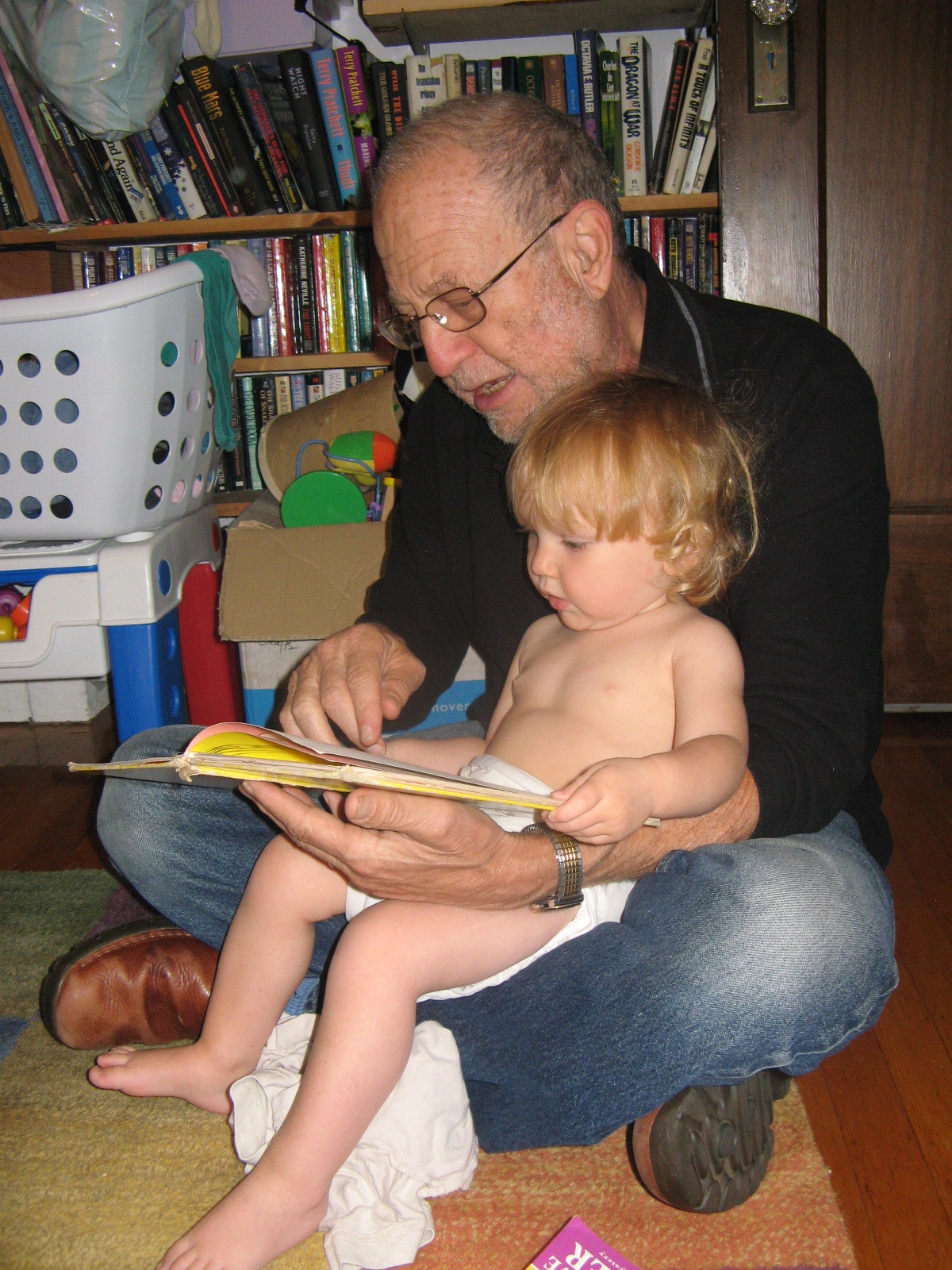
Marty and Mookie started spending a lot of one-on-one time together when she was a toddler. Joy and I both worked at home one day a week, the only problem being that when you have a toddler at home, any hope of doing actual work goes out the window. So on Wednesdays, Marty would come over from Oakland to our home, which was in San Mateo at the time, and take care of Indi. Their usual routine was the playground, then Junior Gym, then lunch or something special like frozen yogurt. I’m pretty sure it was Marty who treated her to her first ice cream cone: chocolate, at Donut Delite in downtown San Mateo.
When Mookie was three, Jerry Brown returned to the governorship of California and Marty came out of retirement to work for his administration again, as he had done in the 1970s. We were delighted that Brown had won, but a bit sad about the personal impact. With a demanding job and a commute to Sacramento, Marty would no longer be able to spend Wednesday mornings with his granddaughter. The job and commute were demanding, but Marty found ways to compensate. For example, although he didn’t spend a lot of time in his department’s San Francisco office, he did have it as a kind of Bay Area base, and to boot, it was in the same building as Mookie’s preschool (we had moved to the city), so he made the most of it. When her group was exploring the cooking and serving of food, they made appetizers and planned a field trip to Papa’s office. Mookie was thrilled to be able to introduce her teacher and friends to her grandfather; the state employees were charmed to be served appetizers by a group of three- and four-year-olds; and Marty was a very proud, happy Papa to be able to show them all his adorable grandchild.
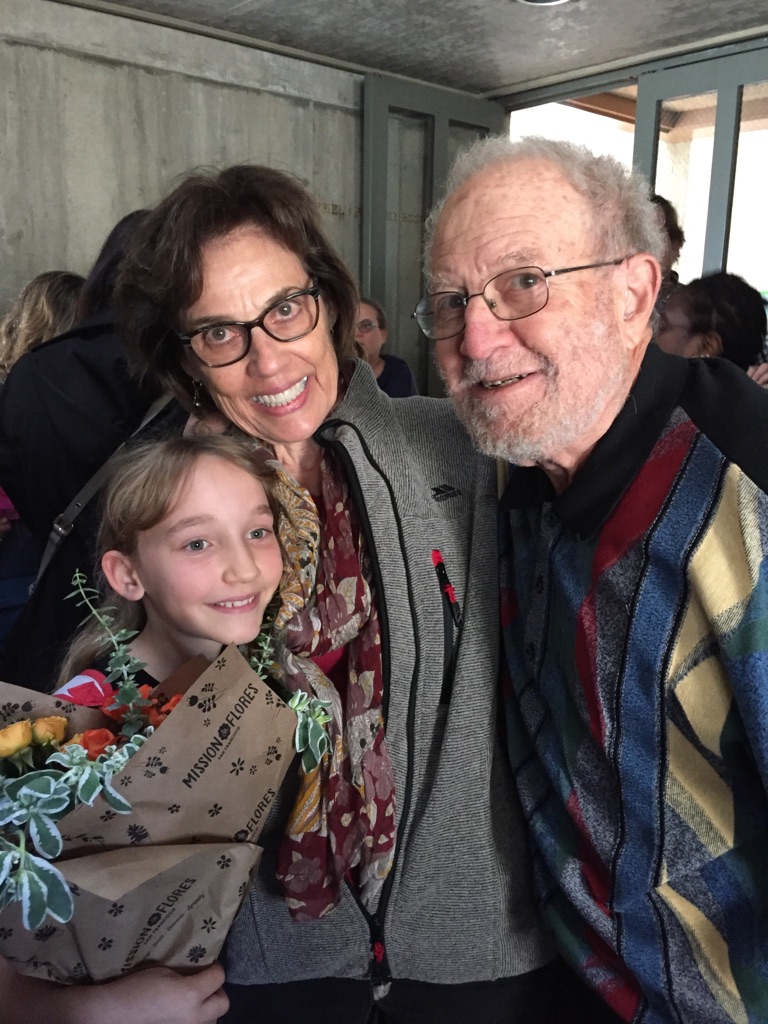
He continued to be just as doting, attentive and admiring as she grew up. They didn’t remain officemates for more than a couple of years, but soon she was going to Shakespeare day camp for a couple of weeks each summer, and Marty, the English major, Shakespeare lover, and Indigo fan, was always in the audience. Theater wasn’t easy for him because of his severe back pain, but he got there. When three summers ago, he had to miss her performance because the drive to and fro and sitting in the theater for an hour were too much for him, we knew his health must really be declining.
I so loved the sound of his delighted voice saying, “Is that my grandchild?” whenever we entered their house, and my heart aches that we won’t hear it again.
I can’t handle the pressure of trying to put everything into one blog post, so I’ll stop here and post more when the memories overflow and leak out my eyes. I love you, Marty. Thank you for being a wonderful father and grandfather to my family, and the best father-in-law I could ever have wished for.

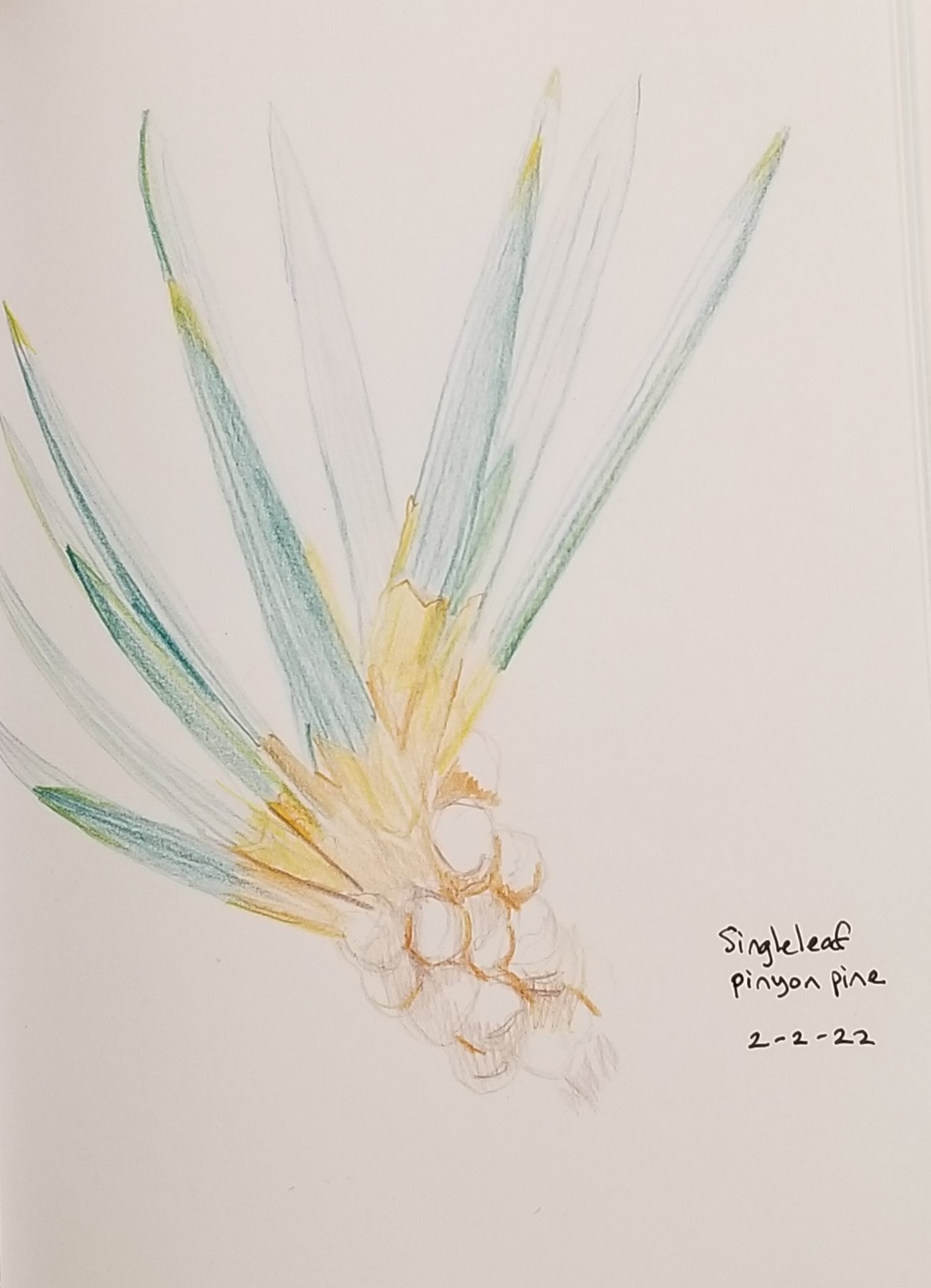
Also known as the two-needle pinyon. “The most common species on the south rim of the Grand Canyon.”

I plan to get back to the needles once I have my field guide again, but I’m tempted to just draw one of these every day until I have done them justice.

I am visiting family without my field guide, so I picked this up in their yard.

I like the sense of scale the hand provides. These are such short needles, only 1-2″ long as a rule. This tree, which as far as I know I have never seen, is just barely native to the land that is now the state of California. Its range is mostly in Baja California, Mexico, and just peeks up over the border into the southernmost part of the state, not by the coast but inland.
I stopped when I got tired, which means that some of these needles cast no shadows or don’t connect up to the twig. Spooky.

As a congregational minister who has been creating worship online and/or outdoors for two years, and will soon, I hope, be resuming indoor services, I read with interest a recent New York Times opinion piece by Tish Harrison Warren, a priest of the conservative Anglican Church in North America. She ends with the reminder, “A chief thing that the church has to offer the world now is to remind us all how to be human creatures, with all the embodiment and physical limits that implies.” However, the rest of the article did not offer much to those human creatures whose physical limits keep them from getting to the church building.
Warren argues that being in one another’s physical presence is irreplaceable, and with that I wholeheartedly agree. However, she takes that as a reason not to offer any other way to gather. The heart of her complaint is that “offering church online implicitly makes embodiment elective,” which suggests that the only form of human embodiment worth the name is the kind that can attend church in person. Need it be said that that is not the case? Whether we are capable of getting out of bed, traveling with manageable pain, and being in a public space for an hour is not a matter of “consumer preference, like whether or not you buy hardwood floors.” It’s something that some of the congregants with whom I serve simply can’t do, no matter how much they may wish to.
In fact, for us at the Unitarian Universalist Church of Palo Alto, one of the boons of these hard, isolating two years has been that we reached people in this situation whom we had previously excluded despite our best intentions. It has opened my eyes to the ways in which our outreach to members with disabilities was simply inadequate. For many years, we have offered rides to anyone who needs one, but some people didn’t take us up on it, saying that they couldn’t predict until Sunday morning whether they would be up for leaving their apartments. I would assure them that that was fine, that the person offering them a ride understood and could change plans on short notice, yet few people accepted this arrangement, and I thought we had done all we could. Once we began offering online services, I realized that this was the “more” that we could do, because some–not a lot, but a few–people attended that way who had not left home for church services in some years. (We also have attendees from far away, which is a lovely new development, but that raises different issues and I’ll set them aside for now.)
Warren offers, as a solution, visits to homebound members, bringing them the worship experience where they are:
A small team of “lay eucharistic ministers” at our former church volunteered to go to the home of anyone who could not make it to church and wanted a visit. They would meet one-on-one with people, caring for them, reciting a short liturgy together, serving communion and catching up.
That’s a great thing to do. We visit folks, of course; we also have a pastoral singing group that goes to people’s homes. We could, and should, do much more of that. But I can’t see myself departing from the church on Sunday afternoon, personally renewed by our experience of corporate worship, and then visiting someone to whom I have effectively said, “Never mind corporate worship. A personal visit is enough.” Many of the members of my congregation may feel–as hundreds have since March 2020–that while attending via the internet is second best, it is far, far better than missing out entirely.
Homebound folks may feel less inclined to attend online church when most other people are there in person. On the other hand, they may feel more eager to turn on their computers: “Everything’s happening at church! I want to be a part of it.”
Perhaps my and Warren’s different liturgical traditions create different circumstances. If the most important element of one’s worship is the eucharist, perhaps a visit centered on communion is enough to make the congregant feel that they have partaken of worship. However, our Unitarian Universalist worship revolves around making music together, the spoken word, silence, and the living knowledge that one is moving along the path in the company of dozens or hundreds of people. Naturally, one can bring some elements of even this worship to a one-on-one visit. When I spent a couple of days in the hospital years ago, it meant a great deal to me when someone visited me, lit an electric version of our ceremonial chalice (hospitals, like other places where pure oxygen flows, forbid open flames), and shared a reading from our hymnal. I absolutely felt ministered to, and as if I had been to worship. However, as a substitute for corporate worship every week of my life, it would be thin gruel.
Furthermore, those few who are endangered by close contact and thus unable to attend corporate worship in person are often reluctant to admit visitors for the same reason. What about, for example, a member who has a very weak immune system and must curtail visits to their home? I’ve had wonderful conversations with such members of my community via phone or Zoom. Due to their health risks, they may never come to in-person services. So if we cease our online services, they will cease to have a service to go to, period.
It may be that once COVID fades, internet worship no longer attracts more than a handful of people. But we have yet to find out. I hope we’ll find out by offering it (alongside indoor and, probably, outdoor services), and seeing who still attends, not by yanking the plug.
So we will most certainly offer both. It’s not about embodiment being elective. It’s about some people simply not having bodies that can get to the building easily, or at all.
If, as Warren fears and as probably is the case, some people who are capable of attending in person opt to attend online rather than engage with the complexities of physical presence, we’ll deal with that when it arises, compassionately and without judgment. And I’ll be glad that while they are hesitating about whether to attend in person or just stay away from everything to do with church, we will be offering them a third option.
Edited to add: Five minutes after I posted this, I happened to get a phone call from an elderly woman in my congregation who attended almost every Sunday before COVID, and has done so online since. She said that as much as she misses gathering in-person, she may keep attending via the internet. (We already have in-person, outdoor services, thanks to our climate.) The 20-minute drive is just too much for her sometimes. I rest my case.


 Sermons in Stones
Recent comments