Adopting a spiritual practice from a tradition not your own is always a delicate matter. Lent was a part of my growing up because so many of my neighbors, teachers, and friends were Catholic, but I’m not Christian myself and so I would not describe myself as “observing Lent.” Also, knowing my oh-so-American attraction to self-improvement, I’m aware of the subtle misuse of the practice: “Try this for forty days and your life will be changed!” As if it were a new, sure-fire, forty-day diet.

Nevertheless, Lent appeals to me because of its teaching that sacrifice and discipline are part of how we grow closer to the holy; because of its invitation to walk a little way with Jesus, who is one of my heroes, and its reference to his suffering and doubt, in other words his being genuinely human; because of its echoes of the forty years’ wandering of the Israelites and the story of Jonah, one of my favorites in the Bible. And because it is a sound and useful practice. So here are my three disciplines for this period:

(1) Go on a Facebook fast. No checking in for the next 40 days (or 46, since I don’t plan to excuse myself on Sundays). We are only a day into Lent and I’ve had the mindless impulse to see what’s happening on FB at least a dozen times. Can I make each of those moments of impulse and turning away from the impulse a meditation on the question: how do I want to spend the next half hour of this wild and precious life?

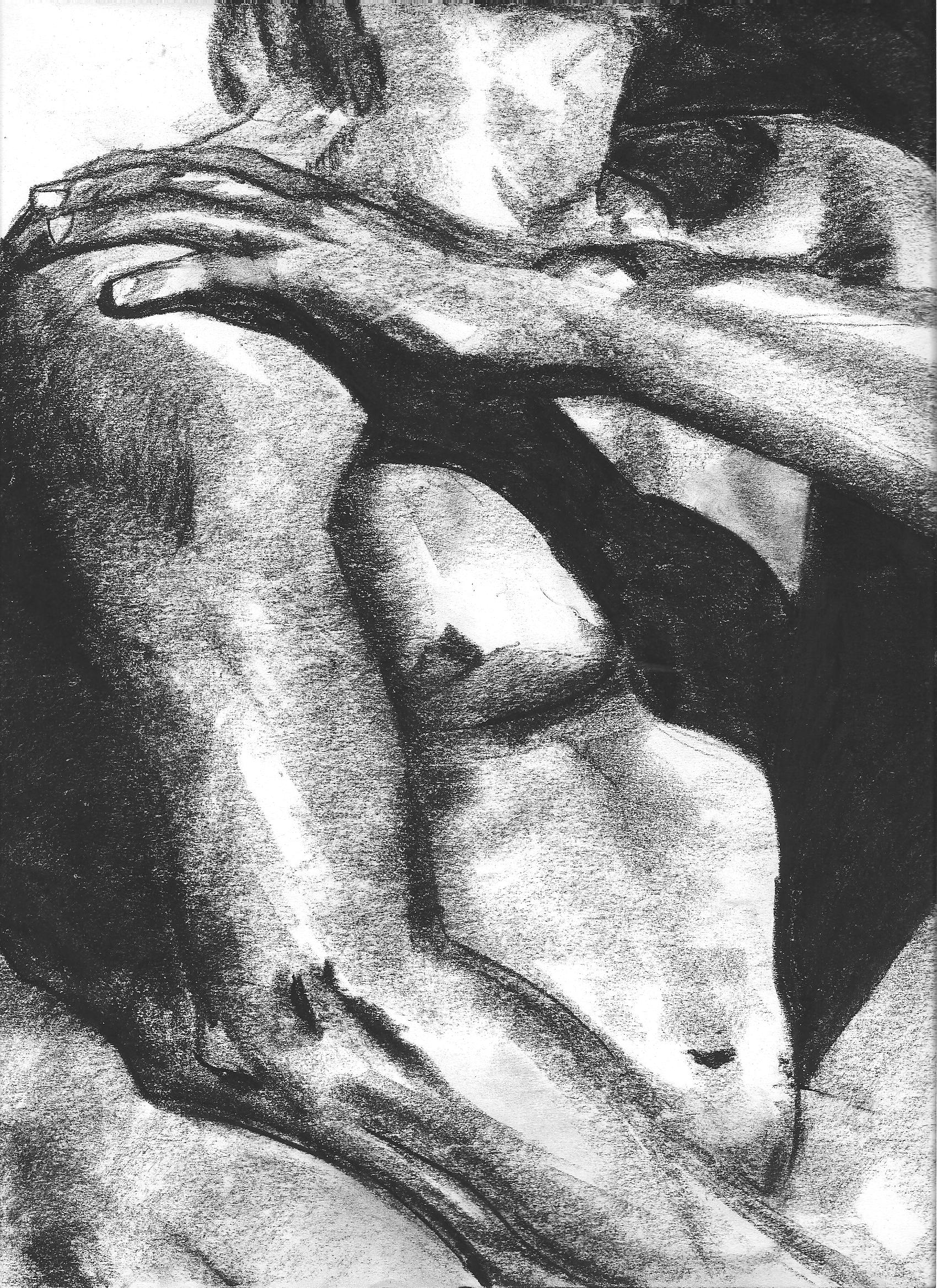
(2) Draw for ten minutes every day. Again, Sundays not excepted. This is about both discipline and discovering, again and again, per the name of this blog, the sacred in everything.

(3) Give to charity (or better, give to justice!). I was thinking of making this a daily practice, but I think I’m pushing my limits on daily practices already, so I’m just going to give, in one lump, to a cause that’s been speaking to my heart: the end of human trafficking. I’m still researching which organizations are most effective.

(c) Anderson—Alinari/Art Resource, New York

(c) Giraudon/Art Resource, New York

Who’s easier to draw, men or women? At the first break on Monday, the man next to me and I discussed it. He thought men were easier–“more obvious,” and added that the Greeks found men more aesthetically interesting. I wondered whether that was because they liked all that visible muscle–it gives you more to grab onto (may I stress: artistically speaking). Of course, they loved to sculpt athletes. Did Greek women do sports in ancient times? He thought yes. I don’t think it worked its way into their ideal of female beauty.  Even allowing for the fact that female athletes seldom develop the pronounced muscles that men do, Atalanta, on the right here, doesn’t really have a runner’s legs.

All of this musing was inspired by the new model. The studio’s been low on male models for a while, but this man started working this week, and he’s excellent. I wouldn’t call it easier, but it was a change and an interesting challenge. Last week’s weren’t that good, and having the rush of first-time readers due to the Freshly Pressed plug was like having all these people dropping by and me in curlers. So here are some from this Monday, a somewhat better hair day.

10-minute, including a rare foray into faces:

20-minute:

photo by Lin Kristensen; used with permission (Creative Commons)

I have always been an avid rereader. My dad, who in my childhood was forever introducing me to new authors he thought I’d like (to my everlasting gratitude), would see me reading Sal Fisher at Girl Scout Camp yet again and give a groan of despair. It didn’t take me long to notice that he did a lot of rereading himself, though, although I admit that The Tempest is more likely to turn up new subtleties on the fourth reading than Sal Fisher.

I do reread books to squeeze more juice out of them, though that’s not the only reason. I just like visiting with an old friend. If I liked them once, I’ll like them again, and I’ll laugh with an extra pleasure at the funny lines, as one does when reminded just how funny an old friend can be (I’m looking at you, Lawrence Block), and the sad parts have an extra poignancy when I know they’re coming but the characters don’t. The books I reread regularly tend to be the ones that had a strong effect on me the first time I read them, and also feature characters with whom I want to spend more time: To Kill a Mockingbird (Harper Lee), Animal Dreams (Barbara Kingsolver), American Gods (Neil Gaiman), The Secret Garden (Frances Hodgson Burnett), The Left Hand of Darkness (Ursula K. LeGuin), and The Dispossessed (ditto) come to mind. Now that I’ve discovered the pleasures of Austen and Dickens, I think they’re going to become frequent rereads. But don’t be deceived by the depth of these books. I reread Terry Pratchett, not just the ones that really moved me or made me think (which tend to rise immediately to the rank of my favorites: Small Gods, Feet of Clay, Jingo, Reaper Man), but all of them, because he makes me laugh.

I also reread mysteries, which may seem particularly bizarre, but as I don’t read mysteries in order to figure out the puzzle in the first place (since I never can), knowing whodunnit doesn’t diminish the enjoyability. In fact, I am particularly drawn to the ones with the unforgettable solution, such as any one of Agatha Christie’s best, because I can watch how she’s laying clues and red herrings and know that I would never, ever spot them on my own. It’s like watching a magician at work after he’s shown you how the trick is done: the magic is not diminished, but doubled.

Rereading is a bit of a drug. Several months after moving and unpacking most of our books, we finally got the mysteries and scifi on their shelves, and my new reading has slowed way down as I read old favorites. More challenging things stay on my “currently reading” list for a couple of weeks, even though I’m a fast reader, because on a Sunday afternoon when I want to do nothing but veg, I reread Lawrence Block’s Burglar books (and oh how I wish he would write a few more. I don’t care if the places Bernie Rhodenbarr chooses to burgle have an improbably high murder rate rivalling St. Mary Mead’s, I just want to spend another 200 pages with him). In the months when the mind candy was still in boxes, I read more new-to-me fiction than in any period of my adulthood–with the possible exception of last spring, when I also read a lot of new stuff, and for the same reason: we were living in Mexico and had no access to the hundreds of already-read books that usually line our walls, and getting a book out of the library that I own and have already read seemed silly. It has been really great to read so much new stuff, and as my mortality presses on me–my gray hairs multiply, my daughter leaps from newborn to four-year-old in a moment, people my age die–I become ever more aware of the profundity of the t-shirt slogan: “So many books, so little time.”

I recently learned that some people don’t reread very often, and so I wonder: Do you reread a lot? Any books or genres in particular? What makes you pick up a book for a second, third, fourth, umpteenth time–or not? What are you reading or rereading now?

ETA: Welcome to everyone who found their way here via Freshly Pressed, and thanks for all the comments!  I’m sorry I can’t respond as fast as you can comment, but I’m loving hearing about what you all reread, or don’t.  And d’oh, Harry Potter is definitely on my frequently-read list.  I’ve read each one at least three times, and some many more than that, since discovering the series in 2000.

I can imagine myself drawing mostly the human form for the rest of my life. This was not the outcome I expected from devoting my sabbatical to art. I thought I’d mostly be making abstract collages, and while I did some of that, I’m feeling blocked in that kind of art, which is something to tackle eventually. I didn’t expect to find figure drawing so exhilarating that I would look forward to Monday mornings the way I look forward to Girl Scout cookie season. Every pose is a treat. No, I’m not doing it justice–it’s more like a religious experience. (Well, maybe Thin Mints are also.) I can’t really write any more about that. After Sunday my ability to express a spiritual moment in words is tapped out.

It’s so instructive to look at these (drawings from last Monday, 2/28) in thumbnail versions–it gives me a similar perspective to seeing them from across a large room.  Three things I’m learning, looking at them, that I want to keep in mind when I get to the studio in a hour:

  1. A tighter focus is yielding good results–don’t try to take in the whole body.  Keep working on small sections and really get into them in detail.
  2. Don’t use the pencil for shading.  Stick with the broad side of the charcoal stick for now.
  3. Go straight to the shadows. That shadow along her right ribs and wrist in (e) begins to give the whole drawing the depth and aliveness that I’m going for.

Our district has been grappling with a painful situation: the firing of our District Executive, Cilla Raughley. Many (all too many) Unitarian Universalists of the Pacific Central District, including the congregation I serve (the Unitarian Universalist Church of Palo Alto, a.k.a. UUCPA), don’t even know that we’re part of a district, nor have any idea what services to expect from–or responsibilities to assume towards–the district. However, some of our members are paying attention, especially since Cilla was a member of UUCPA until she became DE. (A District Executive may certainly belong to a congregation, but some decide that it is best not to belong to any one district church, preferring an option such as membership in the Church of the Larger Fellowship.)

If you’ve ever been in an organization whose leadership went through a crisis, you’ll know it raises pastoral issues and issues of communication. One of the skills of community-making is knowing how to act when we have incomplete or conflicting information about matters of concern to the community. So I used my most recent newsletter column to share what I’ve learned from hard experience.

UUCPA is in a tender position because so many of us know and love Cilla. She and her husband Andrew have played important roles in our congregation, chief among them friend to many of us. Unitarian Universalism was not only Cilla’s employer, but her community, and she and Andrew must be feeling very alienated from their community. I hope you will extend them all the comforts of friendship. We need not know what happened, or what position we take, in order to express our support and affection.

Since employment decisions (with all their necessary secrecy) create strong feelings, conflict, and confusion, I want to urge us all to be mindful of what words and actions help build community in such a time. I have seen the damage done in these situations when we fill the gaps in our knowledge with gossip and speculation. We do it because we want to know what really happened; we have our theories and loyalties; we try to stitch a coherent story out of many and conflicting versions; but in rushing to replace our uncertainty with firm statements for which we have no real support, we do harm to real people. It is best if we:

* assume good intentions of everyone involved;

* remember that behind abstractions such as “the District Executive,” “the UUMA chapter,” “the PCD Board” and “the UUA” are ordinary people who, like us, love our tradition and are doing their best to make the decisions that will benefit it;

* ask ourselves, before we speak, whether what what we are about to say is true; if it is necessary; and if it is kind;

* remember that we are all Unitarian Universalists seeking to build a community together based on the principles we share.

A few months ago, the Worship Associate for the Sunday service touched my heart with a few words. She gestured toward the piano where our wonderful pianist, Veronika Agranov Dafoe, had just played the offertory in her usual stunning way, and said, with a little shake of her head, “A human being wrote that music. And another one played it.” I can’t even remember now who the composer was–maybe Chopin, whom I suspect is Veronika’s favorite, or maybe Mozart himself–but I thought of that moment again last night when I heard Mozart’s Requiem at the San Francisco Symphony. What a wonder that a member of our species created that, and 200 others recreated it for us to hear.

Two more drawings from Monday’s session. The first is more polished, and more successful in general, than the second; both benefit from my focusing on the torso (I could spend 20 minutes just trying to get the feet right). Must do more of that, even bring the focus in even tighter.

Unitarian Universalists need to be countercultural.  We need to be countercultural because there is much in our home culture (I’m thinking of US culture, but it applies everywhere there are UUs) that needs to be challenged.  One such characteristic (and here I’m definitely speaking of the US) is the tendency to equate progress and future orientation with a dismissal of the past.  Tear down the old to build the new. Adopt this exciting new technology and don’t bother to save anything from the one it replaces.  Favor youth over age. Why learn history?–it’s boring and irrelevant. That’s our modus operandi as US Americans.

So Unitarian Universalist ministers are walking in step with the dominant culture when we diss the “gray hymnal,” Singing the Living Tradition (SLT).  There were a few such occasions during the UUMA CENTER Institute in Asilomar earlier this month, which is why I bring it up. There was a lot that bothered me about the “uh-huhs!” that followed the hymnal-bashing, and the gleeful trashing of the past was bothersome element #1.  Hymnals are not just songbooks; they are repositories of history. For example, SLT records a very brief window in our history, between the adoption of the seven principles and five sources in 1985, and the addition of the sixth source in 1995.* And of course, it holds melodies and words that, like the beautiful brick buildings of old mill towns, I would hate to see discarded in favor of the new, no matter how beautiful the new might be (and the songs we are proposing to put in their place are sometimes as unbeautiful as the factory-built, vinyl-sided crap that now occupies the towns, but that’s a topic for another post).

When we changed over to the gray hymnal, what did we do with all the blue ones? In the case of most congregations, we discarded them, maybe keeping one on hand for the library (or not) but not using them anymore.  That great reading that didn’t make the cut for SLT? Forget it. The vast legacy of Kenneth Patton, whose mark is all over the blue hymnal as it was all over the Universalism (and humanism, and UUism) of his time? Reduced to eight nuggets (and most of them are indeed solid gold). Your mother’s favorite hymn? Gone. What a waste.

I appreciate the openness to other music that characterized the week at Asilomar.  We sang music my congregation almost never uses, and a lot of it was great.  It was cool to find spiritual meaning in pop songs that usually make me change the station (but seriously, UU ministers singing “love, lift us up where we belong!” in worship sound much better than Joe Cocker.  Of course, I think just about anything sounds better than Joe Cocker). I have lots more to say, good and bad, about the music of Institute week, but only praise for the willingness to break out of the hymnal(s) and try some new-for-us music.

However, in creating my home music library, I don’t throw out the old stuff when I buy the new, do you?  I bought a Dixie Chicks CD last fall–for me, this is cutting edge–and I still listen to my Beatles albums. (Is it okay to call them albums? I’m seriously dating myself, aren’t I?)  And that Dar Williams disc that I almost wore out the first six months I had it. And the late Beethoven quartets. And so on and so forth. Let’s not bury the hymnal just because we make the radical discovery that there are excellent songs for worship outside it.

Something I would like to bury is the mantra I heard a couple of times during the week and predict will be repeated ten times more at General Assembly, “No church that’s growing sings from a hymnal.” I want to see some documentation before I take that seriously. Also, I would like to know what it actually means. Individual congregations or denominations? Does it mean they don’t even have a hymnal, or that they do but they tend to project the words on a screen rather than use the books? I suspect it is simply a very broad translation of “mainline denominations are not growing,” which is itself a sloppy statement. The Catholic church and the Mormon church are not, technically, mainline denominations, because that’s shorthand for “mainline Protestant denominations,” but they are not independent or evangelical; they are both growing; and they both have hymnals.

I strongly favor expanding our music sources.  I especially favor getting our noses out of the books so we can look at each other.  I’ve purposely made our new Thurday evening services hymnal-free because something different happens when we sing music that doesn’t require reading.  But they use music from SLT, because it is powerful and beautiful.  Let’s not throw that beauty and power away.

__________

*The first five sections of the hymnal, encompassing 356 of the 415 hymns, correspond to the then-five sources. Also, the Principles and Purposes (which also include the sources) are printed on page x-xi.

From yesterday’s figure drawing session. The munchkin declared this “the most beautiful drawing I’ve ever seen!”

Me, I’ve seen better, even in my own batch from this day. I gave the arm too dark a line and could never repair it, so it looks nailed on like a Barbie’s; the shading on her stomach and right shoulder is also too abrupt. The outer line is heavy all the way, which flattens out the shape. Still, those are errors caused by too heavy a hand on the shading, and since my lifetime habit is to be too light, I think they’re errors in the right direction. And there’s a lot I’m happy with: the hand, even though it isn’t quite right, because it was a challenge; and the shading of the right knee and breastbone.

I asked my daughter what she liked so much about it. She said the black part around the edges, though she wanted to know why it got grey and stopped. I told her I’d run out of time. We had an interesting conversation as she asked why I put the black in and I tried to explain the concept of background.

It was an art-filled three-day weekend. My big Christmas gift to Joy was a weekend workshop at the Institute of Mosaic Art in Oakland, coordinated with my Wonderful In-Laws so that they took care of Munchkin and we could take the class together. Joy had already taken a mosaic workshop in San Miguel, with results that you can see here. This was my first go at it–another art form, like quilt, collage, and assemblage, that makes things out of other, often broken, things–and I could see myself seriously getting into this medium. I can’t show the results, because our digital camera is broken and putting a 12″x12″ concrete stepping stone on my scanner would probably be a bad idea.

Then I had my figure drawing session on Monday as usual. I can’t miss it every time Joy and the munchkin have Monday off, so off I went while they had a nice morning at home together. I wanted to get a four-mile walk in, which means a circuitous route to the studio since it’s only about 2 miles away. Unsure how hilly the route I’d planned was, I left much more time than I needed, and with over half an hour to spare, I went to Arizmendi, the fantastic worker-owned bakery that has recently opened in the Mission District, and over my second breakfast, thought about what I wanted to do differently in the day’s session. The previous two sessions, I hadn’t liked my drawings much. I decided on a few approaches: be bolder with shading, especially making sure to put in all the small variations in surface; get back to putting in a dark background where that was what made an edge stand out, rather than inventing a line that wasn’t there; focus on just one part of the body with each drawing; and above all be brave. It ended up being a good session.

Another change I made was to bring some sketch-grade paper, which has a rougher texture than the newsprint I’ve been using. I don’t know if it deserves the credit for yesterday’s improvements, but I like the way it grabs the charcoal, and it feels like an achievement to draw on nice white paper without seizing up from a fear of mistakes.

I’ll post one or two drawings a day instead of one big gallery, so here are two, ten minutes each. The second one here is probably my favorite from the day–I like the shading on the belly and thighs.

figure drawing 02 21 11 d 10 min figure drawing 02 21 11 e 10 min

Enter your e-mail address to receive e-mail notifications of new posts on Sermons in Stones

Links I like