You are currently browsing the category archive for the ‘Mexico’ category.
Our fourth day in Mexico City was Mural Day. First stop was the Diego Rivera mural “A Dream of a Sunday Afternoon in the Alameda” (image #1 here), to be followed by a stroll down the Alameda ourselves. On the way to the Museo Mural Diego Rivera, Munchkin had had a meltdown of major proportions, and I’ll say no more about that here, except to report that she was still a little tense, a little sniffly, when we went into the room with the mural, and it turned her mood around. She was captivated by all the people, who include kids, a balloon seller, a sweets seller; there’s even a dog in the painting; plus, as she pointed out, the room is like a movie theater. I also liked the other work on exhibit, by an artist I wasn’t familiar with, Saul Kaminer. I liked a sculpture that looked like a bird but had a “shadow” (that is, a flat component reminiscent of a shadow) that was shaped like a person (the name of the show was La sombra de la sombra,—sombra means shadow) and the munchkin found that so fascinating that she explained it to Joy a few minutes later.
Then we spent some more time contemplating Rivera’s great portrait of his country-in-progress. I wondered who would be in such a painting if we were the artists. Who shaped our country into what it is now, and who are our best hopes for making it what we dream of? Now Joy and I may make a big collage, which already has the title, in my head, “Nuestra Alameda.” I’m not sure where it should be set. Central Park? But we both thought that that would make it about New York instead of the whole country. Somehow I picture the whole country as background, the redwood forest to the Gulf Stream waters (and Woody Guthrie is definitely one of the people in the mural).
We headed down the Alameda to Bellas Artes, which has murals by Siquieros, Orozco and Rivera, among others. Rivera’s “Man, Controller of the Universe or Man in the Time Machine” was by far my favorite. He had painted it (with the title “Man at the Crossroads”) on commission for the then-new Rockefeller Center, but Nelson Rockefeller balked at the positive portrayal of Lenin, and had it destroyed. Our loss. Rivera had photographs to work from, and re-painted it in Mexico.
(Frida Kahlo had a similar clash with another member of the New York elite, Clare Booth Luce, who commissioned a portrait of a friend who had killed herself; Luce apparently expected a nice straightforward portrait, and was appalled when she opened the crate and saw The Suicide of Dorothy Hale, an explicit and disturbing painting of the actual suicide. I feel for Luce–and appreciate her keeping the painting and eventually donating it to a museum–but I wonder what she’d expected. Didn’t these people look at the artists’ resumes before giving them a commission?)
Bellas Artes also had a Magritte exhibit, irritatingly scattered among several rooms with no signs informing viewers where to go next nor even that it continued in another room. I can see how curating a show in Bellas Artes is a bit of a nightmare, with all the rooms widely separated by these great big murals. I didn’t like the museum much, on the whole. The layout was confusing and the guards were unhelpful and officious. But the curators of the Magritte show created playful videos of falling Magritte apples and tennis-playing Magritte pipes, and also put together a really terrific room of things to do and make in his vein. The munchkin sat down with the paper, pencils and scissors provided to anyone who wanted to make a bird, and made three for the wall.
On this Day of Murals, we also made our first attempt to see the murals that eventually turned out to be my favorites of the week, the Rivera paintings all over the Department of Education, but it didn’t work out. And that is a long story that I’ll tell more fully on Day 7, which is when it finally reached a happy conclusion.
Our last stop before collapsing was the Palacio Nacional, for more Rivera. It’s a crime to spend only 10 minutes looking at these paintings (many of which you can see here), but the munchkin had fallen asleep and Joy and I had to go upstairs separately, with little time left in the day. I might have to get a book of his murals. They are political screeds, biased in ways that are sometimes downright comical (who else would paint an entire history of the Aztecs without so much as a visual mention of human sacrifice?), but they’re so rich and beautiful. I love the composition, like his use of the staircases to show the chaos of battle and the collapse of a country, people and horses tumbling down the diagonals. And I love the panels showing Aztec farming, building, families, etc., one-sided though they are. These paintings, in that place, are like Rivera’s gift to his people: look, this is your heritage, this is where you come from, one of the world’s great civilizations.
On Monday, we traveled 35 km out of the city to the ancient site of Teotihuacán. There are very few trees at Teotihuacán and precious little shade, and the thing to do is get up at 5, get there by 8 and beat the heat, but while there must be some families capable of such a thing, we’re not one of them.
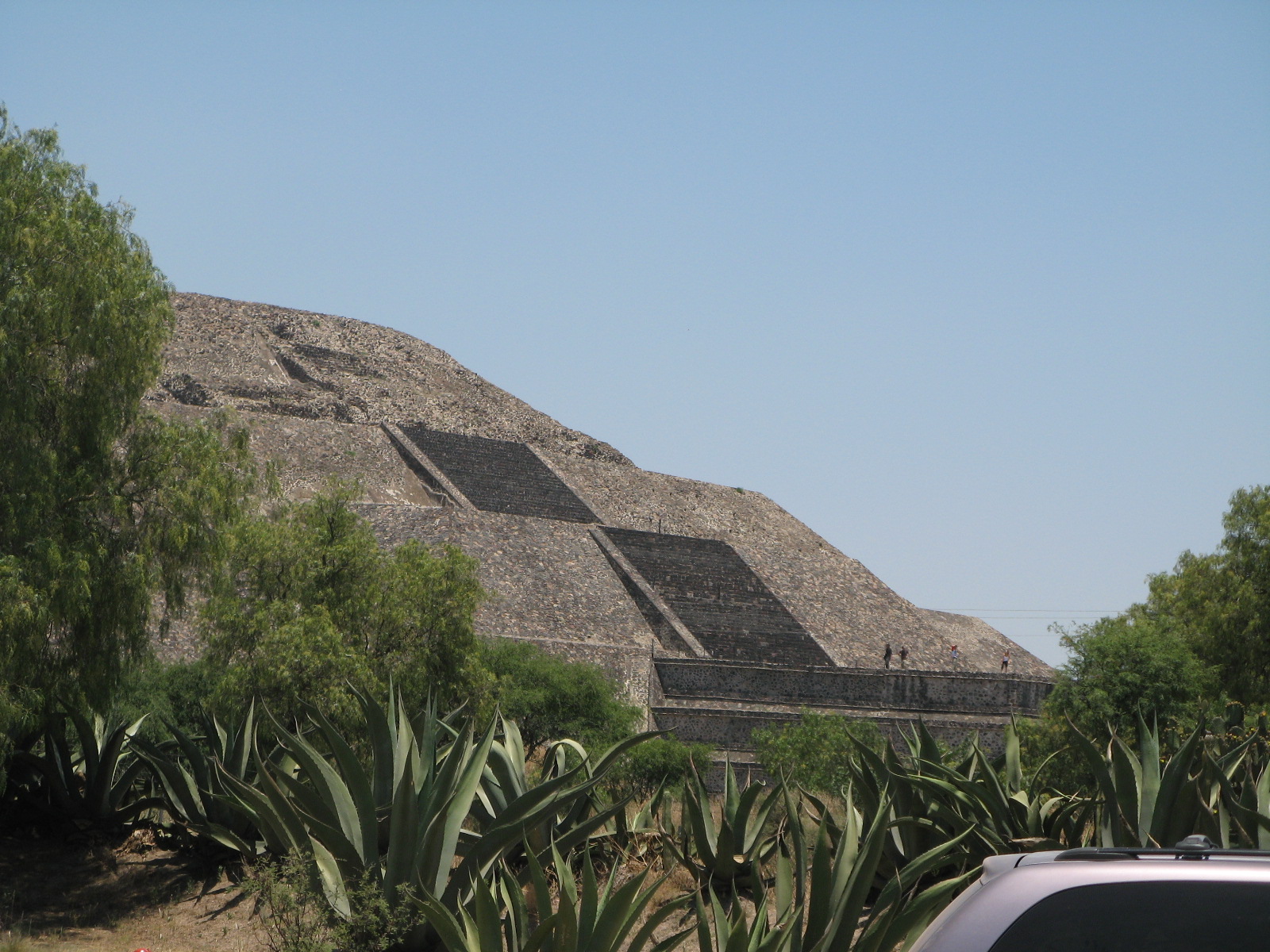
Pyramid of the Moon
No one is quite sure who lived there–the city was already in ruins when the Aztecs came along, and their guess about who had built it was passed along for centuries until archaeologists cast doubt on it–and the purposes of the temples, assuming the pyramids were temples, are also a matter of educated guesswork. The larger of the two enormous pyramids is still called the Pyramid of the Sun, but the information plaque next to it theorized that it was actually a temple to the god of water. If the weather here in the 5th century was similar to today’s, a preoccupation with either would be understandable: the sun because you can’t get away from it, water because you wish you had some.
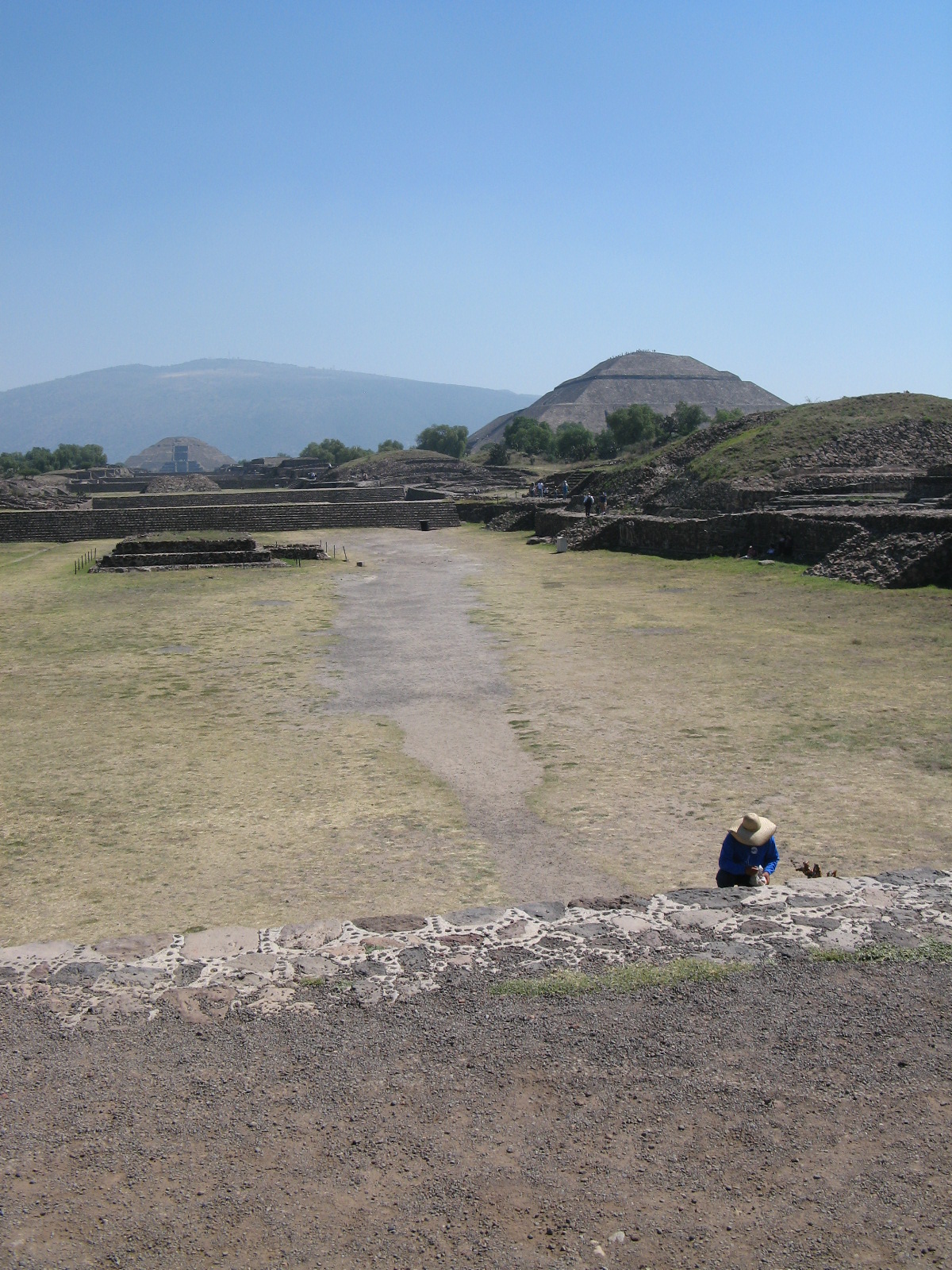
It is strange how a city can become a ruin. Not how it got that way, I mean (though that’s a mystery too–why was the city abandoned? Invasion? An internal uprising?), but how hard it is for us to see past the “ancient ruin” status and picture it like our own cities, filled with all the noise and activity of life. The wide-open spaces of Teotihuacan seemed like they’d always been that way. Even walking among the acres of former homes, even seeing remnants of the paintings that once covered many of the walls, it was hard for me to imagine people walking around there, cooking their dinners, leaning against a wall for a chat with a neighbor, trotting up the steps.
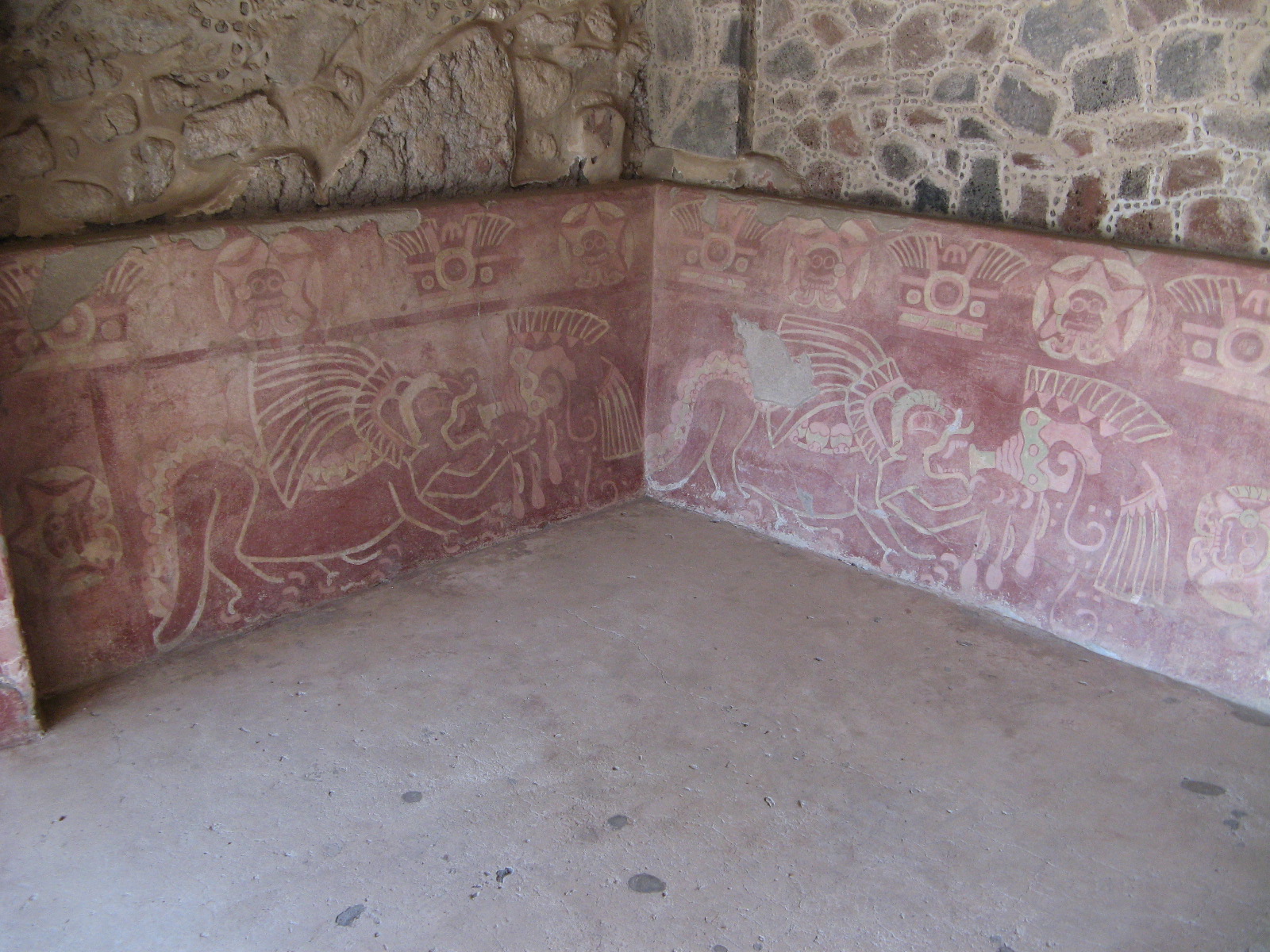

It wasn’t until I got to Templo Mayor, a few days later, that I could really stand within a long-ruined building and imagine it busy with people. For one illuminated moment, I really understood that they were there, in that place, just five hundred years ago, and that they weren’t thinking, “What a fabulous temple–it’ll make an impressive ruin one day.” They weren’t picturing their brilliantly-colored murals faded to fragments. They just swept the floors, got the ritual objects out of the closet, put their worship clothes on, and started the service. I could almost see the crowd strolling along the wall of sculpted skulls. Maybe it was easier to picture Templo Mayor as a living place than Teotihuacán because it is smack dab in the middle of a huge city; or because it has a roof overhead and so it feels like rooms instead of ruins; or even because it was used so much more recently, not by ancients whose name for themselves we don’t even know, but by the practically-modern Aztecs.

Templo Mayor (Aztec temple in Mexico City)
Maybe people in Mexico are better than I am at recognizing their continuity with the past. They certainly honor it more, despite being a thoroughly modern nation. For example, they’re less likely than we are to knock down old stuff to bring in the new, instead incorporating the old into the new. (I just learned that when Wal-mart built a store near Teotihuacán, workers were ordered to hide the artifacts they dug up–those who blew the whistle got fired. I’m feeling worse and worse about that stroller.) In San Miguel they are forever pulling up cobblestones to do work on the streets, and when the new pipe is laid, they put the cobblestones back. Modern Mexico also has a very different relationship with its indigenous roots than we have with ours, not surprisingly for a country where almost everyone is mestizo (mixed, i.e., partly native), but those are musings for another post.
The munchkin often talks about “zooseums,” and I mistakenly thought that it was simply her word for “museum,” so early in our time in San Miguel I told her about a “zooseum” (gallery, actually) I’d been in that I thought she’d like. We all went there and she looked around at the colorful art and said, in a voice that was made somehow more heartbreaking by its simplicity and lack of drama, “I thought we were going to see animals.” My maternal guilt-meter went off the scale. I’d deprived my child of her beloved Coyote Point for six months, plus I’d misled her into thinking she was about to see otters! Joy and I both rushed to tell her that there’s a great zoo in Mexico City and we’d go there soon.
So Sunday we took the long-awaited trip to the zoo in Chapultepec Park. The munchkin did enjoy the zoo very much, but I think in the end the highlight of her day was not the polar bear or hippo or even the terrifyingly agile snakes she adored, but the Spider-Man (-Men, I should say) who hung out in a booth along one of the park pathways and shook her hand. Here they are, only asking 10 pesos each for the photo, with a lesson in the proper hand position for web-spinning thrown in for free.

I’m ambivalent about zoos, to put it mildly. No matter how nice the enclosures (and this one’s are very good), they’re still cages, and the only kind of zoo I could feel 100% happy about would be populated entirely by animals who couldn’t survive elsewhere. (In fact, most of Coyote Point’s animals, and all of their mammals, were found injured and would die if released to the wild.) But it is still amazing to see them so close. And the Chapultepec Park zoo costs . . . zero. Yep, absolutely nothing. Incredible.
The approach to the zoo had approximately ten zillion things for sale besides photo ops with Spider-Man. Shoes, junk food, a skyscraper of cotton candy . . .

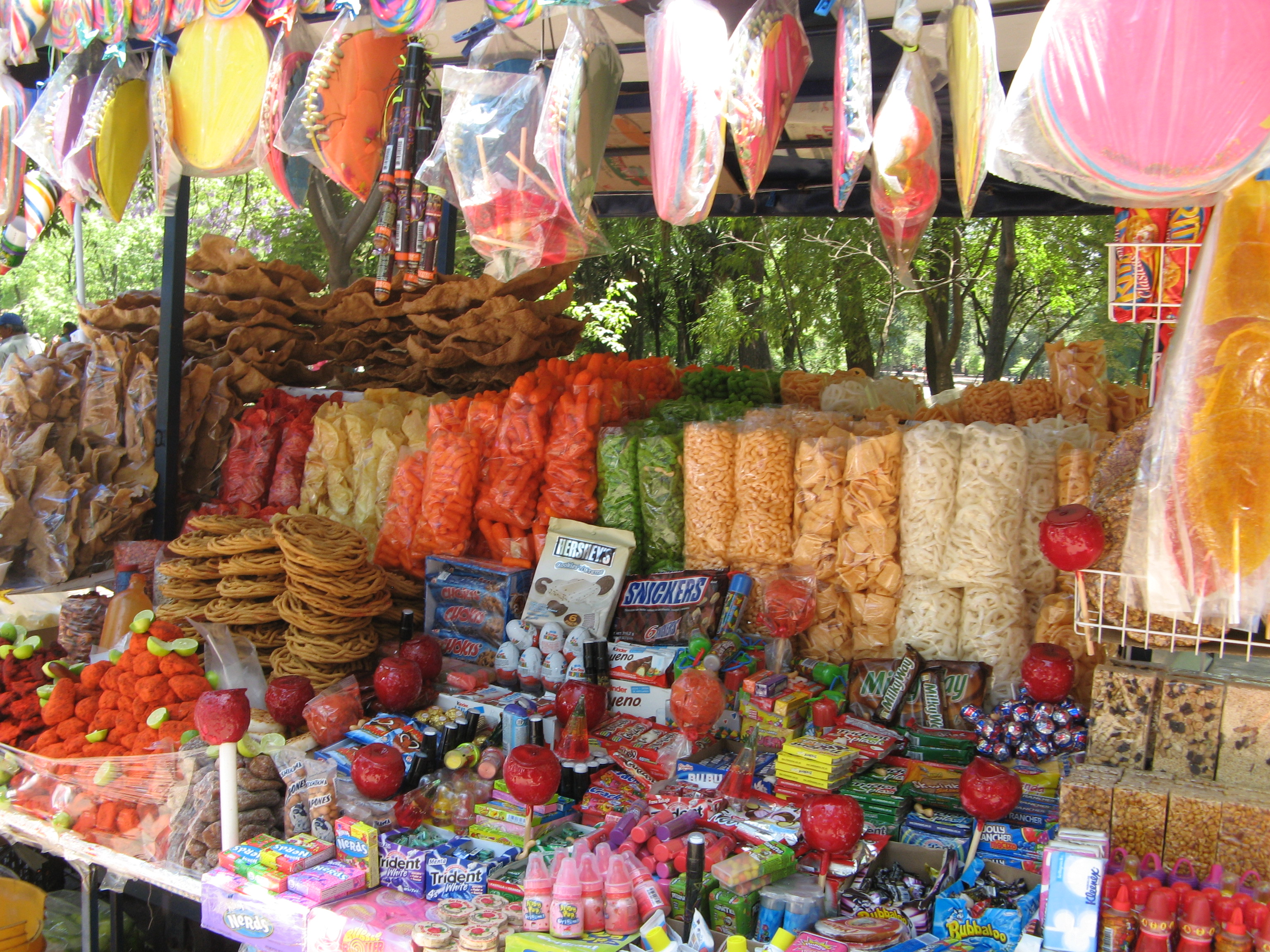

(all three photos by my multitalented spouse, Joy Morgenstern)
Our other visit on Sunday was to El Museo de Arte Moderno. The munchkin (who had a hard time the whole week) was melting down at that point, so we didn’t get to spend much time in the exhibit that interested me most, on the creation of Mexican identity. That’s travel with kids for you, even one who has remarkable museum-staying power for a three-year-old. In fifteen years we’ll come here with her and she’ll want to spend more time in museums than we can stand, plus she’ll want to race us to the top of the Pyramid of the Sun. Actually, she did suggest going to the top, but I thought a few steps were enough.
But I’m getting ahead of myself. Teotihuacán was Day 3, so I’ll write more about it tomorrow.
We’ve just returned from eight days in Mexico City, and boy, are our legs tired. No, we didn’t walk from there, on a variation of the ancient joke. We just walked around there, miles a day, it seemed. I ought to be losing weight here in Mexico, but I think in the battle between More Exercise and Lots of Cheese, the cheese is winning.
We got to the city last Friday evening after a full day Read the rest of this entry »
San Miguel is a great place for a religion junkie, a category to which I definitely belong. By all accounts, this town has even more fiestas and religious holidays than most places in Mexico. This week, Semana Santa, is peak season, but there’s a lot to celebrate even before Holy Week gets going.
At home, before we eat, we all take hands and say “Thank you for the food.” The speaking of the words usually falls to the munchkin, who delights in adding variations: “Thank you to Mommy/Mama for this wonderful dinner,” “Thank you for the shrimp and the noodles and the carrots,” and the like. When we got to Mexico Joy and I proposed saying it in Spanish as well every time. Munchkin responded by adding a third language, one in which she is fluent, and after she’s informed us as to which one will be said by whom, the family meal now begins something like this.
Joy: Thank you for the food!
Me: ¡Gracias por la comida!
Munchkin: Meow!
In such ways do we make rituals our own.
Speaking of which, we went to a fabulous fiesta Friday night, where the image of Jesus “Señor de la conquista” is carried out of the Parroquia (parish church) amid fireworks, dancing, and drumming. The article in the local paper says the fiesta is held “porque el catolicismo conquistó a los indios,” but, while I’m not dismissing the real, frequently devastating impact of Catholicism on native religion, the overall impression I got from the festival is that los indios and their pre-Catholic religious practices are going strong.
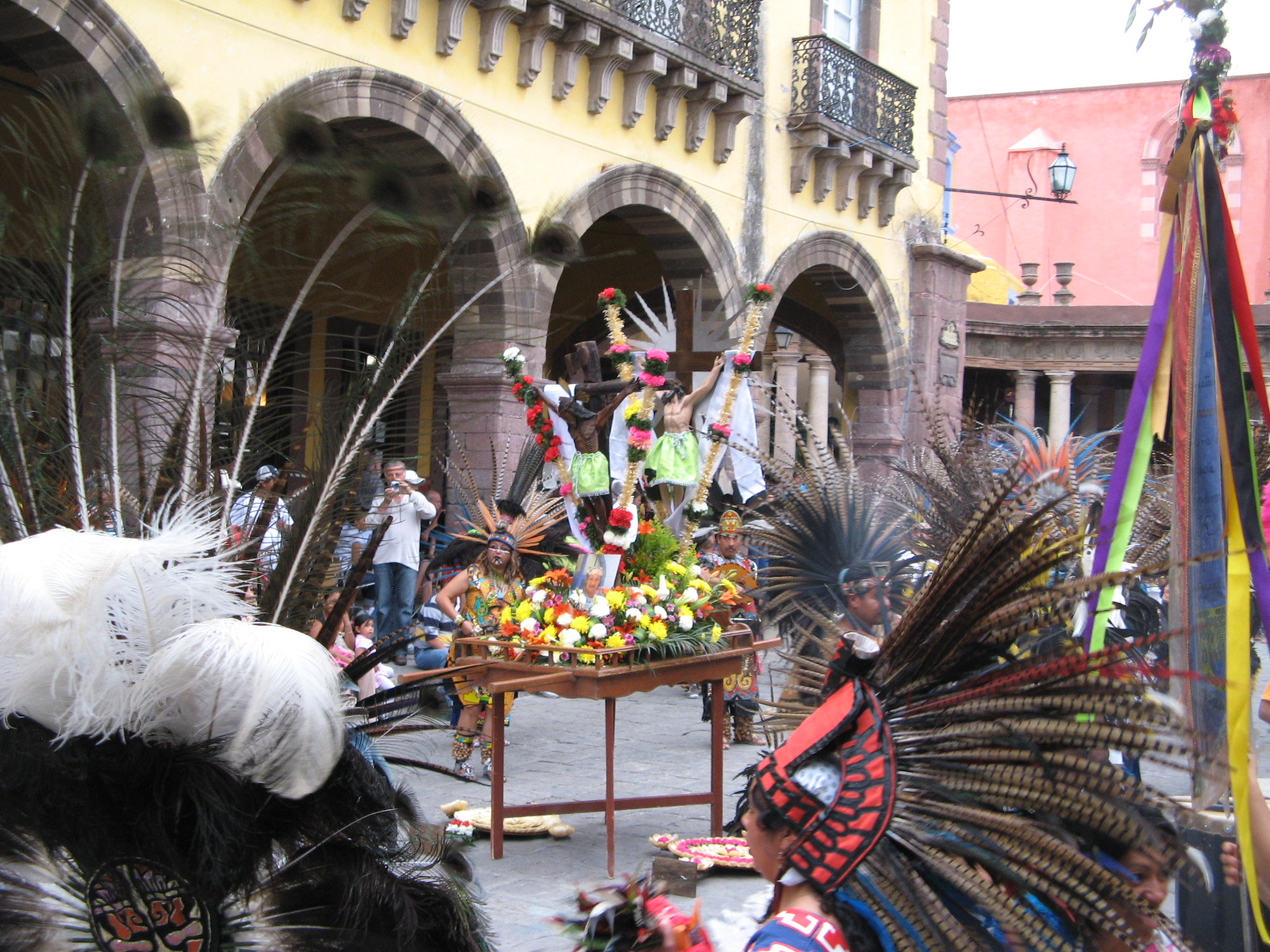

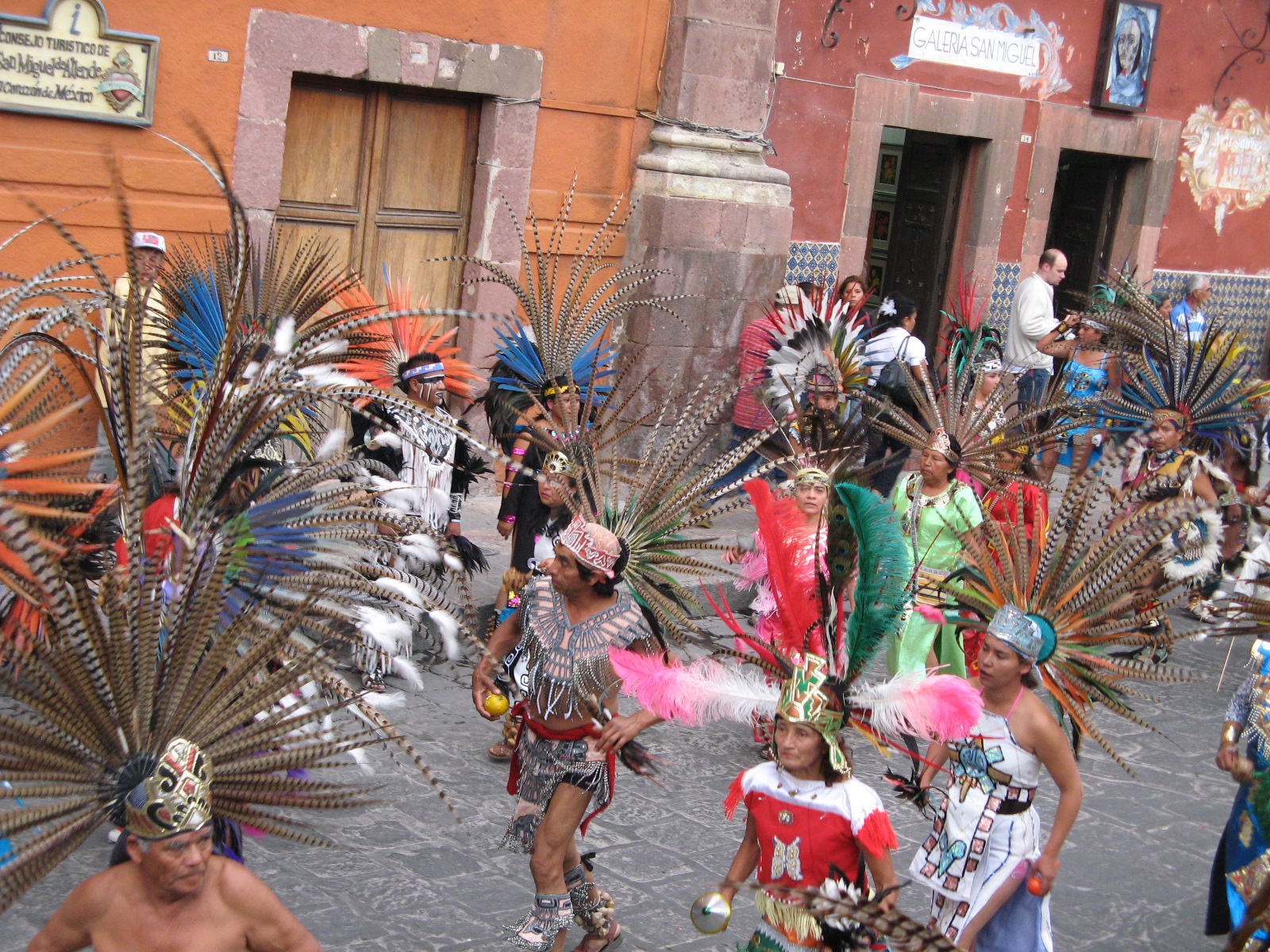
People of all genders and ages danced and drummed. The munchkin declared this guy “scary” but loved the whole event. We thought she’d want to watch for a few minutes and then eat dinner; an hour later she was still mesmerized.
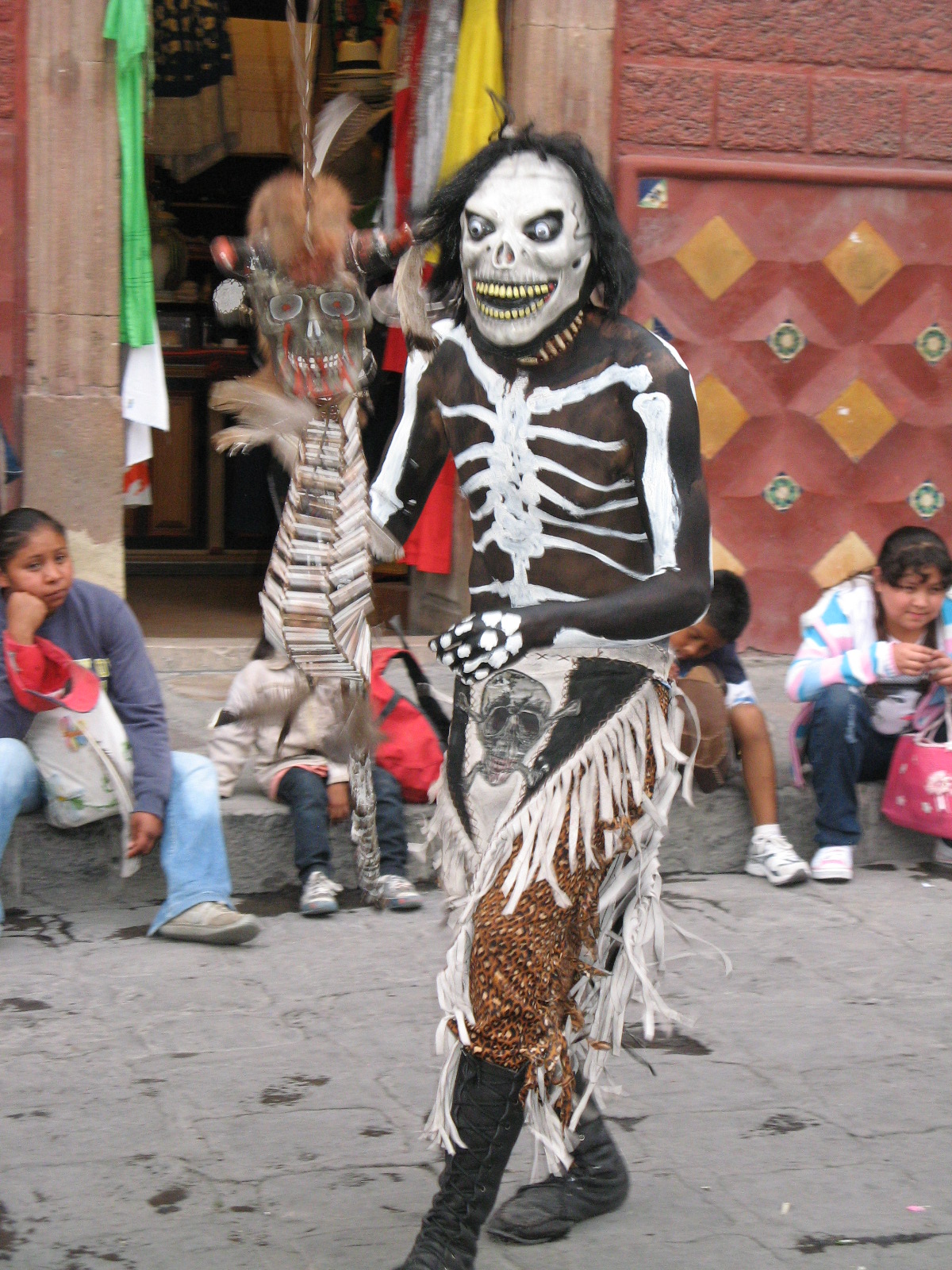
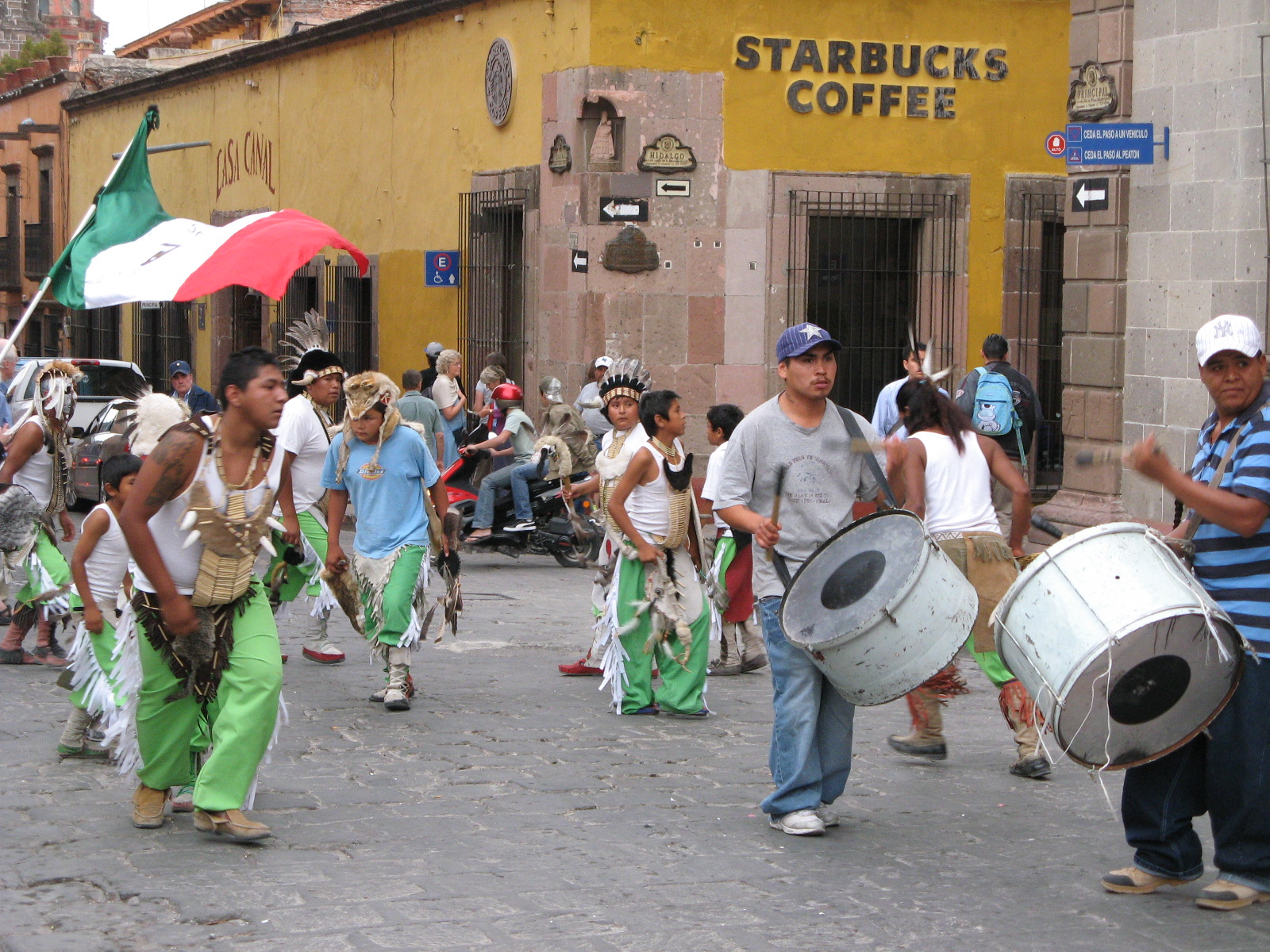
The good old Catholic church. “Fine, keep your feathers and your drums and your heathen dances, as long as you add Jesus into the mix.” (Mexican national pride is part of the mix too, as you can see from the dancers carrying the flag.) I’m betting this relaxed attitude toward syncretism is a more successful way to spread the word than uptightly insisting that indigenous people wear trousers and sing Wesley’s hymns–in short, imposing European cultural forms that are not inextricable from the religious concepts.
I make this assertion knowing almost nothing about missionary history. However, I think it’s a point to ponder for people concerned about church growth and diversity. What would Unitarian Universalism look like if we (meaning those who currently “own” it, a term I use ironically) relaxed a little more about the forms it takes on as it comes to different cultures (or subcultures) than the white, English-speaking, Calvinist-descended people among whom it largely originated? I don’t want us to conquer the natives, but I would like everyone who feels the call of Unitarian Universalism to be able to respond, and meet with a warm welcome instead of skeptical looks from those who are at home with the Protestant worship structure and European classical music that dominate today. It will look different in other hands. They will change it for themselves and, in some part, for everyone. If that means dancing like we saw Friday night, it sounds like a win-win to me.
I sang for my supper by preaching at the Unitarian Universalist Fellowship of San Miguel de Allende (UUFSMA) last Sunday. It turns out that in addition to the week’s stay at a home provided by the congregation, Joy, Munchkin and I were treated to lunch afterwards and got to take the day’s flowers home. Generous compensation for an easy morning; I prepared, of course, because I always do, but it was much easier preparation than usual because I’d given the sermon in essentially the same form two years earler at the Unitarian Universalist Church of Palo Alto. Text version is here, audio here. They were a nice bunch, intelligent and friendly.
Ten percent of San Miguel de Allende’s population come from elsewhere, and 70% of those are from the US or Canada. There are a fair number of expatriates and retirees, and lots more who come every year for a few weeks or months, plus a goodly share of one-time tourists. That’s whom the congregation serves: English-speakers who are here permanently or transiently, that is, mostly norteamericano retirees, snowbirds, and visitors. It is therefore elderly–our hosts joked that we brought the average age of the room down significantly–and has no children’s religious education or child care. As a result, we won’t be going much, since we can’t go together; if one of us goes to church, the other has sole charge of the munchkin all morning, which is okay now and then but far from a desirable every-Sunday arrangement.
They have a weekly discussion group that sounds really interesting, and a Wednesday lunch that we found welcoming, and “Circle Cenas” (like many UU congregations’ Circle Suppers). Everything seems very well-organized for people to drop in, with all information in the weekly order of service, few of the activities requiring an ongoing commitment, and membership offered in various categories to reflect the fact that many members also have commitments to another UU congregation. It’s also organized to gather up the comparative wealth of the congregation and give it to the local community; the church gives away 75% of its post-expenses budget to various San Miguel organizations, and with an all-volunteer staff, its expenses are low.
I’ve run into a couple of people who only started going to UU church when they came to San Miguel, so I know the church is doing outreach (perhaps only passively, though it advertises its services and its location better than a lot of US UU churches). Its outreach, however, is only to English speakers. It announces its weekly services in the English-language newspaper. Services, classes, group meetings are in English.
It makes me wonder about the possibility of having a church here that serves the local population–not just in the sense of the support the UUFSMA gives to San Miguel, but in the full sense that any UU church serves its members: a center for shared worship, religious education, justice work, pastoral care, etc. The vibrancy of the little group of norteamericano UUs points up the lost (or shall we say, not yet taken) opportunity to make Unitarian Universalism known to the tens of thousands of Mexicans who live in and around San Miguel.
How does one sustain a bilingual, bicultural congregation? As someone at UUFSMA noted, to make the Sunday service bilingual would make it very long. But there are other models for bringing people together into one congregation without a common language; San Jose, CA, seems to be making one work, as do many congregations in other faiths. E.g., where I live (near San Francisco) many churches have large populations that speak only or mostly Tagalog, Tongan, Chinese or Spanish, alongside those that speak only or mostly English.
Or might UUs in San Miguel start a truly Mexican congregation, maybe linking the two congregations in some kind of partnership but recognizing that they will be quite separate? There are a couple of emerging congregations in Mexico City. San Miguel might be a candidate for another.
How would someone go about starting a Mexican UU church in San Miguel, given the UUA’s unofficial franchise system (not to mention its almost complete lack of engagement with the world outside the US and Canada)? What resources does the UUA or International Council of Unitarians and Universalists (ICUU) offer to help a new congregation start in a town that already has one, in a way that diminishes any sense of rivalry and increases the partnership between them?
We also frown on UU ministers starting up congregations that they will then serve. There are good reasons for this, but it means that the only way for a new UU congregation to get started is for a very devoted group of laypeople to work at it, probably for many years, before they have the resources to bring in even a half-time minister. It also wastes the tremendous resources that ministers have to offer. In the case of San Miguel, many ministers have come through and led a service or a class; occasionally they retire to the town themselves. Maybe one who was not yet ready to retire would want to plant a church here, if they could count on support. Surely there are ways to safeguard against the problems that can come along with a minister helping to found a congregation: say, a requirement that the minister serve for only a certain number of years (five?), then has to be voted in or out by the congregation, as in the late (and lamented, by me) Extension Ministry program.
I’m not interested in the job (at least, not for another thirty years or so), but the questions make me want to do a little research into the other faiths represented here in San Miguel. I bet some of them, other than the Catholics of course, came from somewhere else and offered their message and their service to Mexicans. Maybe some of them even did it with the respect for the local culture that I’d expect from UU outreach. I’d like to see how they did it and how it’s going.
I’ve barely posted about San Miguel de Allende. It seems to call for photos, and I don’t have many yet. Tomorrow morning I’ll take and post some of the house and colonia. First we have to get some decent batteries for the camera, since the ones we bought in the Tuesday market were crap. They’d probably been sitting there for five years. But for now, for a photos-free post, read on.
On our fourth day here, having taken a few rainy days to get acclimated, we set out on a finally-dry day to visit the preschool we’d heard about and the first of the rental houses on our list. The munchkin explored the school playground while we chatted with the director. Bingo. We liked everything we heard and saw and felt, and the format was just what we were hoping for: half days Monday through Friday, allowing us time for our own explorations but giving us more family time than we have when we’re both at our jobs; teachers who understand English so they’ll know what the munchkin is saying; a program that’s half in Spanish so she’ll learn it; kids from all over, some there to learn Spanish, others English. (Back home in the Bay Area, they call it dual immersion.) Having arranged for her to start school on Monday, we had lunch in the cafe across the street and then headed to our appointment to see the house on Calle Esperanza.
We were running late even by the relaxed standards of Mexico, so Joy went on ahead while I followed at the munchkin’s pace. She told me later that as soon as she walked inside, she told the owner that she loved the place and I would too. And when I joined them about ten minutes later, the first thing I did was signal to Joy that I loved it. So last Monday was an eventful day: Munchkin started at her new school and we moved into the house where we’ll be living until the end of July. Taking note of the streets between school and home, Joy said, “OK, this one is Tesoro. We don’t live on Treasure, we live on Hope.”
San Miguel has spiffier, newer, gringo houses; this one is not one of those . It’s a little funky, with lots of things that are just a little broken and almost everything a lot old. (There’s a huge, beautiful, wardrobe in our room with three mirrored doors and a sign on the center one, “Don’t open–it falls!” We’re not sure whether it’s the door that would fall, or the whole thing, and don’t dare to find out.) We’re waiting for the landlady’s brother to come put in light bulbs in the many fixtures that are missing them, and looking forward to being able to cook by overhead light instead of a floor lamp stolen from a bedroom.
Downstairs, an enormous brick fireplace joins the living room and dining room. Upstairs, twenty-five feet of windows fill our room with light. Brick arches, and in one place a brick cross vault, punctuate the stucco walls and ceiling. The house is decorated with years of amateur artists’ paintings and prints (some excellent), a full-length mirror carved with calla lilies, chandeliers made of thick multicolored glass, odd touches such as a wall of antique keys, tile details everywhere, and about twenty crosses, I kid you not. We need a plant for the hook on the stairway wall, and as it’s next to a cross, a crucifix, and a sacred heart, I’m thinking the Wandering Jew currently living on the roof would be appropriate.
A spiral staircase in the middle of our room goes up to the roof. I told the munchkin that in Spanish it’s called a caracol, a snail; she loves snails. She now calls it the snailcase. The huge rooftop has places to sit and a fabulous view of the city. It has a wall all around, but the munchkin still isn’t allowed up there alone, of course. The shared courtyard at ground level–a jungle of plants–is completely shut in and often houses a sweet old Golden Retriever named Zumm, and there she can play with minimal supervision. On her first couple of days here, she seemed to have developed a fear of dogs we’d never seen in her before. There are a lot of wandering dogs in San Miguel, and while I’m glad she doesn’t run up to every strange dog and pet it, I don’t want her to cry and try to climb up our legs every time she sees one, either. She was very scared of Zumm when she first saw him, and who can blame her? He’s taller than she is and about four times her weight. But she bravely made friends on Monday when we moved in, and now asks all the time if she can go outside and pet Zumm.
Tomorrow I’m moving a table into the second bedroom and making it my studio. Room to work, a bathtub the size of Lake Michigan, lots of light, a view of a beautiful city, funky touches everywhere–and all for less than one quarter of our rent at home. We’ve landed in a good place.
Buying hardcover is such an indulgence, when a year’s wait will get you a paperback and a month or two’s wait will get you to the top of the queue at the library. So it was a real treat when Joy gave me the newest books from three favorite authors at the holidays: Terry Pratchett (Unseen Academicals), Robert Barnard (The Killings at Jubilee Terrace), and Barbara Kingsolver (The Lacuna). It was Christmas week and my first week on sabbatical, so I wolfed down the mystery and the Pratchett before so much as peeking at Kingsolver’s thick new novel. But by the time I got to page 5 of The Lacuna I couldn’t put it down.
I was a little apprehensive going in, especially when I realized the book was going to deal with overtly political issues. Not that I expect (or want) Kingsolver ever to be apolitical, and Animal Dreams, which wears its politics on every chapter if not every page, is not only my favorite of hers but one of my favorite books, period. But my last go at a Kingsolver book had been Prodigal Summer a few months before, and I couldn’t stand the lectures on the preservation of despised predators that she forced out of her heroine’s mouth. I love Aldo Leopold, but I don’t want to read him reproduced in improbable dialogue. I like my essays to be essays and my novels to be novels. If telling is inferior to showing, ranting is worse than telling.
She does stray into ranting a couple of times in The Lacuna, but late and seldom. I was so captivated by then that I could forgive a couple of unnecessary, distractingly lecture-y passages on the subject of the blacklist. I love the main character, I love the way she writes about people like Kahlo and Rivera and Trotsky so convincingly, I love the painterly detail of her descriptions of Mexico. And I love the metaphor of the lacuna.
A lacuna is a gap, such as a missing page in an old book or a period of silence, longer than a rest, in a piece of music. Kingsolver uses it in multiple meanings, layered and interacting, which is one reason I can tell this book will reward rereading. One is the geological phenomenon of a cave that is actually a tunnel; another is the missing volume in a lifetime of diaries; a third is whatever you don’t know about others’ lives. What they choose to leave out when they tell you about themselves.
The most poignant lacuna evoked by the novel, for me, is the gap in our world created by the failure of Communism, by which I mean not the collapse of the USSR, but the failure that concerns Kingsolver here, the true one, the one that began in the 1920s when Stalin rose to power. What did we lose when the revolution was betrayed to totalitarianism . . . ? Workers’ ownership of the wealth they produce has always struck me as eminently sensible, but I got through four years at what I privately dubbed Marx-and-Freud University without ever reading Marx, something I still regard as a, well, lacuna in my education as a citizen of the 20th-and 21st centuries. (I did read plenty of Freud there. And for the record, as outdated as much of his thinking is judged to be and surely is, I think he was a genius and a hell of a writer.) I’ve never given much thought to Trotsky, the sum of what I know about him being that he was an early Communist leader and visionary, he had an affair with Frida Kahlo, he was assassinated in Mexico City, and he (probably) shows up in Animal Farm as Snowball the pig. All but the latter get attention from Kingsolver. Now I want to know more about him and his philosophy. Her protagonist grieves for him as a person; I grieve for what we lost, as a world, when the great Communist revolutions died.
Not that ideas ever die. The end of the book suggests that there might be life in these “dead” ideas yet.
Another, related lacuna suggested by The Lacuna is the work lost to our culture by our imposition of the blacklist. All those writers and directors and actors who were shut down and never got back to their life’s work. What might they have created? It’s gone now, unrecoverable.
I also realized, with a laugh, that I did my undergraduate art thesis on lacunae. Not that I used the word–thank heaven, undergraduate art majors have enough of a struggle with pretentiousness–but my senior show in ceramic sculpture was called “What’s Not There,” each piece having in some way to do with an absence that makes itself felt as a presence. More on this in another post, as this one is long enough.
Barbara Kingsolver is giving the keynote at the San Miguel Writers’ Conference in a couple of weeks, called “Finding my way into The Lacuna,” and we will be there.
Estamos en México! We arrived Monday night and are enjoying the hospitality of the Unitarian Universalist community here via a generous couple who lends their home to visiting UUs and others. In exchange for my preaching on February 14, we are staying here for nine nights, which should be long enough for us to find the place we’ll rent for the next several months. They also met us at the house at 11 p.m., got us settled in, and lent us several hundred pesos since the casa de cambio at the airport had closed by the time we got into Leon.
I was up at 6 a.m. on Tuesday, or was it seven? Joy’s cellphone had adjusted on arrival, yet didn’t agree with the airport clock, so I wasn’t sure. I wanted to walk those streets we’d come through in the rainy dark the previous night. “Did you look out the front window?” Joy asked. Across the narrow street, one building in orange, another one yellow with a bright blue door, another with a row of flowers blooming in cans along the rooftop terrace. Ah, llegamos! We’ve arrived!
Joy reminded me to take it easy. We’d jumped 6000 feet in one day and it can take a couple of days to adjust to this altitude–I already felt it in the unusual effort it took to lug our suitcases upstairs. I stopped at two—the other one could wait—and slipped into the rainy street, where everything reminded me, go slowly, go slowly.

 Sermons in Stones


Recent comments