
You are currently browsing the category archive for the ‘family’ category.
We deliberated for several days about what to do about Pesach this year. Our ideal is to host a Seder and invite friends, but most of our friends are 1500 miles away (or more), and we had trouble reaching the few we do have here. We looked into the San Miguel Jewish community’s Seder, but their response to “would a three-year-old enjoy it?” was not very encouraging. So we decided to just have a Seder for the three of us, with Joy cooking and me in charge of creating an abbreviated Haggadah.
Then, a few hours before the Seder, Joy saw an e-mail from a woman looking for a child-friendly Seder for her and her six-year-old son, K. We always have more food than we need, so we called them, they came, and we were so glad they did. They were really nice, interesting people; they’re UUs too; the munchkin and K hit it off (what a find, a six-year-old who’s happy to play with a three-year-old!); and having them here made our holiday complete. Eating dinner with just our family is lovely, but for the holidays it doesn’t feel quite right.
It was a funny business, creating the Haggadah. I’ve done it almost every year for several years now, for our church Seder, but having to really cut out most of it brought home to me what a crazy conglomeration and compilation it is. It shows all the signs of having been built by accretion; not just the recent, feminism-inspired additions like the orange and Miriam’s cup, but many elements, have been incorporated in response to some need or political moment that’s fallen into the obscurity of history. The four children, for instance; when did that come along, and why? All the lists and formulations, like the singing of the order of the Seder itself, and the “matzah, maror, pesach” bit—where did they come from? Why the four cups of wine? What does Chad Gadya have to do with Passover? Reading a typical Haggadah is like a walk through Jewish history. I’d love to see one that includes the works, with annotations about how each element entered the flexible canon that is the Haggadah.
What follows is what we considered essential and absorbable by our daughter. She has been to four or five Seders in her three years, starting with the one we held with close friends at home when she was a month old, but I don’t think she remembers anything from any previous ones. If she remembers anything from this one a year from now, I’m betting it will be playing with K, and the prizes they won.
(ETA that I notice a lot of people are finding this entry via searches for “unitarian haggadah” or “abbreviated haggadah” or the like. So if you’re wondering if you can use this, yes, and if your family doesn’t do “mad face” or blessings in Cat, adapt it to your own kids. Just please credit me, and make it clear to whoever uses it that it is drastically edited out of the vast realm that is the Haggadah.)
At home, before we eat, we all take hands and say “Thank you for the food.” The speaking of the words usually falls to the munchkin, who delights in adding variations: “Thank you to Mommy/Mama for this wonderful dinner,” “Thank you for the shrimp and the noodles and the carrots,” and the like. When we got to Mexico Joy and I proposed saying it in Spanish as well every time. Munchkin responded by adding a third language, one in which she is fluent, and after she’s informed us as to which one will be said by whom, the family meal now begins something like this.
Joy: Thank you for the food!
Me: ¡Gracias por la comida!
Munchkin: Meow!
In such ways do we make rituals our own.
Speaking of which, we went to a fabulous fiesta Friday night, where the image of Jesus “Señor de la conquista” is carried out of the Parroquia (parish church) amid fireworks, dancing, and drumming. The article in the local paper says the fiesta is held “porque el catolicismo conquistó a los indios,” but, while I’m not dismissing the real, frequently devastating impact of Catholicism on native religion, the overall impression I got from the festival is that los indios and their pre-Catholic religious practices are going strong.
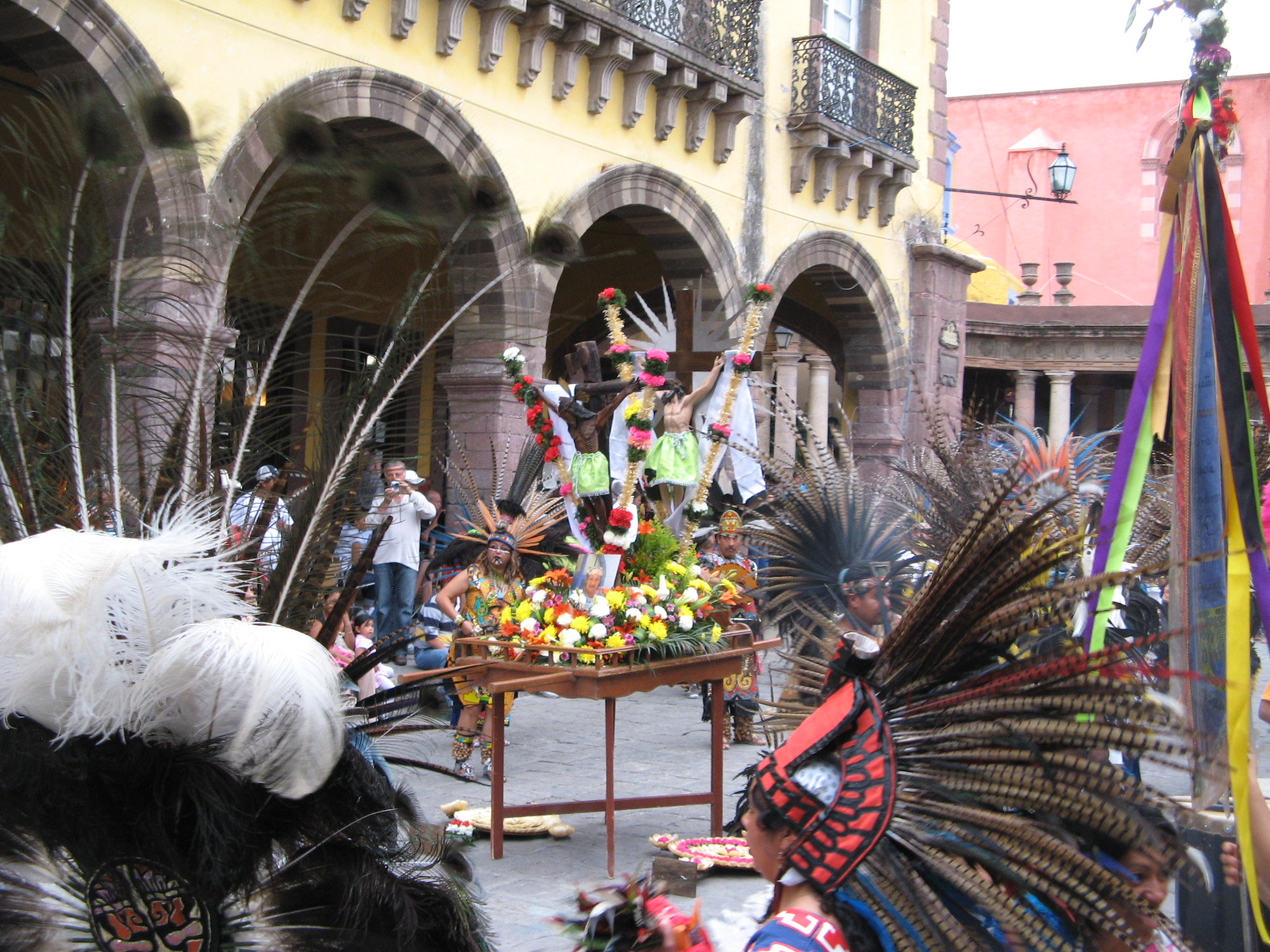

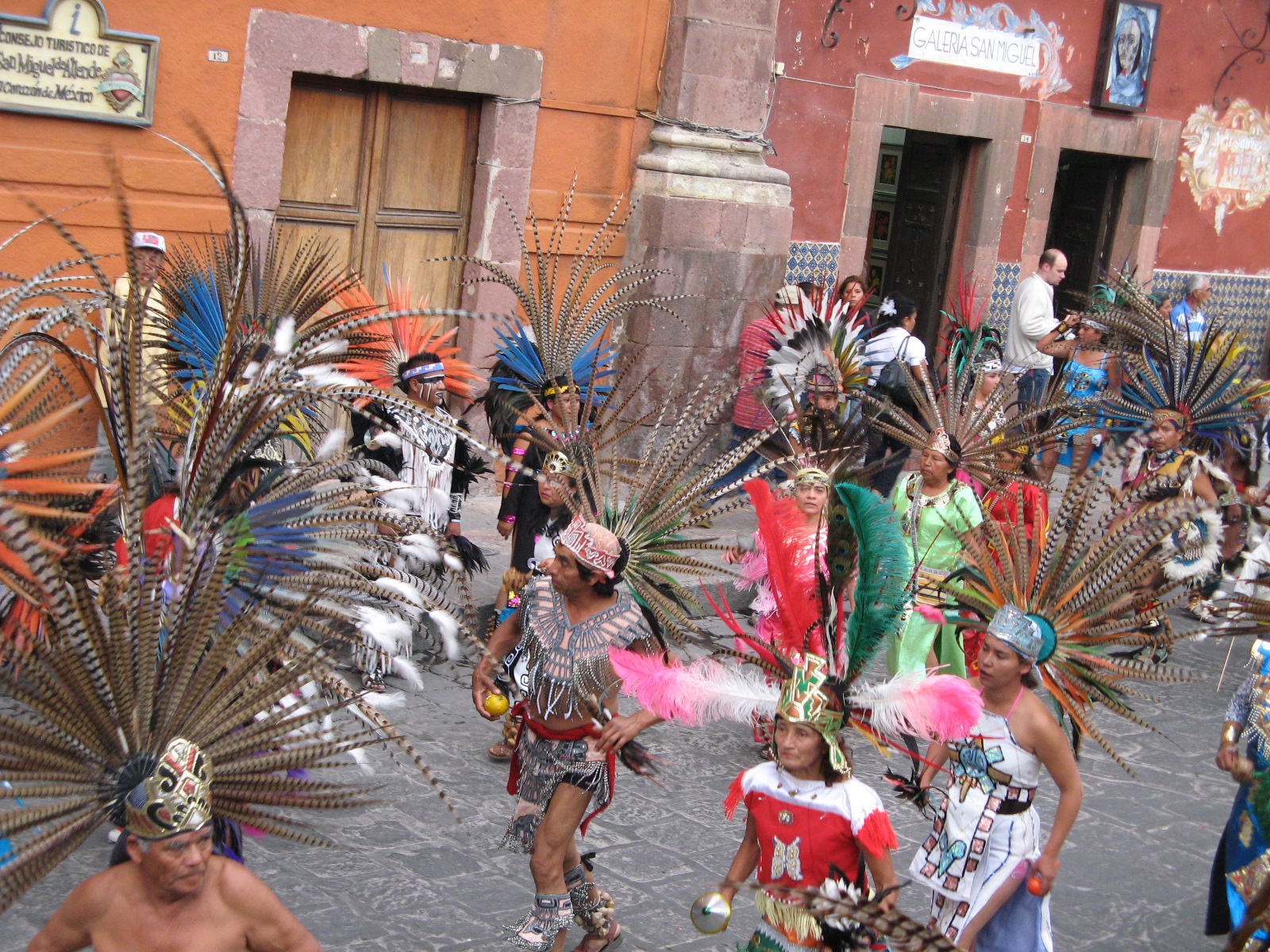
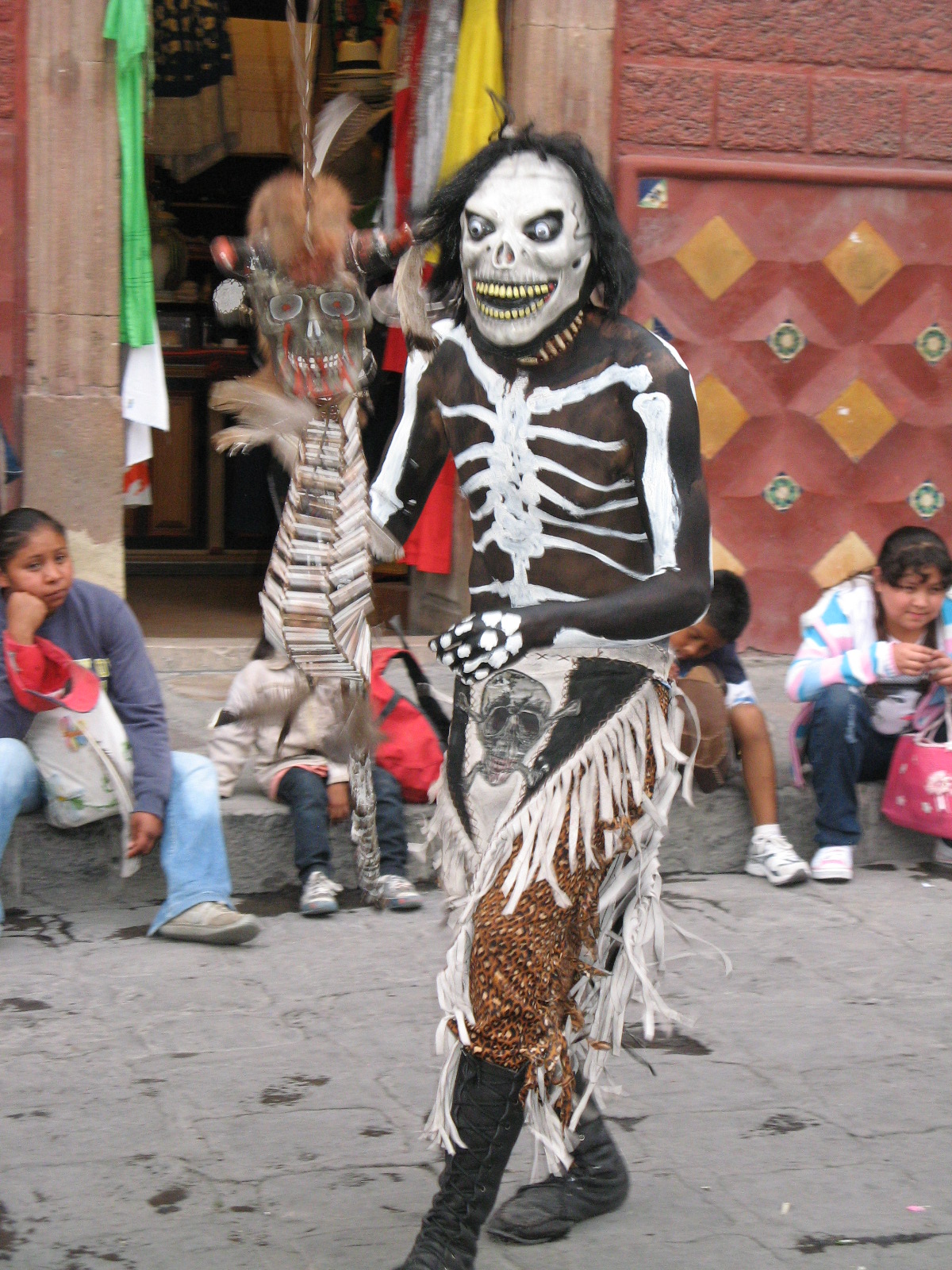
People of all genders and ages danced and drummed. The munchkin declared this guy “scary” but loved the whole event. We thought she’d want to watch for a few minutes and then eat dinner; an hour later she was still mesmerized.
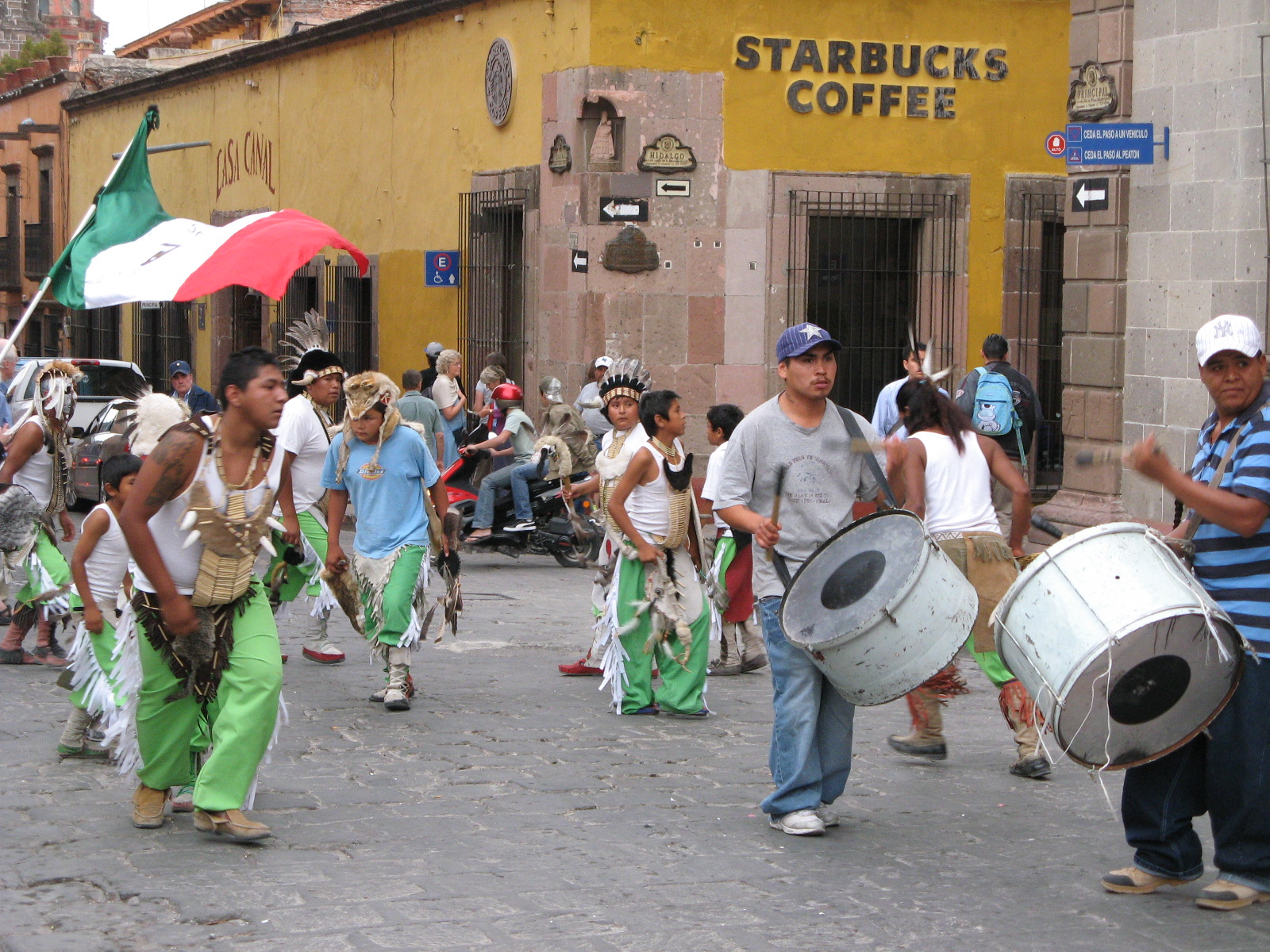
The good old Catholic church. “Fine, keep your feathers and your drums and your heathen dances, as long as you add Jesus into the mix.” (Mexican national pride is part of the mix too, as you can see from the dancers carrying the flag.) I’m betting this relaxed attitude toward syncretism is a more successful way to spread the word than uptightly insisting that indigenous people wear trousers and sing Wesley’s hymns–in short, imposing European cultural forms that are not inextricable from the religious concepts.
I make this assertion knowing almost nothing about missionary history. However, I think it’s a point to ponder for people concerned about church growth and diversity. What would Unitarian Universalism look like if we (meaning those who currently “own” it, a term I use ironically) relaxed a little more about the forms it takes on as it comes to different cultures (or subcultures) than the white, English-speaking, Calvinist-descended people among whom it largely originated? I don’t want us to conquer the natives, but I would like everyone who feels the call of Unitarian Universalism to be able to respond, and meet with a warm welcome instead of skeptical looks from those who are at home with the Protestant worship structure and European classical music that dominate today. It will look different in other hands. They will change it for themselves and, in some part, for everyone. If that means dancing like we saw Friday night, it sounds like a win-win to me.
I’ve barely posted about San Miguel de Allende. It seems to call for photos, and I don’t have many yet. Tomorrow morning I’ll take and post some of the house and colonia. First we have to get some decent batteries for the camera, since the ones we bought in the Tuesday market were crap. They’d probably been sitting there for five years. But for now, for a photos-free post, read on.
On our fourth day here, having taken a few rainy days to get acclimated, we set out on a finally-dry day to visit the preschool we’d heard about and the first of the rental houses on our list. The munchkin explored the school playground while we chatted with the director. Bingo. We liked everything we heard and saw and felt, and the format was just what we were hoping for: half days Monday through Friday, allowing us time for our own explorations but giving us more family time than we have when we’re both at our jobs; teachers who understand English so they’ll know what the munchkin is saying; a program that’s half in Spanish so she’ll learn it; kids from all over, some there to learn Spanish, others English. (Back home in the Bay Area, they call it dual immersion.) Having arranged for her to start school on Monday, we had lunch in the cafe across the street and then headed to our appointment to see the house on Calle Esperanza.
We were running late even by the relaxed standards of Mexico, so Joy went on ahead while I followed at the munchkin’s pace. She told me later that as soon as she walked inside, she told the owner that she loved the place and I would too. And when I joined them about ten minutes later, the first thing I did was signal to Joy that I loved it. So last Monday was an eventful day: Munchkin started at her new school and we moved into the house where we’ll be living until the end of July. Taking note of the streets between school and home, Joy said, “OK, this one is Tesoro. We don’t live on Treasure, we live on Hope.”
San Miguel has spiffier, newer, gringo houses; this one is not one of those . It’s a little funky, with lots of things that are just a little broken and almost everything a lot old. (There’s a huge, beautiful, wardrobe in our room with three mirrored doors and a sign on the center one, “Don’t open–it falls!” We’re not sure whether it’s the door that would fall, or the whole thing, and don’t dare to find out.) We’re waiting for the landlady’s brother to come put in light bulbs in the many fixtures that are missing them, and looking forward to being able to cook by overhead light instead of a floor lamp stolen from a bedroom.
Downstairs, an enormous brick fireplace joins the living room and dining room. Upstairs, twenty-five feet of windows fill our room with light. Brick arches, and in one place a brick cross vault, punctuate the stucco walls and ceiling. The house is decorated with years of amateur artists’ paintings and prints (some excellent), a full-length mirror carved with calla lilies, chandeliers made of thick multicolored glass, odd touches such as a wall of antique keys, tile details everywhere, and about twenty crosses, I kid you not. We need a plant for the hook on the stairway wall, and as it’s next to a cross, a crucifix, and a sacred heart, I’m thinking the Wandering Jew currently living on the roof would be appropriate.
A spiral staircase in the middle of our room goes up to the roof. I told the munchkin that in Spanish it’s called a caracol, a snail; she loves snails. She now calls it the snailcase. The huge rooftop has places to sit and a fabulous view of the city. It has a wall all around, but the munchkin still isn’t allowed up there alone, of course. The shared courtyard at ground level–a jungle of plants–is completely shut in and often houses a sweet old Golden Retriever named Zumm, and there she can play with minimal supervision. On her first couple of days here, she seemed to have developed a fear of dogs we’d never seen in her before. There are a lot of wandering dogs in San Miguel, and while I’m glad she doesn’t run up to every strange dog and pet it, I don’t want her to cry and try to climb up our legs every time she sees one, either. She was very scared of Zumm when she first saw him, and who can blame her? He’s taller than she is and about four times her weight. But she bravely made friends on Monday when we moved in, and now asks all the time if she can go outside and pet Zumm.
Tomorrow I’m moving a table into the second bedroom and making it my studio. Room to work, a bathtub the size of Lake Michigan, lots of light, a view of a beautiful city, funky touches everywhere–and all for less than one quarter of our rent at home. We’ve landed in a good place.

 Sermons in Stones
Recent comments