You are currently browsing the yearly archive for 2012.
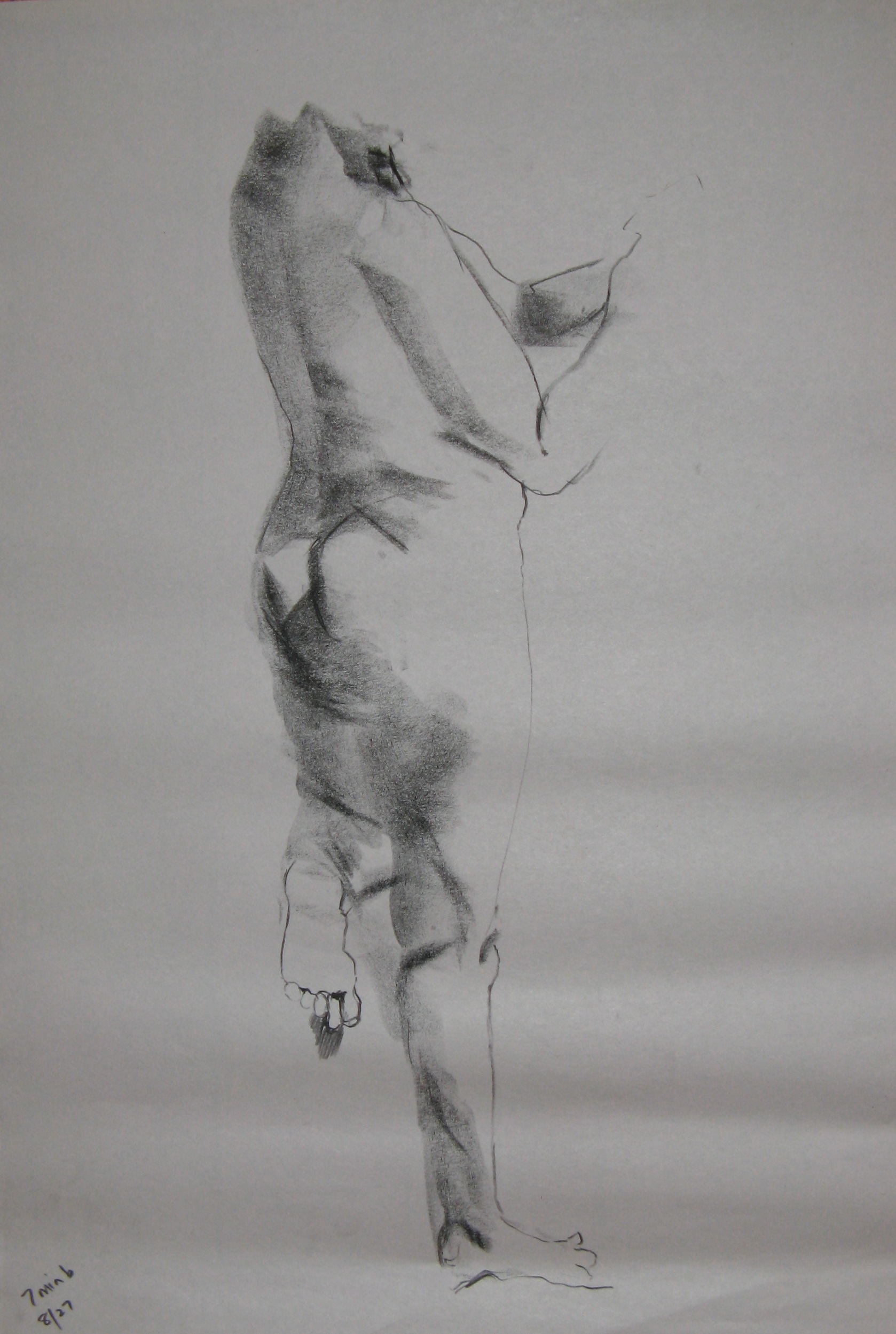
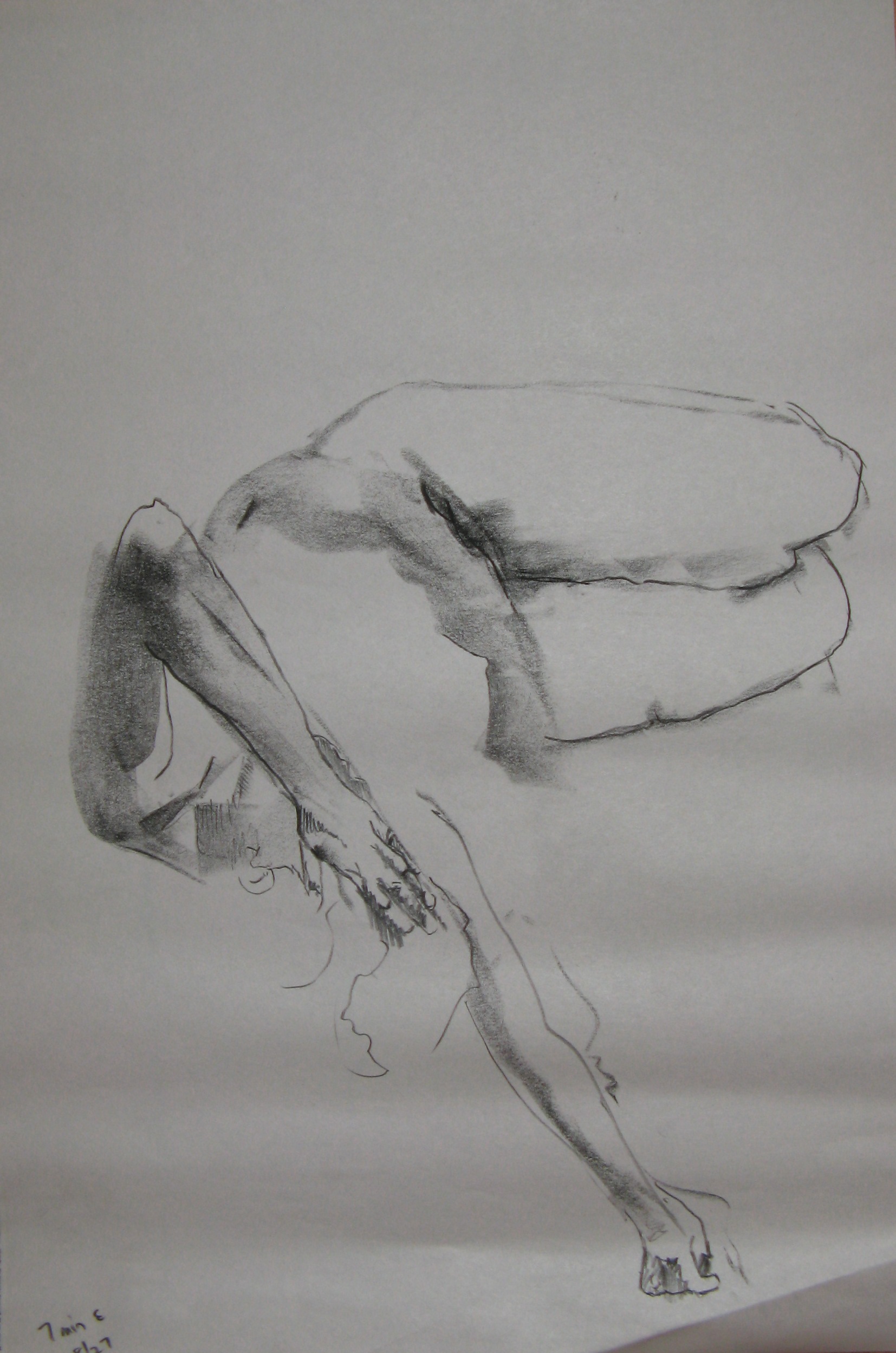
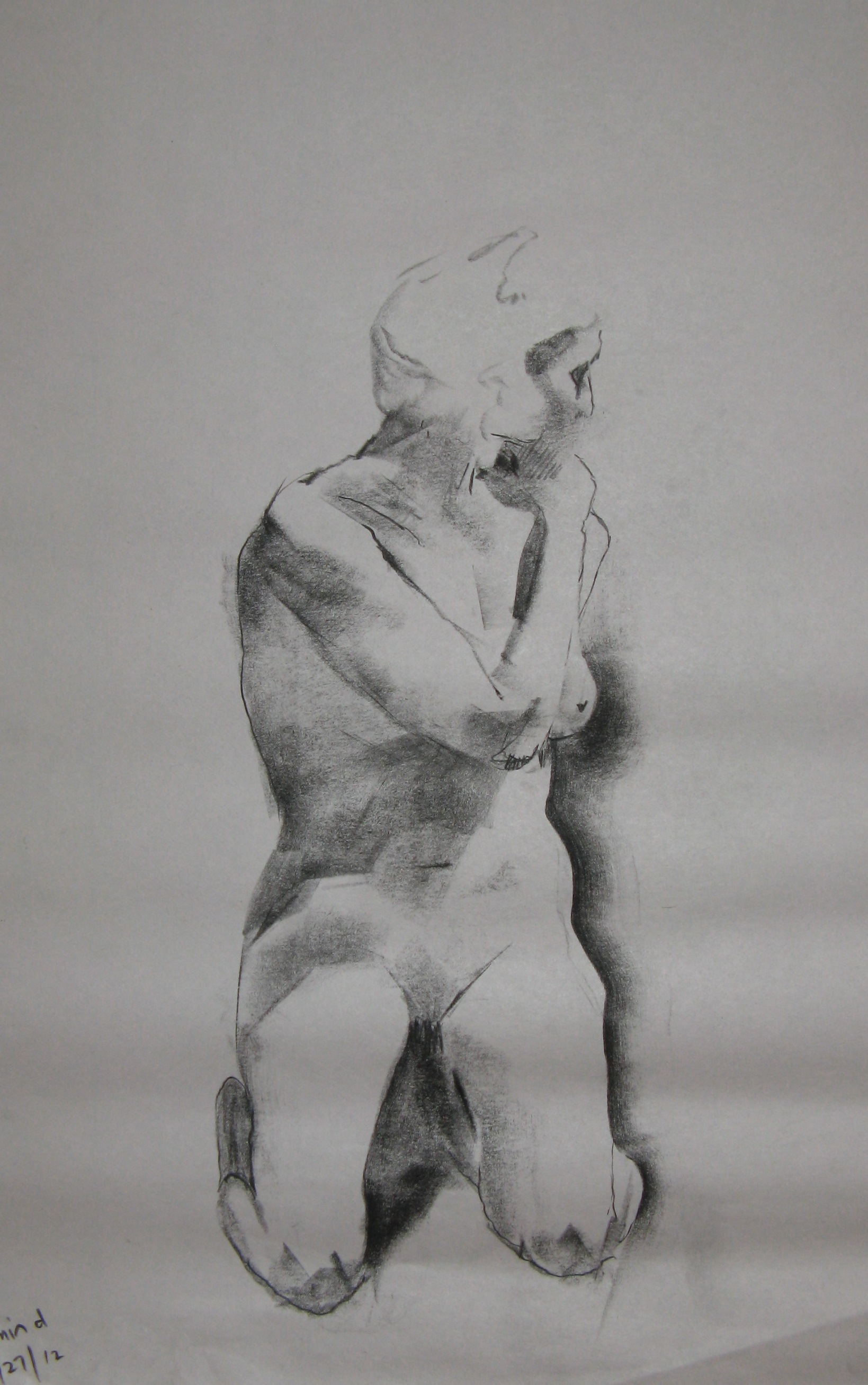
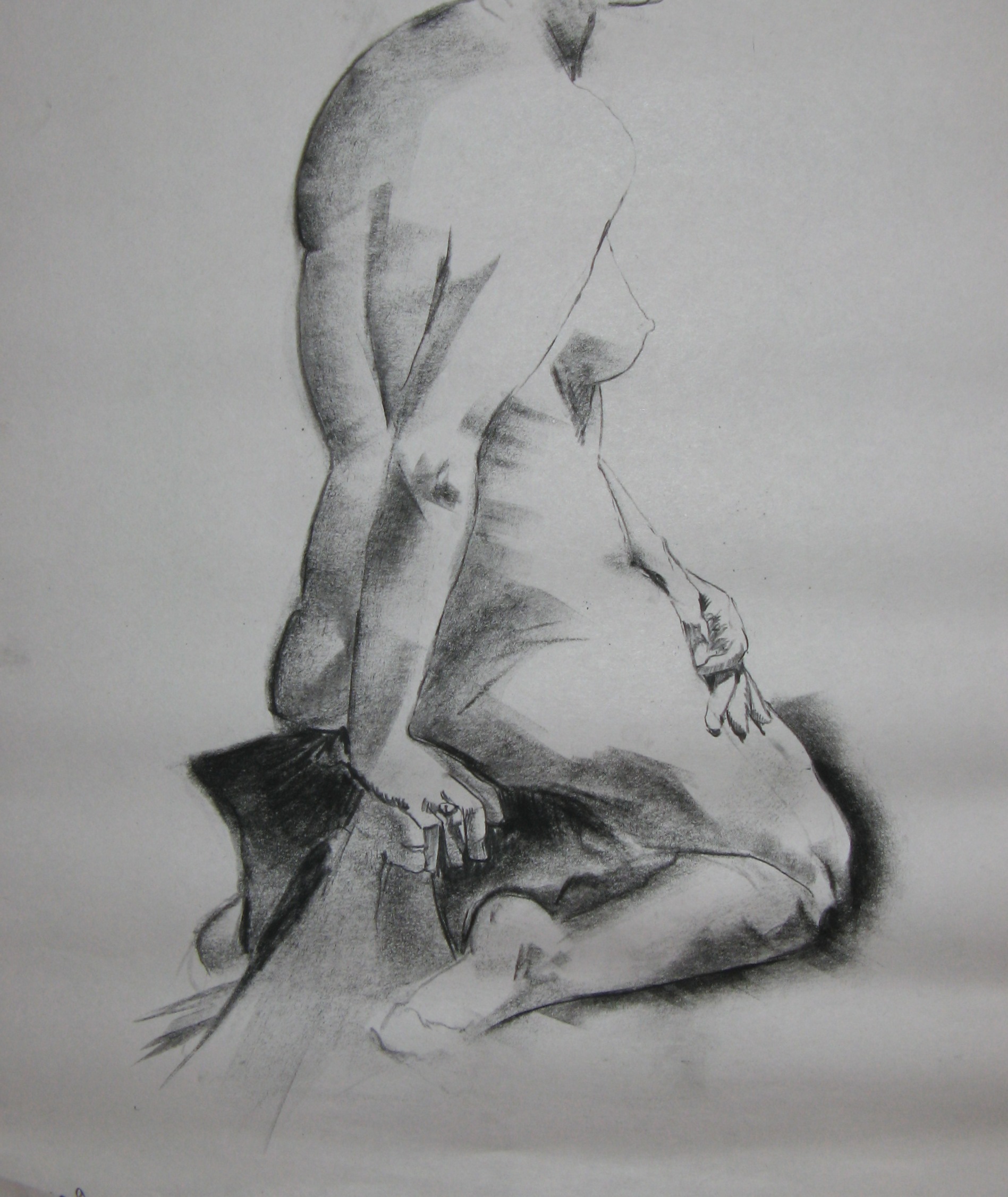
Some drawing days are better than others–who knows why. I take a day like today as a gift. I didn’t want to stop. On the second to last one (g), I particularly wished for a lot more time, as drawing the hands took about half the time and I would have loved to get into more detail elsewhere. There’s nothing wrong with leaving the studio hungry for more.
I’ve been experimenting with conté crayon a little, so the first one is conté. The rest are charcoal. Click to enlarge.



As a Universalist, I have a naturalistic view of hell. Actions carry their own consequences, which often create hellish conditions for ourselves or others. One sin that clearly comes pre-packaged with its own punishment is gluttony, as I learned last week.
We had a big family farewell dinner at a seafood restaurant in Seattle, and I ordered the two pounds of clams and ate them all. Every single one. If you’ve ever steamed clams yourself, you know that there are always a couple that don’t open up, and that that is precisely the way to decide which clams are okay to eat. The ones that emerge from the pot still closed should not be eaten. They are bad–again, not theologically, but biologically.
Well, when I came to a couple of closed clams, I pried them open and ate them. I wasn’t really thinking; I was immersed in conversation with my interesting in-laws, and I don’t think very well about anything else when I’m in an interesting conversation. And what vague idea did amble across my mind about discarding closed clams was shouted down by my desire for as many clams as I could eat.
At bedtime that night, I felt a little under the weather. At 1:30 a.m., I woke feeling distinctly ill, visions of those last few clams dancing in my head. The nausea and the knowledge that it was my own damn fault struck simultaneously, so I didn’t even have the consolation of self-pity. I looked up food poisoning on the internet and decided it was too late to do anything except drink a big glass of water and wait for the bug to tear through my system. On a travel day, too: no hope of lying in bed whimpering, since we had to pack up and fly home.
I seem to have gotten lucky, because I got back to sleep, and come morning, I had nothing worse than some tummy upset and a mild case of cold sweats, which didn’t lift until about 24 hours had passed, but stayed manageable. Some bacillus or staphylococcus fired a shot across my bow, and I learned a lesson. Gluttony isn’t worth it. Throw out the closed clams.
A lot of the items on my bucket list are natural wonders that might not even be termed wonders by many. Yes, I want to see the Grand Canyon before I die, and the northern lights, and a dolphin in the wild; but less spectacularly, I’d like just once to come across a lady slipper in the woods. Watching a spider spin its web on a branch above the church patio one Sunday, I was stunned by the realization that of all the hundreds of webs I’ve stopped to admire, I’d never seen one in the making. It felt almost sacrilegious to call people away to begin the service. And I wouldn’t trade the experience for a trip to the Grand Canyon.
Yesterday, lying on a blanket at a blues festival with friends we’re visiting in northwest Oregon, I was watching a raptor overhead. It must be some kind of hawk with light head feathers, because it couldn’t be what I thought it was–aren’t they very rare? And only seen in, I don’t know, Alaska? So I pointed “that hawk” out to C., who said, “Yes, but it’s not a hawk, it’s a bald eagle.” Stirring. Another simple wonder I didn’t know was on my must-see list until that moment.
“How’d drawing go?” several family members asked me yesterday. The first half of the answer, I realized, is always the same–“Great”–because I’ve drawn for three hours and it always feels like exactly the way I want to spend a Monday morning. Answer 2a depends on how I like what I produced, and answer 2b depends on how much I learned. Answer 2a for yesterday is “eh.” Maybe by blogging a drawing-by-drawing journal entry I can learn enough to turn 2b into “great” too.
We started with the usual warmups, in which my only goal is to pay attention and keep working, and then this was the first 7-minute (A). Ugh ugh ugh. Stiff, proportions wrong, got lost in useless detail with hand.

7 minutes, A
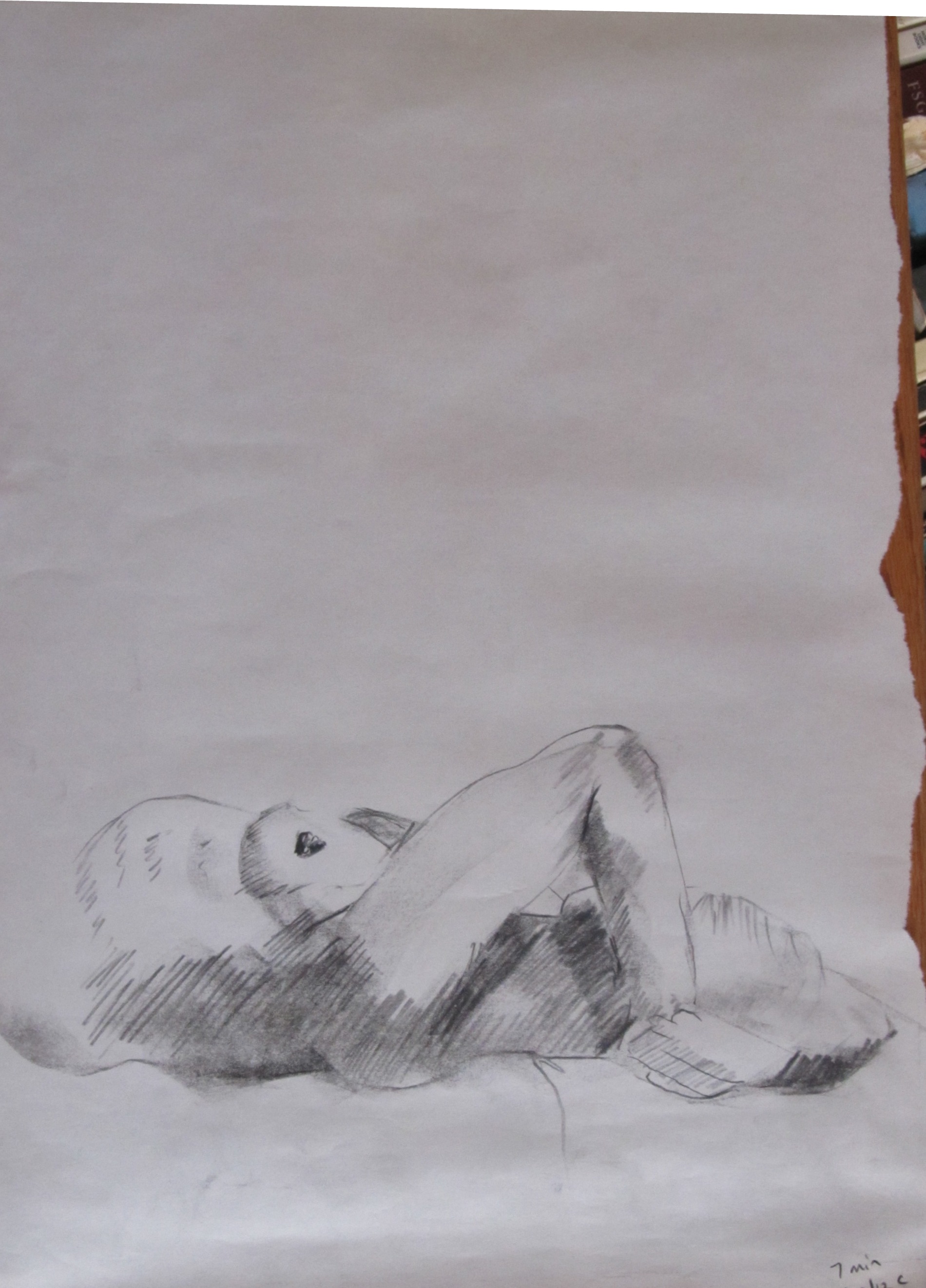
Next 7-minute: ah! Now she looks alive. I kept looking back at this one for the rest of the morning to remind myself what I was going for: loose, spontaneous, responsive.

7 minutes, B
On the next two, however, I felt like I was being fiddly and had lost that eye for the light, and the sweep of the charcoal. D (the first 10-minute pose) has some good things going on in the elbow and the legs, but it also has me doing some of my clunkiest details with the wrinkles under the arm. My own arm felt stiff. (Sorry I can’t intersperse the photos the way I would like. They are below.)
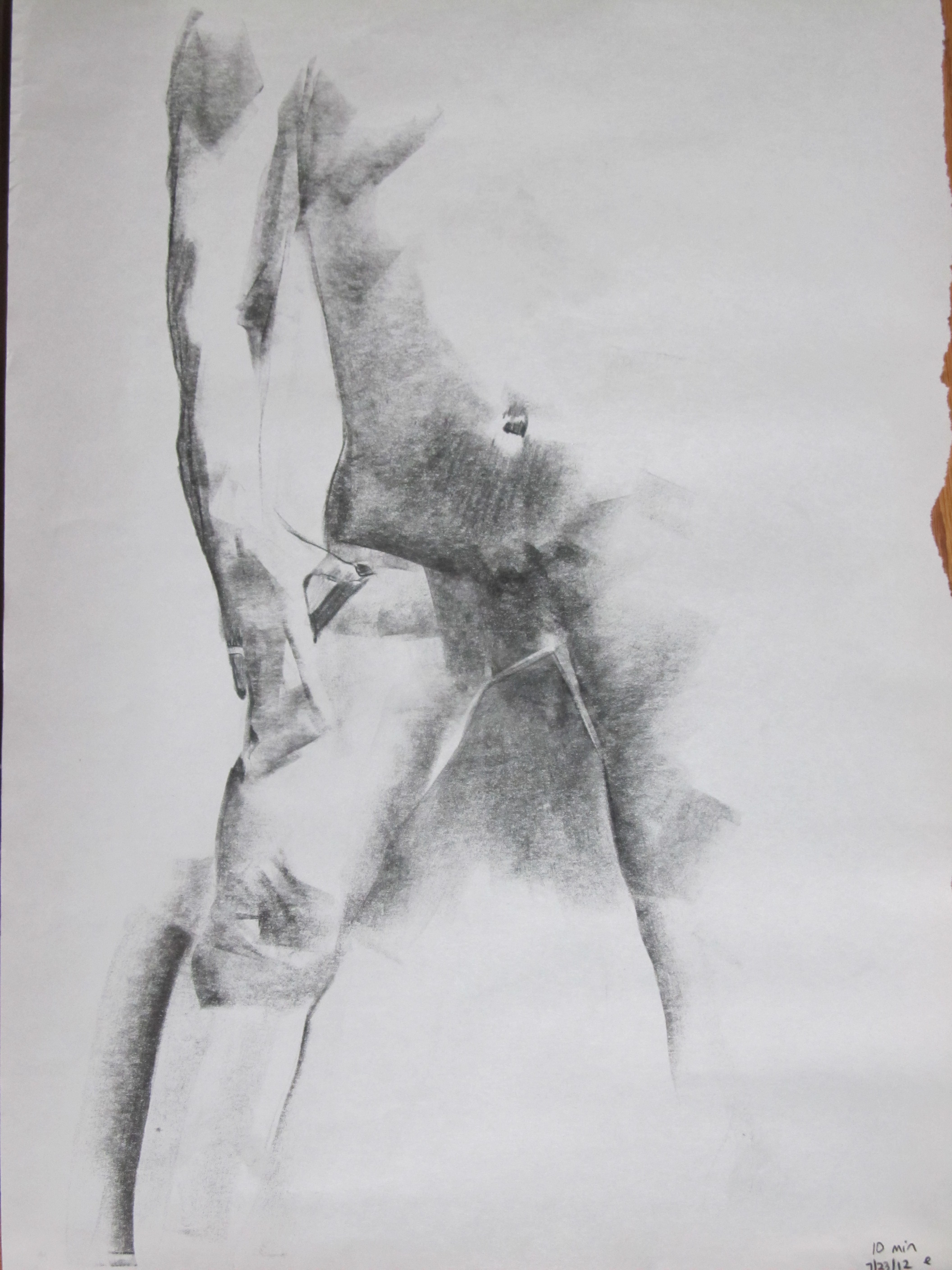
On the second 10-minute pose (E) I got it again. This hand is the best thing I did all morning, especially because I find this model’s hands difficult. Hands are hands, you might think, but these are extra-challenging for me. I also like the shadows on her belly.
As I often do, I had intended to work dark, and I had backed off. Sheer timidity made it hard to pick up the soft (i.e., dark) charcoal. I kept starting with the medium one and planning to add darker shadows, then never getting around to it. On this next one (F) I got braver. Due in part to the darker shadows, something good happened with the light on the shoulder, back, and side, the kind of area that tends to be hard. I thought I got a little too fiddly again. But in the next one (G), I also remembered to loosen up and work in broader strokes, and again I was much happier with it. I’m also inordinately proud of the half of the nipple ring I got to show. I don’t know where the other half went.
From a 2a standpoint, I ended with a whimper–I don’t like the product (H). Not enough time on the back, and a rush to sketch in the wrist in the last minute, so that I didn’t pay it enough attention and made it much thinner than it is. Most of my time went to the hand, that elusive hand, and I never managed to see the fourth finger right. Fussed over this and that detail of the hand, so that I never did capture the overall light and shadow, though the overall shape is okay. But it isn’t mostly about the product–so, 2b, what can I glean here to make the learning worthwhile? Work loose. Look for the light and shadows and put them in–just look how it worked back at that first 10-minute, with the right hand on the thigh drawn with few strokes. If I’d done that here, I might have missed a lot of detail but I’d probably have caught something of the feeling of her hand that is missing here: the weight pressing it down, the twist of the arm, the stretch between the thumb and finger.
No figure drawing until August 13, because I’ll be traveling in the Pacific Northwest, but I will get to use what I’ve learned.
C

D
E

F

G

H
The Rev. Dr. William R. Jones, one of that rare breed known as Unitarian Universalist theologians, and the even rarer breed of African-American Unitarian Universalist theologians, died on Friday at age 79 (obituary here). From the time I encountered his work when I was in seminary, it gave me that mix of headiness and humility that we get when someone articulates our own most cherished ideas far better than we can.
For example, this passage from his 1975 article in The Christian Century, “Theism and Religious Humanism: The Chasm Narrows”:
Abraham’s situation, when he is commanded to slay Isaac, represents the human situation. Forced to decide whether he is addressed by God or Moloch and given the impossibility of demonstrating whose voice he hears, Abraham must assume the mantle of ultimate valuator. He must decide the source of the command, and in the final analysis his judgment of the source determines the value of the command. If he concludes that the decree is from God, it is morally imperative. If, however, he decides that it is Moloch’s voice that he hears, the order must be rejected. But clearly, only Abraham can make this crucial decision.
Likewise with humankind: forced by virtue of our freedom and the existential situation of objective uncertainty, we cannot escape the necessity to be the measure of even that higher reality that created us. There is no way to escape this responsibility short of denaturing humanity, for it is a factor of the freedom that is our essence.
The same sense of uncertainty informs the humanist concept of history. The humanist acts “as if” history were open-ended and multivalued, as if human choices and actions were determinative for human destiny. But once history is afforded this character, it becomes problematical that the good is guaranteed. There does not appear to be an inevitable historical development, sponsored by ultimate reality, that ensures the liberation of the oppressed or a more humane society. Rather, oppression and liberation are equally probable. Nor is there a cosmic lifeguard to save humanity from its self-destructive choices. This is the meaning of the tragic sense of history in humanism — not that human efforts are doomed to defeat, but that the best-laid plans of one generation may be sabotaged by the actions of the next.
Thus, rather than fanatical advocates of absolute human freedom, religious humanists view themselves as faithful stewards of human finitude and creatureliness.
Amen, amen, and amen. Not to suggest that his work only recapitulated what I already believed; he has also challenged me, as good scholars and ministers do. I believe even this decades-old piece challenges humanists today, who sometimes act as if human beings are the pinnacle of creation (or, for that matter, gods) instead of finite and creaturely.
I wrote a few months ago about the promise and potential of black humanism, and what humanists and Unitarian Universalists of all backgrounds can learn from it. Bill Jones has done his part; the next steps will have to be taken by those of us he has inspired. Rest in peace and go with our gratitude.
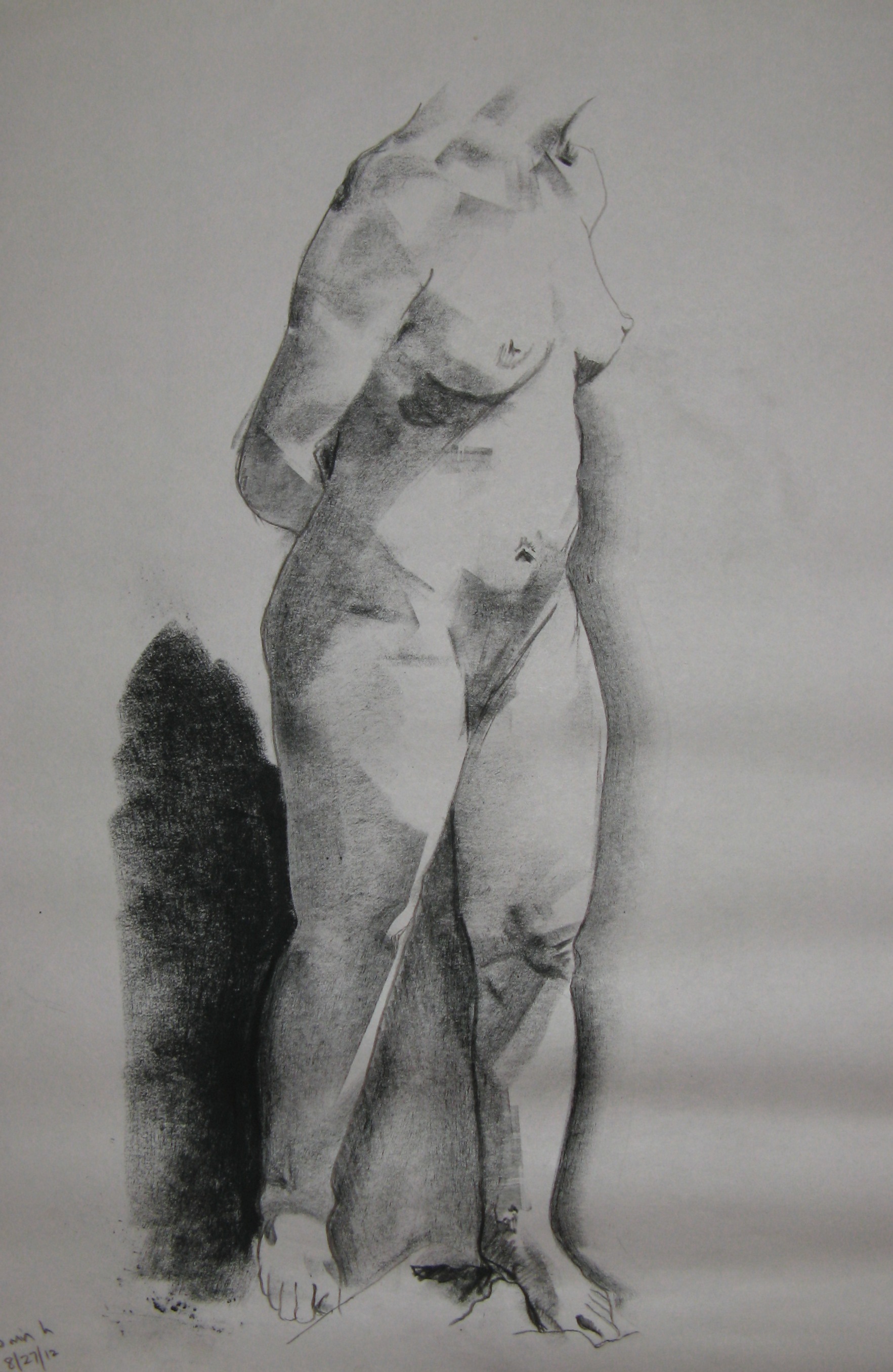
These are from the long-pose session, which consists of 1- and 2-minute warmups, then a 20-minute pose and then one pose held for almost three hours (with breaks, obviously). Here’s the 20-minute drawing:
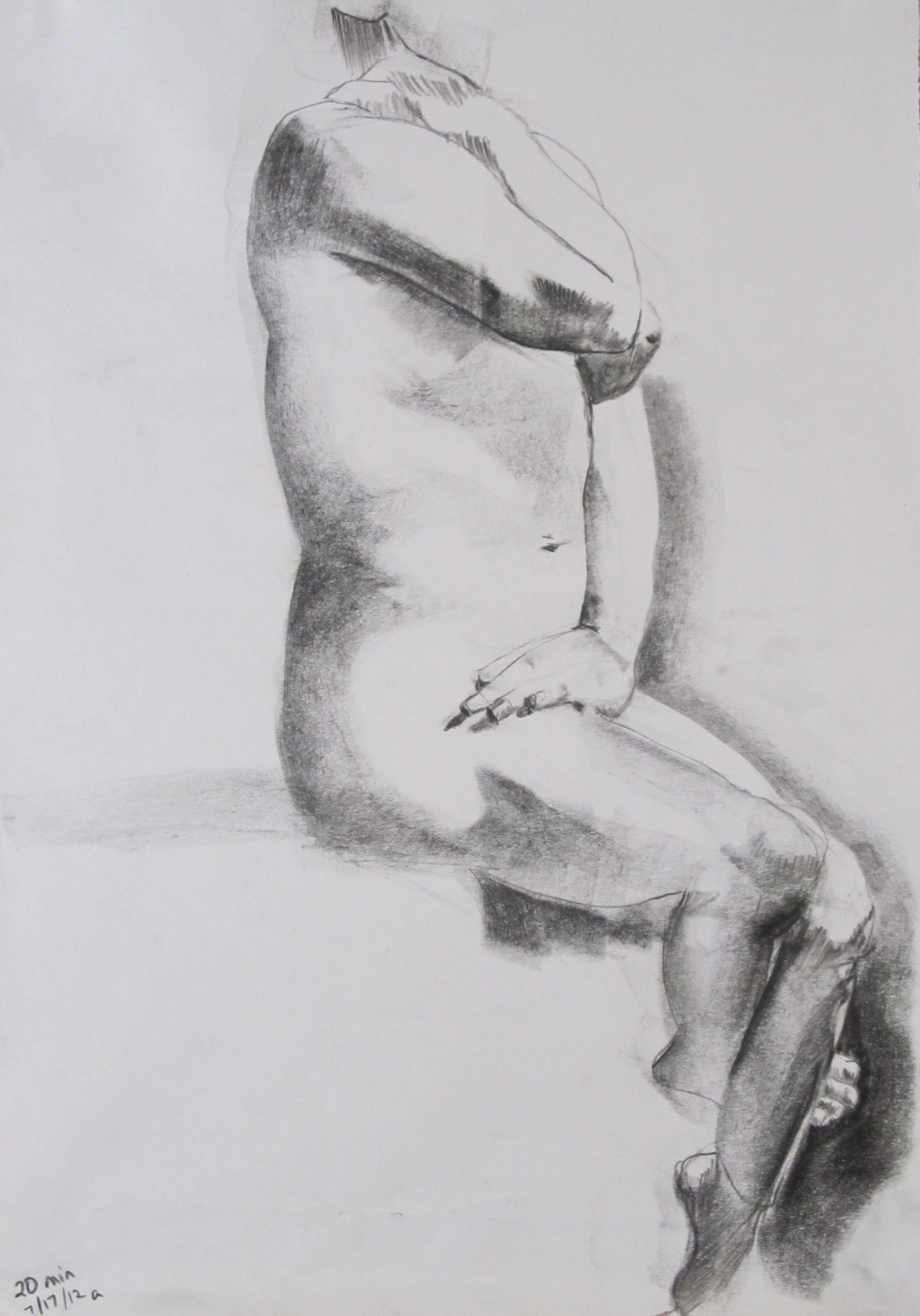
Here’s the long pose, about 70 minutes of drawing:

My favorite part is probably her right hand, though it is just a tad large. Also the light on her left leg (the one underneath), especially because I sweated over that section, thinking it was just going to look like a very skinny leg, but when I stepped back at a break, the alchemy had worked. I’m happy enough about the whole thing that I wish I had done it on better paper. It is my usual newsprint. I meant to use better paper but only had much smaller sheets.
I generally leave off faces because drawing the face will probably require as much time as the rest put together, and I want to focus on the rest of the body. Since we had so much time, I meant to incorporate her face, but just couldn’t make her whole body fit on the paper. I do an overall very sketchy sketch to fit in what I want to fit in, but when I worked in detail, I started from the feet and the body just grew a little beyond the scale I started with; the feet kept looking too small, even though I looked again and again and could not quite figure out where I had gone wrong. Anyway, it didn’t leave room for her head. So I did just a portrait, about 15 minutes:

I seem to have cut off the top of her head slightly. Sorry about that, dear model–guess I got spooked by the corner and didn’t work right to the edge. Something about the way I photographed this (too much daylight?) wiped all the color out of it. It is actually on orange paper. This was my first serious try at hair oh, probably since my first semester of college, when I discovered how hard it was to draw hair realistically and gave up. Maybe I will devote a few sessions to hair, the way I have done to hands, but it’s hard to get as interested in it.
It’s a good thing I can’t draw twice in a week very often. Michael bakes cake for the long break every session, and it’s hard to resist, especially after smelling it for the first hour and a half. Yes, cake. Here’s the link to the studio again.
The studio where I draw has a long-pose session every other Tuesday, but I can never go, since it’s a work day and invariably a busy one. Today, being on study leave, I could, so I had three hours of drawing yesterday and four today. I feel steeped in beauty and challenge.
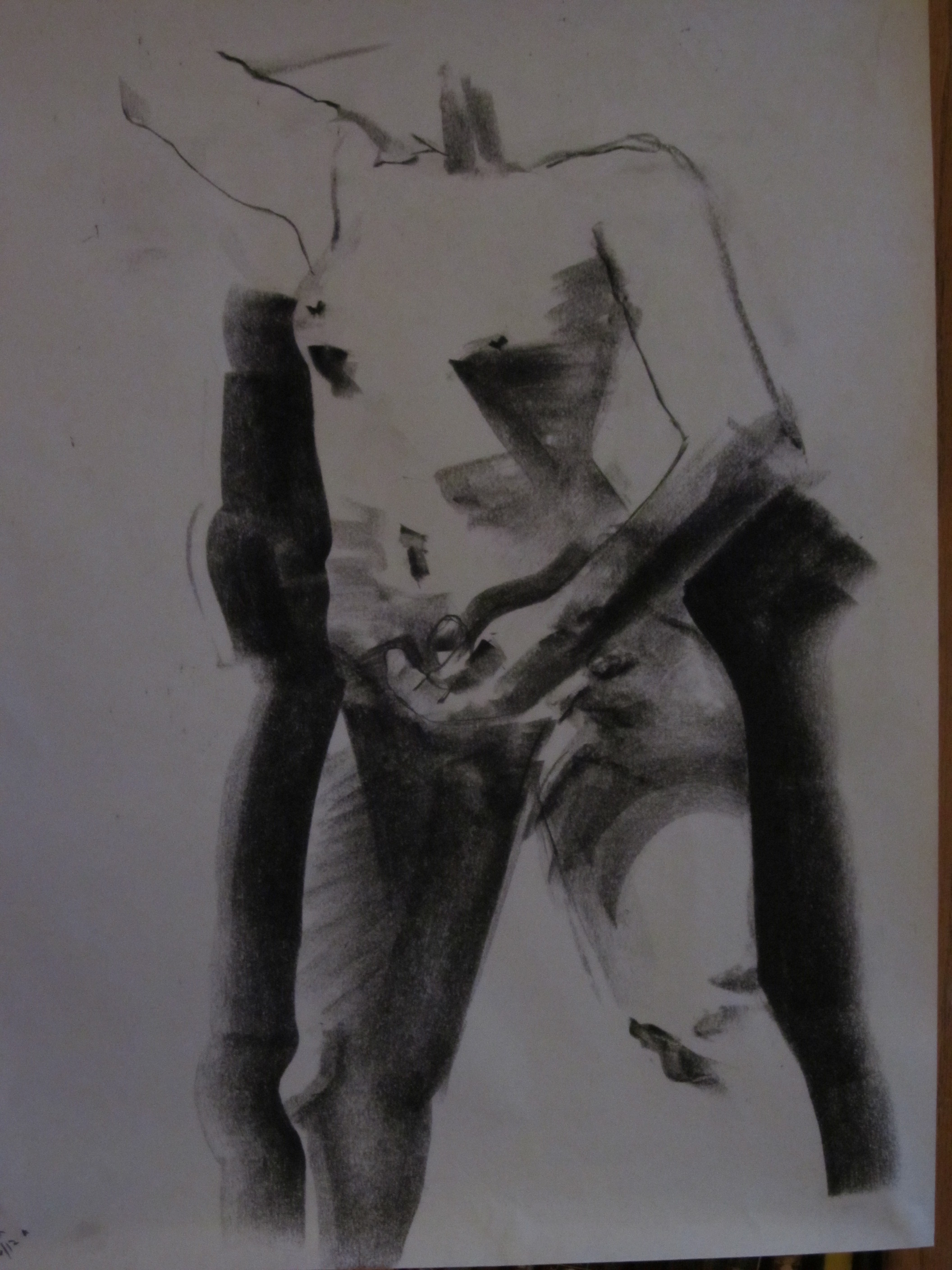
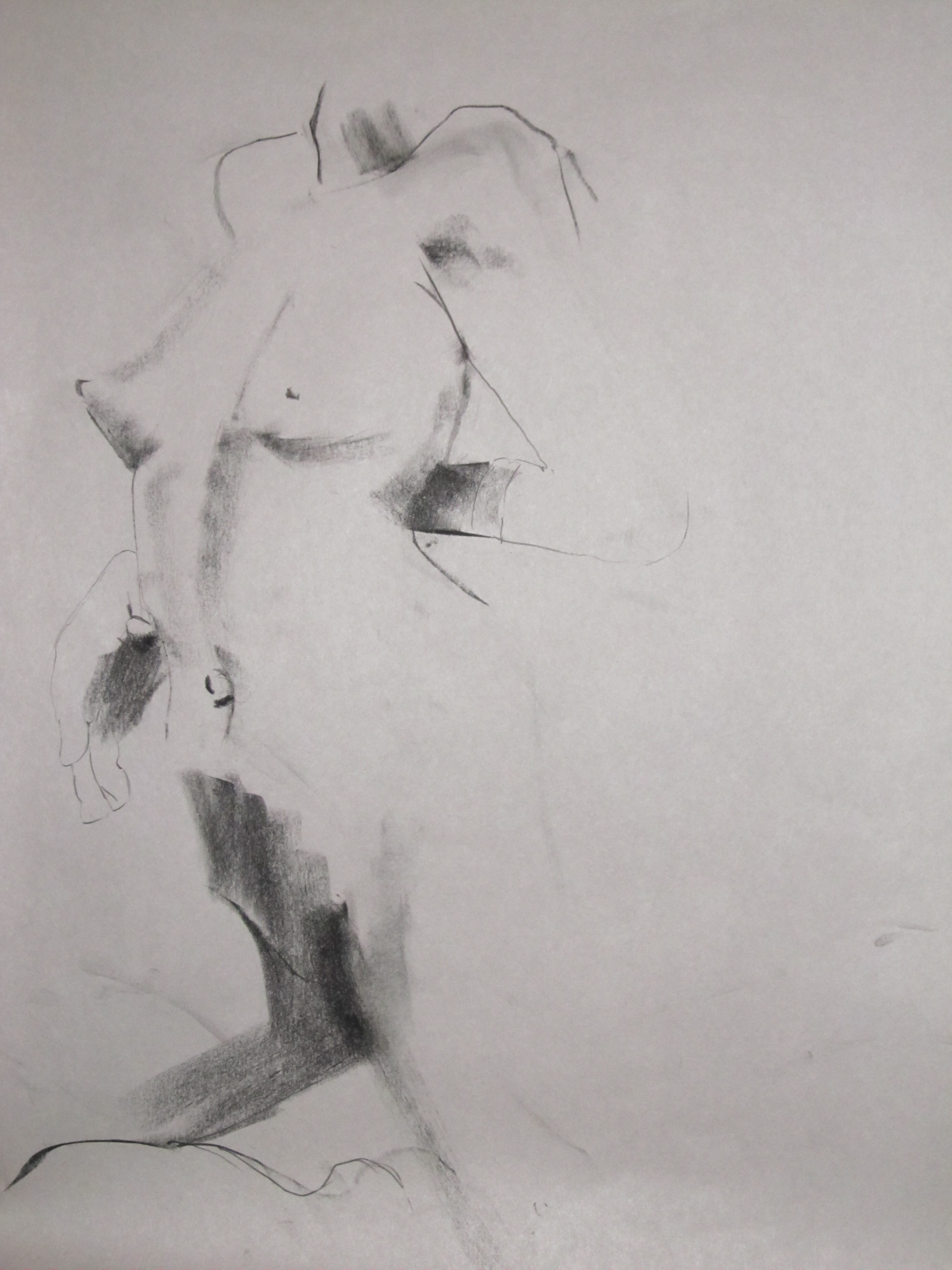
Yesterday, I started with the intention of working dark, in high contrast, and without getting lost in detail as I am prone to do. My resolve weakened over the course of the morning. The later drawings are also longer poses, so I have the time to get into more detail on those, but I can see that I never went as dark even to start with. It was also the day of the unintentionally large hands. There’s stuff I like here, though.
Some of the drawings:



Reading Gary Dorrien’s The Making of American Liberal Theology has sent me back to the Divinity School Address, in particular to confirm Dorrien’s interpretation that Emerson claimed, “To Jesus, all of life was a miracle.” “Did he really say that?” I wondered. Yes, here’s the passage:
“[Jesus] spoke of miracles; for he felt that man’s life was a miracle, and all that man doth, and he knew that this daily miracle shines, as the character ascends.”
That’s a lovely sentiment, but what justifies attributing it to Jesus, RWE doesn’t say. I would like to think that Jesus was a Transcendentalist, but the evidence in the canonical gospels doesn’t support it.
Almost everyone, even those as iconoclastic as Emerson, wants to claim Jesus as one of their own. A revolutionary, a feminist, an upholder of law and order, a Taoist or Buddhist master, a prophet, a communist, a capitalist. We have just a few texts to judge by, and they support only a few of these interpretations. I would love to embrace the image of Jesus as a saint, the best humanity can be, but I don’t see him as having an exemplary character; he’s impatient and hot-tempered at times. And I would love to see him as a Transcendentalist, perceiving and proclaiming the miracle in the ordinary, but I think that’s Emerson, not Jesus.
Today is the 100th anniversary of the birth of one of my heroes, Woody Guthrie. My family and I celebrated in the most appropriate way, by singing lots of his songs, thanks to a sing-along at Reach and Teach, a local company devoted to peace and justice education. Our singing was led by the duo Folk This! and punctuated by occasional passage of Caltrain, as the store’s yard backs onto the train tracks. Since Guthrie spent plenty of time riding the rails with other hoboes, wrote many songs about trains and popularized Goebel Reeves’s beautiful “Hobo’s Lullaby,” the clack and rush of the train seemed very appropriate, though it would have been even more appropriate in the early morning when the freight trains come through.
The scope of what his songs mean to me is beyond my ability to say, so I will go smaller. Certain phrases in Guthrie’s songs have woven themselves into the fabric of my life, the way words will when they shape our thoughts or express something we’ve long felt.
Oh, the gamblin’ man is rich an’ the workin’ man is poor (“I Ain’t Got No Home”)
I don’t think he’s talking about Las Vegas. Guthrie turned 17, a working man, the year the stock market threw the country into the Great Depression. The Glass-Steagall Act not having been passed yet, bankers and investors could speculate wildly with people’s deposits, as they can again today, and I think those were the gamblers he had in mind. What the line always makes me think about is how we tax the income earned from work at a higher rate than the income from investments, which is to say, bets placed on the market. If we valued work the way Guthrie did, I don’t think we would set up the tax system this way.
– – – –
I’d like to dream my troubles all away
On a bed of California stars
Jump up from my starbed and make another day
Underneath my California stars
They hang like grapes on vines that shine
And warm the lovers glass like friendly wine
“California Stars” is one of the hundreds (thousands?) of songs Guthrie wrote but never recorded; his daughter Nora wanted some of them to be set to music and performed, and Jay Bennett and Jeff Tweedy of Wilco wrote the music. It’s my favorite song on the first Wilco/Billy Bragg collaboration, Mermaid Avenue. It has a place in the soundtrack of my life, since I was listening to this album a lot at the time I moved to California and danced to it often in my first weeks here, which were lonely and full of promise. I just love that image of the stars hanging in the sky like grapes. What a wine they would make.
– – – –
Since our daughter’s birth we’ve had Guthrie’s Songs to Grow on for Mother and Child, which all sound like songs an astoundingly prolific songwriter might spontaneously invent while taking care of his children. They are full of nonsense and endearments, and talk about topics like burping a baby (“You’ll fly up so high / In the clouds and skies / If you don’t make a blubble . . . Blow a bubble soon”), taking a bath, picking up toys, and this one about the incessant questions in a houseful of young children (“Why Oh Why”):
Why, oh why, oh why oh, why?
Why, oh why, oh why?
Because because because because
Goodbye goodbye goodbye
To know why a mouse can’t eat a streetcar, why a cow drinks water, why your grandpa ain’t your grandma, etc., you’ll have to click above and read all the lyrics.
– – – –
I’m moved by “The Unwelcome Guest” (another set to music posthumously, by Billy Bragg), and its paradox of “I’ll still be here after I’m gone.”
Yes, they´ll catch me napping one day
and they´ll kill me
And then I´ll be gone but that won´t be my end
For my guns and my saddle will always be filled
By unwelcome travellers and other brave men
Guthrie uses a similar trope about absence, presence, and immortality in “Tom Joad,” when Tom says goodbye to his Ma and says, “Wherever people ain’t free, Wherever men are fightin’ for their rights, That’s where I’m a-gonna be.” And of course it shows up in Alfred Hayes’s song “Joe Hill,” which Guthrie surely knew. It seems to have been the kind of immortality that was most important to Woody Guthrie, who suspected by his 30s that he had the same disease that killed his mother at age 42. It’s the kind of immortality he has achieved, and a kind that’s available to any of us, if we choose to live that way.
Our grocery store is a worker-owned cooperative. Among its eight days off each year are Martin Luther King, Jr., Day, May Day, Labor Day, Cesar Chavez Day, and LGBT Pride Day. It’s packed full of organic foods but it’s a full-service grocery, not one of those “natural foods stores” where you can’t get a bag of pretzels. It also has beautiful murals, and you know how I feel about murals. When the Munchkin sees this one, by the checkout counters, she cries out, “Her hair is the earth.”
Other worker-owned companies include a bakery right around the corner from where I draw and an art supplies store. (That one’s all over the country, non-Bay-Area folks: check and see if there’s one near you.) Not only is this a sensible and refreshing form of capitalism, but the baked goods are delicious and the art supplies store is well stocked and staffed with people who know what they’re talking about.
The fence around the 16th and Mission BART entrance looks like papel picado, the strings of cut-paper pennants so essential to Mexican celebrations.
To be continued . . .

 Sermons in Stones

Recent comments